

You know that slightly disappointing moment when you pull on a beautiful jumper, feel how lovely it looks, then realise you're already a bit clammy by the time the kettle's boiled? That's the gap between a garment that looks breathable and one that behaves like it in real life. A breathability rating helps close that gap, turning a fuzzy promise into something you can compare with a number.
For stylish, conscious shoppers, that number matters far beyond mountain kit. It helps explain why some clothes feel fresh in a damp commuter train, why others cling after a brisk walk, and why natural fibres can feel so elegant without becoming stuffy. A little technical knowledge can save a lot of wardrobe disappointment, and it can make choosing clothes feel more like selecting a reliable friend than gambling on a label.
If you've ever wanted a calmer way to read those fabric claims, think of this as a cosy translation service. A good place to start is with the basics of natural fibres and why they behave the way they do, which sits neatly alongside The Lavender Lobster's guide to natural fibre clothing. There's also a useful parallel in home textiles, where breathable waterproof layers are explained clearly in Protect-A-Bed mattress protectors, because comfort is comfort whether it's on your bed or on your shoulders.
Beyond the Buzzword What Breathability Really Means
A “breathable” jumper can still leave you feeling damp if the fabric traps moisture instead of letting it escape. That's why the phrase alone isn't enough. A garment may look airy on a hanger, but once body heat, movement, and changing weather join the party, comfort depends on how well the cloth manages vapour.
Comfort is a fabric behaviour, not a mood
In UK clothing, breathability usually means a fabric's ability to let moisture vapour from sweat escape while still helping keep outside water out, a definition used in UK buying guidance from Snow+Rock's waterproof and breathable clothing guide. That sounds technical, but the feeling is simple. If vapour can move away from your skin, clothes are less likely to feel sticky, heavy, or strangely cold after you've been warm for a while.
Shoppers often get misled by romantic wording. A soft weave, a light colour, or a luxury hand feel can suggest freshness, yet none of those things guarantee real airflow. A proper breathability rating gives you something firmer to go on, which is a relief if you like buying clothes that earn their place rather than merely posing prettily.
Why the number matters in everyday wardrobes
Think of breathability as the difference between a room with a window cracked open and one with every curtain drawn. The same garment can feel fine in a shop, then sulky after a walk, a dash for the bus, or an over-warm office. That's why the rating is useful for more than hikers and skiers. It helps explain comfort in commuting, layering, and day-to-day wear, especially when the weather can't make up its mind.
For a thoughtful wardrobe, that matters as much as drape or colour. A well-made piece should feel pleasant when you're standing still and still behave kindly when you're moving. That's part of the charm of seasonless clothing, and it's one reason breathable natural fabrics keep winning hearts.
A small practical rule helps here.
Practical rule: if a label says “breathable” but gives no scale, treat it as a description, not proof.
Decoding the Numbers MVTR and RET Explained
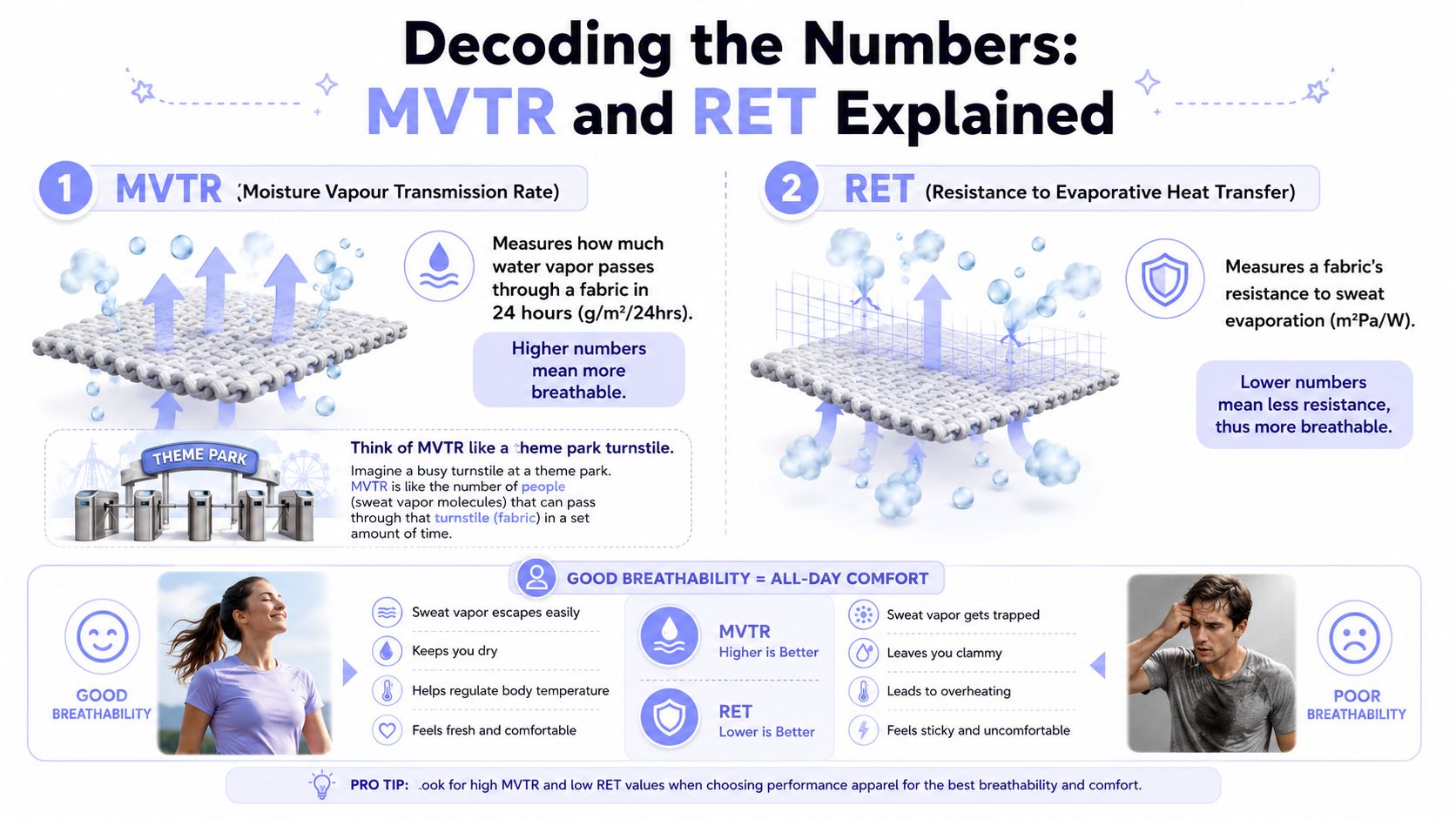
MVTR and RET are the two names you'll most often see on technical clothing, and they work in opposite directions. MVTR stands for moisture vapour transmission rate, measured in g/m²/24h. In plain English, it tells you how much vapour can pass through a fabric in 24 hours. A higher number means more vapour escapes, which is why the industry treats higher MVTR as better.
MVTR like tiny windows in a doll's house
A simple way to think about MVTR is to imagine a doll's house with tiny windows. The more windows that are open, the easier it is for steam to drift out after tea has been made in the miniature kitchen. That's what a high MVTR rating suggests, more vapour movement, less trapped warmth, and a better chance of staying comfortable when you're active or the weather turns damp.
One benchmark often used in the UK outdoor-clothing market is 20,000 g/m²/24h, which INOV8 describes as a premium score in its breathability guide, and RET-based systems use the opposite logic, where 0–6 is considered excellent and 20+ is poor. You can see how easily confusion creeps in. Two garments can both be “breathable”, but if one uses MVTR and the other uses RET, the numbers won't point the same way.
RET like a cosy blanket with a personality
RET stands for Resistance to Evaporative Heat Transfer. Lower numbers mean less resistance, which is better. That can feel backwards if you're used to bigger-is-better thinking. The easiest mental image is a blanket. A thick, clingy blanket traps warmth and resists escape, while a lighter, airier layer lets heat and moisture move on.
That's why guides often present RET on bands such as 0–6 for excellent, 7–13 for good, 14–20 for OK, and 20+ for poor, as explained in T3's overview of breathability ratings. Snow+Rock's UK buying guide also notes practical banding, and Trespass describes 0–6 as “extremely breathable”, 6–13 as “good to very good”, and 30+ as “unsatisfactory or not breathable”.
Key takeaway: MVTR rises with better breathability. RET falls with better breathability.
The easiest way to read a tag is to ask one question first, which scale am I looking at? Once you know that, the rest becomes much less mysterious, rather like noticing that the same fabric can be elegant and cleverly engineered at the same time.
The Lobster Bisque Dress fits this idea nicely. It's described as 100% organic linen with a soft, organic cotton lining, which is a material pairing that makes sense for someone who wants a dress to feel as good as it looks, rather than merely looking the part.
A short film can help visual learners as well.
How Fabric Breathability Is Tested
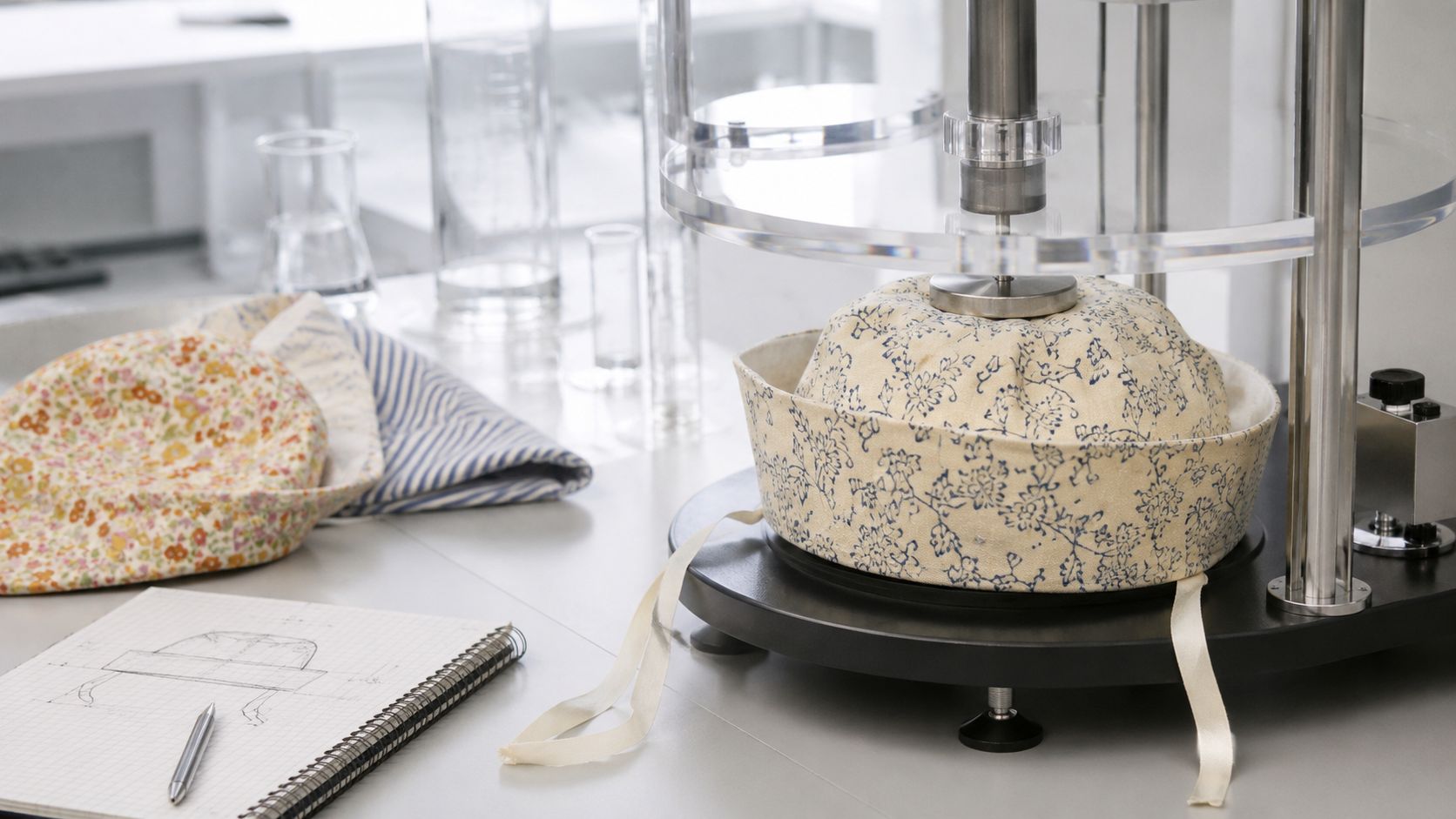
A breathability rating isn't plucked out of the air by a marketing team in a nice scarf. It comes from a controlled lab method designed to mimic perspiration. That matters, because it gives the number a proper backbone. The test is repeatable, which is why shoppers can compare fabrics more confidently instead of relying on vague claims like “light”, “airy”, or “cool”.
A fabric sample in a tiny science theatre
One tested method places the fabric sample in a controlled environment with regulated temperature and humidity, then generates moisture vapour underneath to imitate sweat. After that, the lab measures how much passes through over 24 hours. Another method, the Sweating Hot Plate Method, uses a heated porous metal plate with water on it, then measures evaporative heat loss as the fabric sits above the plate.
That sounds a bit like a miniature science theatre, and in a way it is. The cloth gets its stage, the vapour does its quiet performance, and the result is a number that tells you how well the material lets moisture move away from the body. The point isn't glamour. The point is consistency.
Why that matters when you're shopping
When a fabric has been tested this way, the result is easier to compare with another fabric tested under a similar method. That's particularly useful when you're weighing up natural fibres, blends, and technical shells. It means the label is doing real work instead of merely sounding clever at the rail.
The Sailor Hats are a nice example of thoughtful construction rather than a performance claim. They're made from offcuts of larger garments, then individually made in the UK, which shows how fabric decisions can carry through an entire wardrobe ecosystem. A breathable rating won't tell you everything about a hat, but it does reveal that textile performance is a measurable property, not a decorative adjective.
The lab test isn't about proving a fabric is luxurious. It's about showing how it behaves when warmth and moisture meet.
That's the bit shoppers can trust. Once you know the rating is built from a repeatable procedure, the number starts to feel less like jargon and more like a quiet promise.
A Breath of Fresh Air Comparing Common Fabrics
Natural fibres often win people over because they tend to feel less plasticky against the skin, but breathability still varies a lot from one fabric to another. Cotton, linen, wool, alpaca, and polyester can all be comfortable in the right garment, yet they manage moisture in different ways. That's why it helps to compare them side by side rather than assuming one fibre magically solves everything.
Breathability at a Glance A Fabric Comparison
| Fibre | Natural Breathability | Moisture Management | Best For |
|---|---|---|---|
| Cotton | Comfortable and familiar, usually easy to wear in warmer settings | Absorbs moisture and can feel heavy if it stays damp | Everyday tops, shirts, relaxed summer dressing |
| Linen | Naturally airy, with a crisp open feel | Lets heat move away well and often feels fresh on the skin | Warm-weather clothes, dresses, shirts, tailored separates |
| Polyester | Depends heavily on construction and finish | Can move moisture well in engineered fabrics, but may feel less natural next to the skin | Activewear, travel pieces, technical layers |
| Wool | Naturally temperature-regulating and often comfortable in changeable weather | Can handle moisture while still feeling warm | Knitwear, layering pieces, cooler conditions |
| Alpaca wool | Light, soft, and often prized for its breathable warmth | A natural fibre with a comfortable feel for layering and season-spanning wear | Jumpers, dresses, cosy smart layers |
The useful thing about alpaca is that it doesn't ask you to choose between warmth and elegance. In the right garment, it can feel light enough for layering while still delivering the soft, cocooning quality people want from knitwear. That makes it especially appealing for wardrobes built around fewer, better pieces.
Reading the comparison like a smart shopper
Snow+Rock's UK guidance defines breathability as a fabric's ability to let sweat vapour escape, and Trespass's RET bands show how the market turns that idea into usable thresholds, from 0–6 for extremely breathable to 30+ for unsatisfactory or not breathable. For fabric comparison, the lesson is simpler. The best material depends on the job, not the marketing mythology around it.
If you want a little more guidance on summer-friendly cottons, The Fabric Company's note on breathable cotton for summer garment sewing is a handy place to see how fibre choice shapes comfort in warm weather. That same logic also explains why The Lavender Lobster's eco-fabrics guide matters to conscious shoppers who want beauty, responsibility, and wearability to sit happily together.
Comfort clue: the most breathable fabric on paper isn't always the nicest one on your body, the weave, lining, and finish matter too.
That's why a well-cut linen dress can feel fresher than a technically clever fabric with a less pleasant hand. The fabric is only part of the story, and the garment around it matters just as much.
Smart Shopping and Gentle Care Tips
The fastest way to shop well is to look for the scale, not the adjective. If a website or label says MVTR, remember that higher is better. If it says RET, remember that lower is better, and T3's guide places 0–6 in the excellent zone, 7–13 as good, 14–20 as OK, and 20+ as poor. That one mental switch can save you from comparing apples with pears.
Match the rating to the life you actually live
A commuter coat, a dress for lunch in town, and a layer for a windy hill walk don't need the same performance profile. For gentler everyday wear, you may care more about comfort and drape than maximum technical output. For more active use, the rating becomes more important because sweat and movement are doing a bit more work.
A helpful habit is to think in terms of situation rather than status. A high number isn't automatically better if the garment feels stiff, heavy, or overbuilt for your life. Many stylish wardrobes do better with fabric that breathes well enough, layers neatly, and still looks lovely when you reach for it all season.
Keep the fibres doing their quiet job
Care matters because fibres can lose some of their lovely behaviour when they're coated in residue. Gentle washing, sensible layering, and avoiding anything that clogs the cloth will usually serve breathability better than overcomplicated routines. For natural fibres, especially those worn close to the skin, simple care often preserves comfort more effectively than fuss.
The Lavender Lobster's advice on how to make clothes last longer fits that mindset well, because breathable clothing tends to stay more wearable when it's treated with a little respect. For lifestyle pieces rather than outerwear, even something like the Living Air reusable face mask from EcoQuest Purifiers shows how consumers keep returning to the same idea, that comfort depends on airflow as much as on appearance.
Gentle care rule: wash for cleanliness, not punishment. Fibres usually last longer when they're not overwhelmed by heat, rough treatment, or unnecessary additives.
Layering helps too. A breathable base under a beautiful outer layer often feels better than piling on one thick garment and hoping for the best. That approach suits elegant dressing, because it keeps the silhouette graceful while letting your clothes behave properly.
Common Breathability Myths Debunked
Does waterproof mean it can't be breathable
No. The whole point of breathable outerwear is that it helps vapour escape while resisting outside water. Breathable waterproof clothing exists specifically to solve that tension, and UK buying guides treat the two features as partners rather than enemies. The trick is understanding that different garments balance the two in different ways.
Is a thicker fabric always less breathable
Not necessarily. Thickness can affect how a cloth feels, but it doesn't tell the full story. Weave, fibre type, finish, and construction all shape airflow and moisture movement. A well-made natural fibre can feel surprisingly airy, while a thin fabric can still behave badly if it traps dampness.
Are natural fibres always more breathable than synthetics
Not always. Natural fibres often feel lovely and can breathe beautifully, but a synthetic fabric can be engineered for impressive moisture movement too. That's why the rating matters. It gives you a more grounded way to judge performance than fibre prejudice alone.
Can you judge breathability by touch alone
Only partly. A fabric that feels cool in your hand might still hold moisture in wear, and a slightly denser cloth may still manage sweat well. Touch gives a first impression, but the breathability rating gives a clearer clue about how the fabric behaves over time.
The Clubhouse Cocktail Napkins | Set of 4 also show how linen can lend a crisp, considered feel to an everyday object, because material choice changes comfort and character even in the smallest things. That same principle applies to clothing, where the fabric's behaviour matters just as much as its appearance.
Bottom line: breathability isn't a myth, a vibe, or a luxury-only concern. It's a measurable part of comfort, and once you understand the scale, you can shop with much more confidence.
If you're choosing your next jumper, dress, or layer, start with the fabric label and ask which breathability scale it uses. Then compare the number with the kind of day you want to live in. For more pieces that balance natural fibres, thoughtful construction, and everyday wearability, explore The Lavender Lobster's clothing and fabric guides, then choose the one that feels like your weather, your pace, and your cup of tea.