

You know the scene. You're half-dressed, holding one trouser leg in one hand and a top in the other, trying to decide whether the colours look intentional or just vaguely apologetic. A matching top and bottom set skips that whole internal debate, which is why so many wardrobes have made room for them. The best ones feel like a tiny act of kindness, especially on mornings when your brain wants tea before it wants styling decisions.
There's a reason they've moved from niche buy to mainstream habit. Business of Fashion reported that new arrivals in the womenswear set category increased by around 75% between 2019 and 2022, while Silk Laundry said focusing on sets lifted average order value by 50% over the previous three years. The same report noted that Shein saw sales of sets on its website rise 20% year over year in September 2022, which shows the pull wasn't limited to premium labels, it had broad reach across the market as a whole. Business of Fashion's report on matching sets makes one thing clear, coordinated dressing became a commercially proven category, not just a passing styling whim.
That matters because the appeal isn't only visual. A set gives you the neatness of a finished outfit, but the trick is whether the pieces also earn their keep apart, worn with denim, knitwear, or a favourite jacket. Some sets do that beautifully. Others look marvellous on a hanger and then behave like two strangers on a first date.
Why Matching Top and Bottom Sets Captured Our Wardrobes
The first time a set really wins someone over is usually on an ordinary day. You pull it on, glance in the mirror, and suddenly you look more composed than you feel, which is a small domestic miracle. That sense of ease is part of the charm. A coordinated outfit removes the mental tug-of-war between top and bottom, and for busy mornings, that can feel like the gentlest kind of luxury.
The appeal is practical before it is poetic
Matching sets became popular because they make getting dressed feel less like a project and more like a decision that's already been made. They also carry a soft psychological reassurance, since coordination suggests intention even when the rest of life is running slightly sideways. A good set can make a person feel put together without asking for much back.
The market growth reflects that same logic. The rise in womenswear set arrivals and the sales lift at a value-led retailer show that shoppers aren't treating sets as occasional novelty buys. They're treating them as useful wardrobe units, especially when the top and bottom can be split and restyled in ordinary life. That practical versatility is what turns a trend into a habit.
Practical rule: if a set only works as one outfit, it's a costume. If it works as two separate pieces, it starts behaving like wardrobe architecture.
There's also a lovely cultural side to this. Coordinated dressing has a certain old-fashioned polish, but modern sets often come with a looser, more relaxed attitude. They can feel seaside, studio, or city-casual depending on the fabric and cut, which gives them room to live far beyond the moment you first buy them.
The hanger test is not the life test
A set can look perfect folded on a shelf and then disappoint once worn. Sleeves can tug, trousers can pool, waistbands can twist, and suddenly the promised harmony turns theatrical. That's why the best sets are not just about colour matching, they're about proportional matching, where the pieces work together on a real body, not just on a styling rail.
The Lavender Lobster's embroidered Clubhouse Cocktail Napkins | Set of 4 feel like a tiny tabletop cousin to this idea, with their pale blue linen, red stitched border, and playful clubhouse scenes. They're not clothing, of course, but they share the same spirit, coordinated pieces can be useful and a bit mischievous at the same time.
How to Choose a Set That Actually Fits and Flatters
Start with the boring-looking details, because those are the ones that decide whether you'll wear the set all day or spend the afternoon adjusting it. The pretty print is only the surface. Underneath, you want rise, inseam, waistband recovery, sleeve length, drape, and seam construction to behave like a system rather than a compromise.
Read the garment, not just the styling
Check rise against your torso length first. If the rise is too short, you'll get gaping or constant hitching at the waist. If it's too long, the fabric can bunch and make the set feel heavier than it is.
Then look at inseam and leg shape together. A cropped top paired with a long, straight trouser can feel balanced on one person and visually awkward on another, because the proportions between top line and hemline matter as much as the colour story. Shoulder seams should sit where your shoulders end, not hang off them like an afterthought. Sleeve length does the same kind of work, especially on fitted tops where a small mismatch becomes obvious very quickly.
Useful check: stretch the fabric gently, then let it go. If it doesn't recover cleanly, the set will stop looking crisp long before you're ready to retire it.
Inspect waistband construction too. A wide elastic or a more structured band usually gives better support and shape than a flimsy casing that folds in on itself. If you're shopping online, zoom in on seam placement, because seam lines often tell you more than the product copy does about whether the garment will sit cleanly across the body.
There's a useful proportional warning in buying guidance: a back-length-to-rise difference of more than 1.5 cm can signal that a set may not be engineered as a true pair. That matters because “matching” language can hide real differences in patterning and performance. The same guidance recommends checking that stretch-recovery claims are identical across both pieces, since one item often gets more wear than the other and reveals weaknesses quickly. The buying guide on matching set construction also points buyers towards seam construction and care-label symmetry, which is the sort of unglamorous detail that saves money and frustration.
Use a quick fitting checklist
- Measure the rise: compare it to your torso length so the waistband doesn't cut across you oddly.
- Check shoulder seams: they should sit at the shoulder edge, not droop.
- Test the recovery: the fabric should spring back after a stretch, not stay tired.
- Compare the two pieces: both should share the same stretch and care logic, or the set will age unevenly.
If you're standing in a shop, do a seated test. If you're online, read the product page like a fitting room transcript. The best matching top and bottom sets don't just photograph well, they move through a day without asking you to negotiate with them.
Dressing Every Body Shape with Confidence
The trouble with a lot of styling advice is that it assumes one body type and dresses everyone as if they've been cut from the same cloth, which they haven't. Petite, tall, curvy, and post-pregnancy bodies all interact with matching sets differently. The trick is to stop asking whether the trend suits your shape and start asking which proportions make your shape look and feel at ease.
Different proportions need different balances
For petite frames, shorter hems and higher waists often create a cleaner line, because they stop the outfit from swallowing height. A cropped top with high-waisted bottoms can be a smart choice when you want the leg line to feel longer and the torso to stay neat. If the trousers are too voluminous, the set can start wearing you instead of the other way round.
For tall bodies, a longer top or a relaxed trouser often helps keep the proportions deliberate. Cropped pieces can still work, but they usually need structure somewhere else, a sharper shoulder, a defined waist, or a substantial hem. Without that, the outfit can feel a little skimpy on length.
For curvy figures, look for sets that honour shape rather than flattening it. A structured blouse with relaxed-fit trousers can create lovely balance, especially when the top skims rather than clings. A waistband that stays stable and doesn't roll is doing quiet hero work here, because comfort and polish tend to rise and fall together.
For post-pregnancy bodies, comfort is not a side issue, it's the main one. Fabrics with enough recovery, waistbands that don't dig, and drape that follows the body rather than fighting it all matter more than trend language. The goal is to find a set that feels steady across changing proportions, not one that demands the body settle back into a single fixed shape.
Bodies change, brands size differently, and labels are not truth written in stone.
Measure before you trust the tag
That warning is especially useful in the UK, where sizing can be inconsistent enough to make labels feel like suggestions. Which? found that among 10 high-street women's brands, only 7 of 10 provided accurate sizing information, and body-fit complaints were common enough to remain a recurring consumer issue. Which? makes the point clearly, measure yourself, compare the garment measurements, and don't assume two brands mean the same thing when they say the same size.
Accessories can help the proportions too. A crisp hat, like the brand's Sailor Hats, can draw the eye upward and add a little theatrical balance to a simple set. The Lobster Bisque Dress, with its 100% organic linen and soft organic cotton lining, is another reminder that a garment can be both practical and graceful when the fabric and cut do their jobs properly.
Styling Sets Across Seasons and Occasions
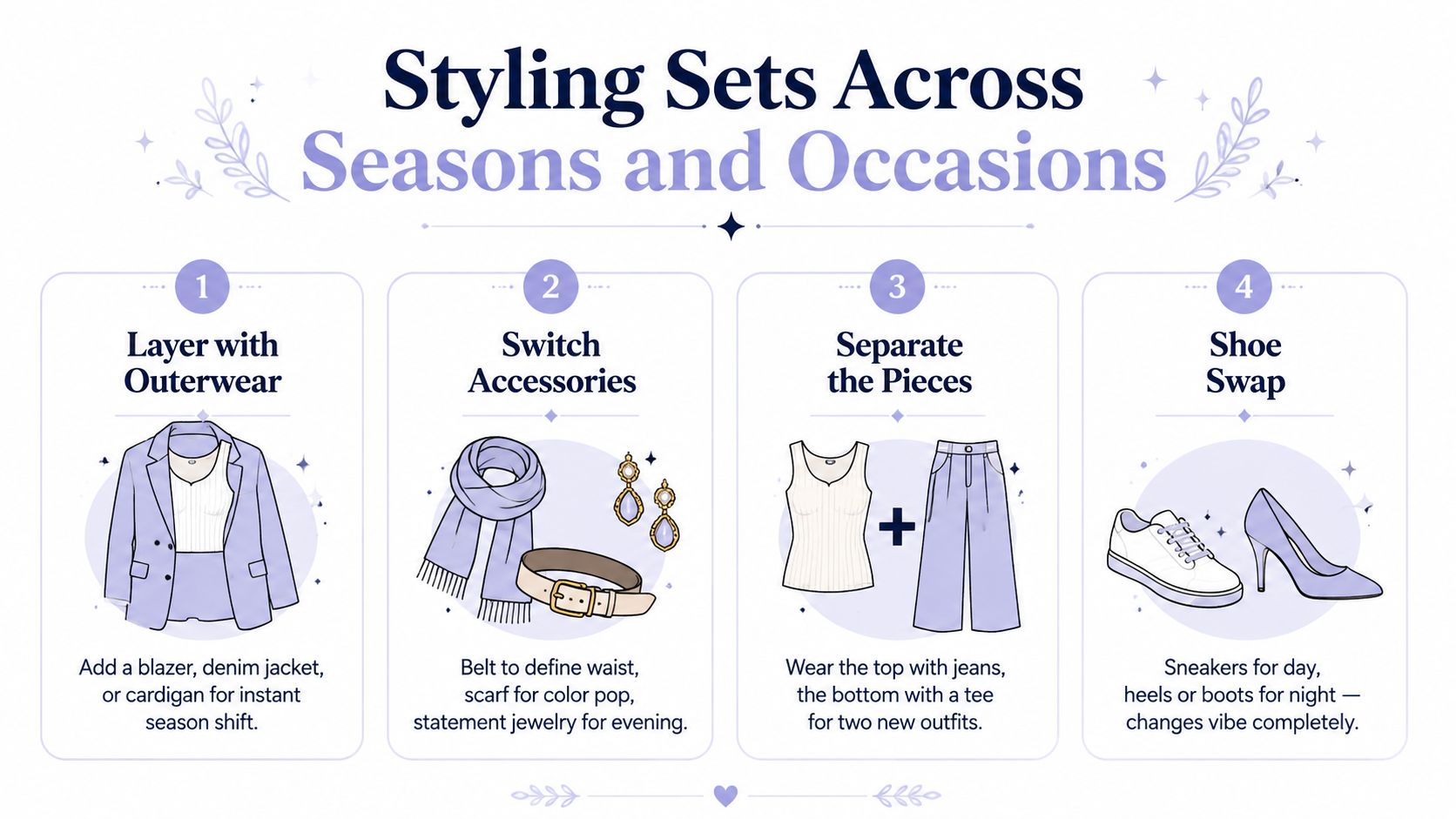
A set becomes far more interesting when it stops being a single outfit and starts acting like a quiet little wardrobe system. A linen top and trouser pairing can feel crisp at lunch, then soften under knitwear in the evening. The same pieces can travel from market stalls to garden parties with only a few adjustments, which is where matching dressing becomes less about uniformity and more about rhythm.
Layering changes the mood without changing the outfit
A linen set can sit under an alpaca cardigan when the weather cools, and that pairing feels especially right for British months that can't quite decide what they're doing. Organic linen breathes, while British alpaca wool adds warmth without the stiff, overbuilt feeling some winter layers bring. Together, they create a look that feels seaside and countryside at once, which is very much where conscious dressing can get delightfully useful.
The easiest changes often come from accessories. Swap trainers for loafers and a casual set starts reading smarter. Add a scarf, and the same outfit picks up a bit of narrative, as if you've just stepped out for oysters, a gallery visit, or a slightly overcast weekend in the village.
Split the pieces and let them earn their keep
The magic is in wearing the top and bottom separately. A matching shirt can work with denim, and the trousers can relax beside a simple tee, which gives the set a much longer life in the wardrobe. That kind of restyling matters because it shifts the purchase away from one-off dressing and towards repeated use.
For more ideas on mixing and shifting wardrobe pieces through the seasons, transitional dressing guidance from The Lavender Lobster fits neatly with the same mindset. A belt can define the waist for daytime, then statement jewellery can push the look towards evening without making it fussy.
- Daytime: wear trainers, keep the jewellery small, and let the set stay relaxed.
- Garden party: add loafers or low heels, then bring in a scarf or light jacket.
- Evening: swap in a sharper shoe and a bolder accessory.
- Travel: keep both pieces together, then separate them later to stretch the wardrobe.
A set should feel like a foundation, not a decision with a deadline. That's the sweet spot.
Are Matching Sets Really More Sustainable
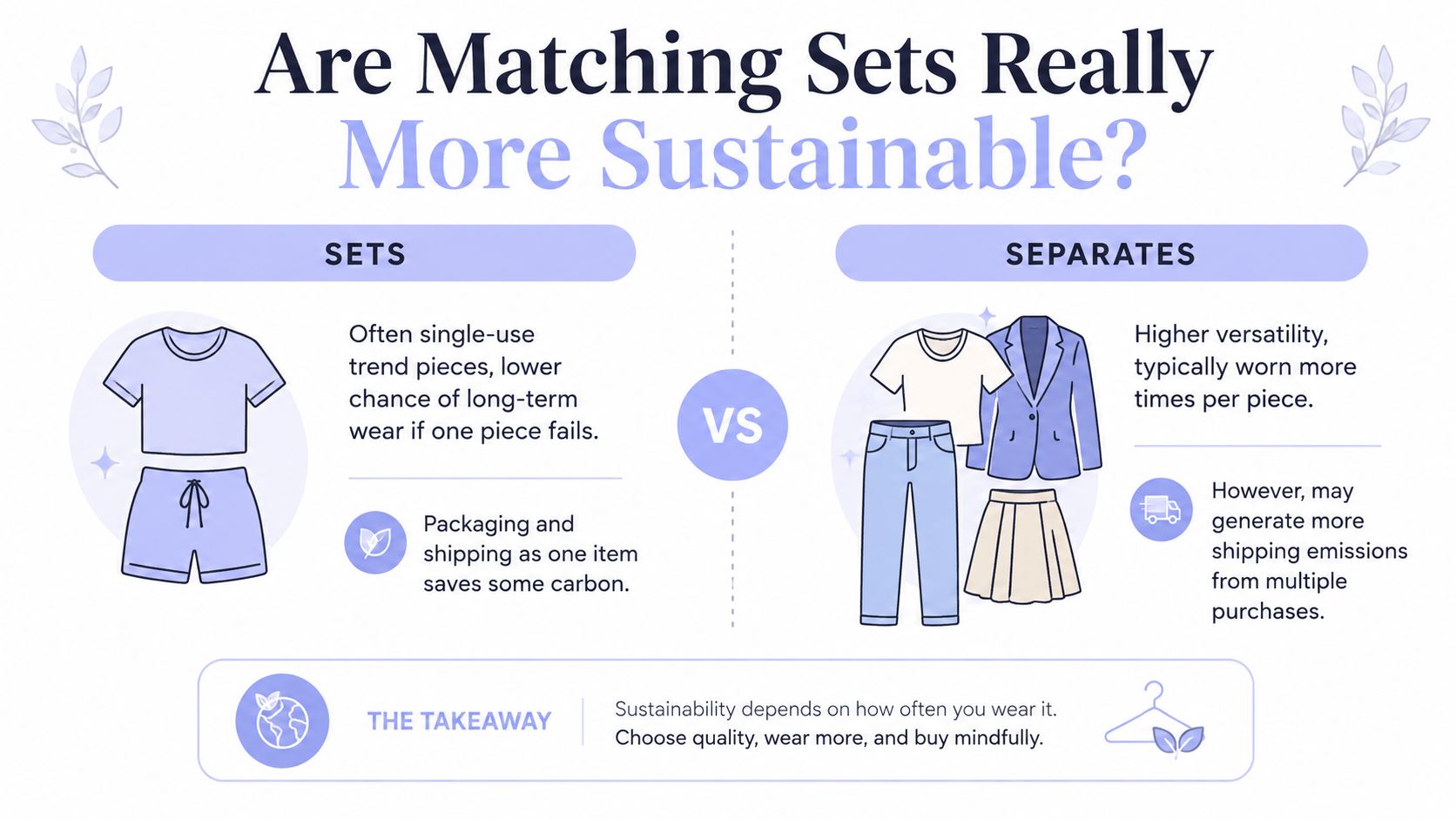
A coordinated outfit can look responsible at first glance, but coordination alone doesn't make a garment lower-impact. The question is what happens after the first wear, and then the tenth. Does the set get worn together and apart, repaired when needed, and stored well enough to survive future seasons, or does it become a neatly packaged form of short-lived novelty?
Lifecycle matters more than the label on the hanger
In the UK, the waste picture is sobering. WRAP reports that around 320,000 tonnes of clothing are sent to landfill or incinerated each year, and the UK throws away about 13 million items of clothing weekly. WRAP's clothing waste figure gives the context for why cost-per-wear and garment longevity matter so much. A set that's bought for a single occasion and never re-worn as separates is taking part in the same throwaway rhythm as any other impulse buy.
A more thoughtful set behaves differently. If both pieces can be reworn with other clothes, if the fabric can be repaired, and if the cut is versatile enough to survive seasonal changes, then the purchase starts to look more like a useful long-term addition. That doesn't automatically make it “sustainable” in the broad sense, but it does make it more defensible in a conscious wardrobe.
Simple test: if one piece fails, would you still wear the other? If the answer is yes, the set has far better staying power.
Pre-order, rental, and careful buying all shift the equation
Pre-order models can reduce the risk of overproduction, and rental can be a sensible route for special pieces that don't need permanent storage. Neither option is magic on its own. Both still depend on whether the garment is made well enough to survive use, cleaning, and return cycles without losing shape.
That's why the question isn't “Are matching sets sustainable?” It's “Is this set designed for reuse, repair, and re-styling?” The Lavender Lobster's sustainability notes sit comfortably in that framework, especially if you're weighing a purchase that should work beyond one season.
The cleanest answer is usually the least glamorous one. Buy fewer pieces that do more work, choose fabrics that last, and avoid mistaking a tidy pairing for a tidy impact. The planet doesn't care whether the outfit is coordinated, it cares how long it stays in circulation.
Caring for Your Sets So They Last for Years
Natural fabrics repay gentleness. Wash organic linen and alpaca blends on cool, mild cycles, and avoid harsh spins that distort shape or wear the fibres down faster. Air-drying keeps the fabric calmer, and for knitwear especially, it helps the garment hold its line instead of growing lazy at the hem.
Store with the fabric's future in mind
Fold knit sets rather than hanging them, because hangers can stretch shoulders and waistlines out of shape. Linen can usually be stored flat or neatly folded in a dry place, away from direct sun, which helps preserve colour and texture. If a seam starts to open or a cuff begins to look tired, repair it early rather than waiting until the whole piece feels beyond saving.
The guide to making clothes last longer echoes a simple truth, maintenance is part of ownership. A beautiful set deserves the same attention you'd give a well-loved chair, a sharpened pencil, or a book you return to often.
Keep the story going by treating care as part of the design, not an afterthought.
That mindset changes how a wardrobe feels. A set stops being a one-time flourish and starts becoming a memory holder, carrying lunches, walks, workdays, and all the small weather shifts in between. Years later, you won't just remember how it looked. You'll remember where it took you, and that's the loveliest kind of longevity.
If you're choosing your next set, look for the one that fits your body, splits into at least two strong outfits, and asks for care you're willing to give. Browse thoughtfully, compare measurements, and let your wardrobe become a little more practical, a little more whimsical, and a great deal more enduring.