

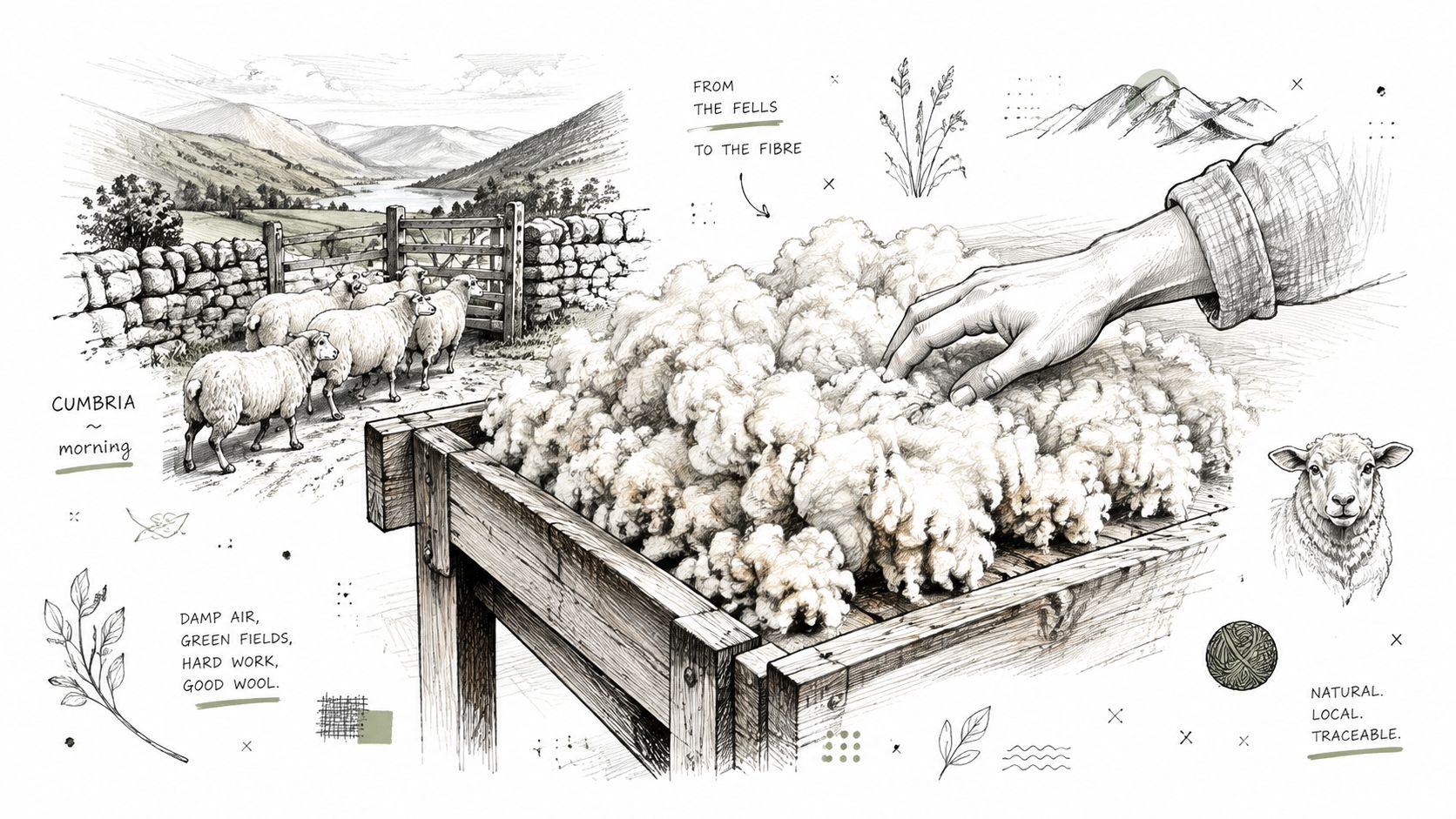
On a damp Cumbrian morning, a flock presses through a wooden gate while a freshly shorn fleece rests on a sorting table. Touch it and you meet lanolin, springy crimp and the quiet, earthy scent of the shed before the wool has become anything as polished as a jumper.
A First Encounter with Organic Wool
The fleece feels alive in a way a finished garment rarely does. Each lock curls back on itself, and the fibres hold tiny traces of the surrounding environment, grass, dust and the animal's natural protective oils. In the stillness of the shearing shed, wool becomes less like a commodity and more like a small archive of weather, husbandry and human hands.
That first touch also reveals why wool can confuse shoppers. A soft knit may carry several appealing descriptions, such as natural, ethical, responsible or organic, yet those words don't necessarily answer the same question. One may describe the fibre's origin, another the treatment of the sheep, and another the way a mill handled dyes or wastewater.
Organic wool fabrics make sense when you follow the material backwards. Start with the finished cloth, then travel through spinning, scouring and shearing until you reach the pasture. At every stage, someone has made a decision about land, animal care, chemicals, records and accountability.
A useful instinct: treat “organic” as a journey the wool must prove, not a charming adjective attached to a label.
The UK already has a domestic footing for this journey. Textile-processing guidance identifies organic wool as wool from sheep reared on organic feed and grazed on organic land, with controls covering toxicity, biodegradability and wastewater treatment. It also names Isle of Mull Weavers and Cornish Organic Wool as UK examples, showing that certified organic wool production isn't only an imported curiosity. UK textile-processing guidance gives the material a distinctly local shape.
The questions that follow are wonderfully practical. Where did the wool come from? What do the labels mean? Why might one fabric feel different from another? The answers lie in the chain between flock, farm, mill and wardrobe.
What Organic Wool Really Means
Organic wool isn't just wool that grew on a sheep living outdoors. Organic standards follow the fibre through the supply chain, asking what happened to the land, the animal and the material at each stage.
From pasture to fleece
At the pasture stage, the question is how the land is managed. Organic systems restrict synthetic herbicides and pesticides and rely on approved organic practices. Good management may include rotating grazing areas so the ground can recover, although a product label alone won't tell you every detail of a farm's rotation plan.
Breed matters for fibre character, but it doesn't automatically make wool organic. A fine merino, a sturdier hill breed or a lustrous longwool can all produce useful fleece. Organic status depends on the approved production system and its records, not on the breed name printed in attractive lettering.
Shearing is the physical handover from animal to textile. Responsible handling matters, and mulesing is prohibited for organic wool within the GOTS-linked requirements described for UK products. That distinction is important: “mulesing-free” can describe one animal-welfare practice, while organic certification addresses a wider set of production and processing conditions.
From fleece to fabric
After shearing, the fleece is sorted and scoured. Scouring removes lanolin and dirt, so the wash chemistry and wastewater route matter. The wool is then carded, spun and woven or knitted. Mechanical processing doesn't erase organic status, but the chain must remain documented.
Dyeing and finishing bring another layer of control. GOTS-linked organic wool fabrics must manage restricted chemistry, including dyes and wastewater treatment, rather than assuming that an organic fibre makes every later process acceptable. That's why organic wool is best understood as a chain-of-custody and chemistry-control problem, not a single raw-material claim. GOTS-certified yarn guidance explains the distinction in practical terms.
Products carrying the standard label need at least 70% certified organic fibres, while the higher “Organic” grade requires at least 95%, as detailed in the same guidance. The calculation applies to the textile product, and the wool itself must come from sheep raised under approved organic standards.
This broader way of thinking also helps with adjacent products. Someone furnishing a bedroom might explore best organic mattresses while asking the same questions about fibre origin, processing and evidence. Likewise, The Lobster Bisque Dress is described as 100% organic linen with an organic cotton lining, which illustrates why shoppers should read the exact fibre claim rather than transfer “organic” from one material to another.
Certifications Worth Knowing
Labels become less mysterious when you give each one a job. GOTS, RWS and recycled-wool standards can all support a more responsible wardrobe, but they don't certify the same thing.
Three questions, three standards
GOTS asks whether organic fibres and textile processing meet its requirements. For organic wool, that means traceability back through the supply chain, approved fibre origin, restricted chemistry and treatment of wastewater from wet processing. It reaches further than a farm-only statement because scouring, dyeing and finishing also matter.
RWS, or the Responsible Wool Standard, answers a different question. It focuses on animal welfare and land-management requirements within the wool supply chain. An RWS mark doesn't automatically mean the fibre was produced under organic standards, so a welfare certification can sit alongside organic certification without replacing it.
Recycled-wool certification addresses the input's previous life. Woolmark's recycled-wool specification, launched in 2024, requires at least 20% recycled wool, according to FashionUnited's coverage of the specification. That verifies recycled content, not organic farming. Recycled wool can be a sensible material choice, but it belongs in a different column from certified organic wool.
| Standard | Primary Question Answered | Scope | Key Limitation |
|---|---|---|---|
| GOTS | Is the fibre organic, and was the textile processed under strict environmental and social criteria? | Fibre origin, processing, chemistry and supply-chain documentation | A product must meet the relevant organic-content threshold and certification route |
| RWS | Were animal welfare and responsible land-management requirements followed? | Farm and wool supply-chain practices | It doesn't automatically certify organic fibre |
| Recycled wool standard | Does the product contain verified recycled wool? | Recycled input and related chain documentation | It doesn't prove organic farming or virgin-fibre origin |
A scope certificate shows what a supplier is authorised to produce or handle. A transaction certificate connects a particular shipment or sale to certified material. An on-product label is useful, but it's strongest when the brand can connect it to current documentation.
For a broader explanation of how different textile marks work, the guide to ethical manufacturing standards is a helpful companion. You'll also find useful examples of merino-focused product language in Comfort Pure's Mymerino collection, although merino itself isn't proof of organic certification.
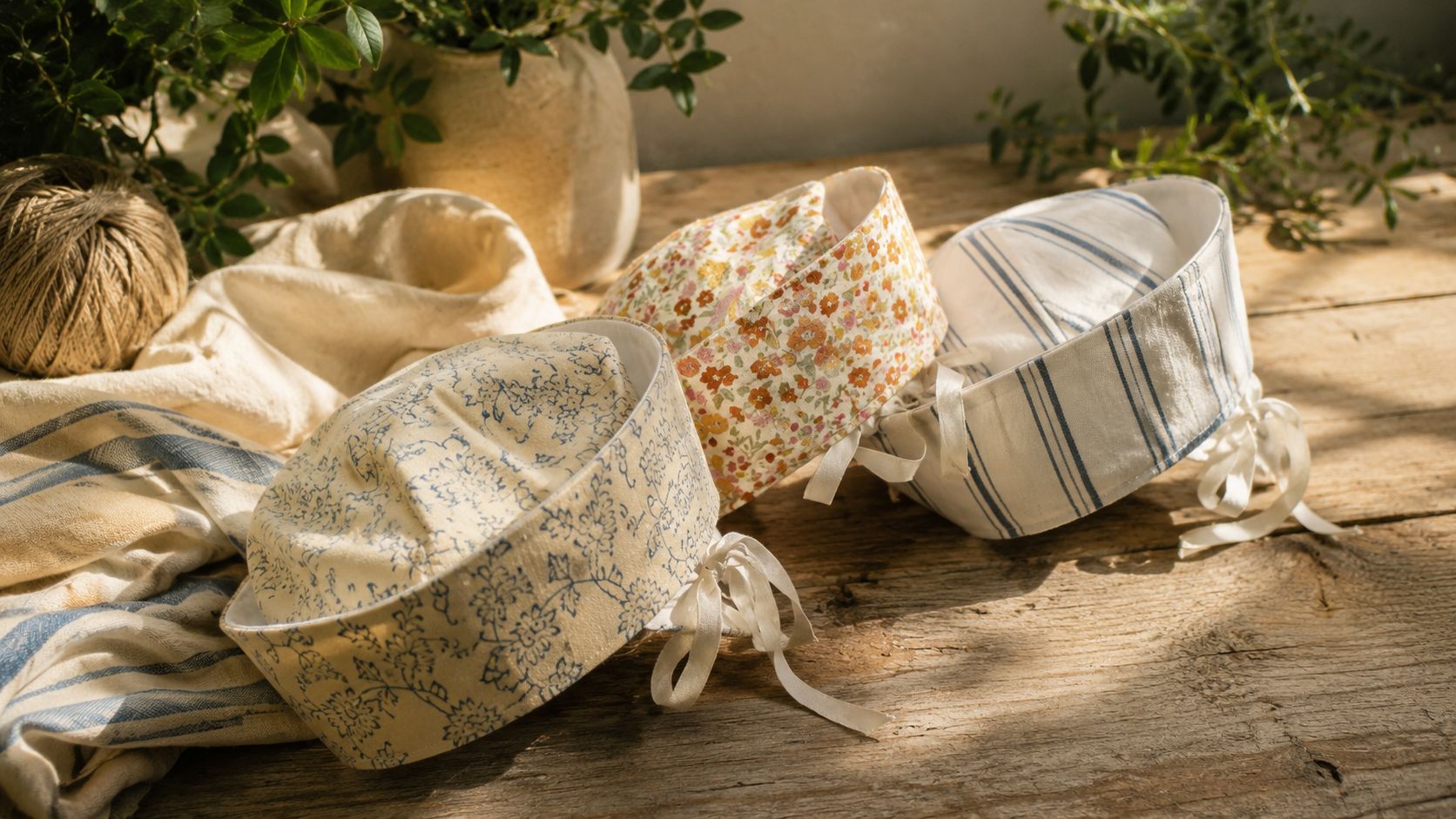
Waste reduction deserves its own label literacy too. The Sailor Hats are described as made-to-order accessories crafted from garment offcuts, with production by seamstresses in the UK. That's a reuse story, not an organic-wool certification claim, and keeping those ideas separate helps shoppers avoid accidental greenwashing.
Organic Wool and Conventional Wool Compared
Organic and conventional wool can both be warm, resilient and beautifully made. The meaningful differences usually appear in animal husbandry, land management and processing chemistry, not in a magical divide between good fibres and bad ones.
On a farm, organic production places stricter conditions around approved inputs and organic land. It also incorporates the welfare requirements attached to the relevant certification route. Conventional wool may come from carefully managed farms too, but without organic certification there's no equivalent assurance that the whole system followed organic rules.
Land tells a similar story. Organic management aims to reduce reliance on prohibited synthetic pesticides and maintain a healthier relationship between grazing and pasture recovery. Conventional systems vary widely, so one shouldn't assume that every non-organic farm uses the same fertilisers, stocking approach or parasite-control programme.
A practical comparison
| Dimension | Organic Wool | Conventional Wool |
|---|---|---|
| Animal welfare | Organic certification includes defined welfare requirements, with mulesing prohibited in the cited GOTS-linked guidance | Welfare depends on the farm, region and separate certification |
| Land | Sheep graze land managed under approved organic standards, including restrictions on synthetic herbicides and pesticides | Land management varies and may use inputs that organic standards prohibit |
| Chemistry | GOTS-linked routes constrain scouring, dyeing, finishing and wastewater handling | Processing requirements vary by mill and product |
| Traceability | Certification requires documented chain-of-custody evidence | Claims may rely on the supplier's own disclosures |
| Feel and handle | Fibre character still depends on breed, micron, spinning and finishing | The same variables shape the final fabric |
| Price | Added certification and controlled processing can contribute to a higher price | Costs vary according to fibre, mill, labour and finishing |
Wool fibre naturally has crimp and a keratin structure, which support elasticity, loft and recovery. Fibre diameter commonly ranges from about 16 to 40 microns, and finer fibres generally feel softer next to the skin, as explained by Britannica's overview of wool. Organic status doesn't automatically make a fibre finer, stronger or softer. The spinner, breed and fabric construction still do that work.
Chemistry deserves careful language. It's tempting to name particular dyes as if every conventional mill uses them, but processing varies. The sounder distinction is that certified organic routes impose documented restrictions and controls, while a conventional route may offer less standardised evidence.
Nor is organic automatically the lowest-impact option in every scenario. A UK-spun organic yarn may travel farther than a nearby conventional yarn, and transport, dyeing, finishing and garment life all influence the overall picture. If you're comparing broader natural-fibre choices, this guide to the difference between organic and conventional cotton uses the same useful principle: examine the whole route, not one virtuous-sounding word.
How to Verify Before You Buy
Verification shouldn't feel like detective work in a foggy attic. Use a repeatable routine, and stop when the evidence becomes too vague.
Four calm checks
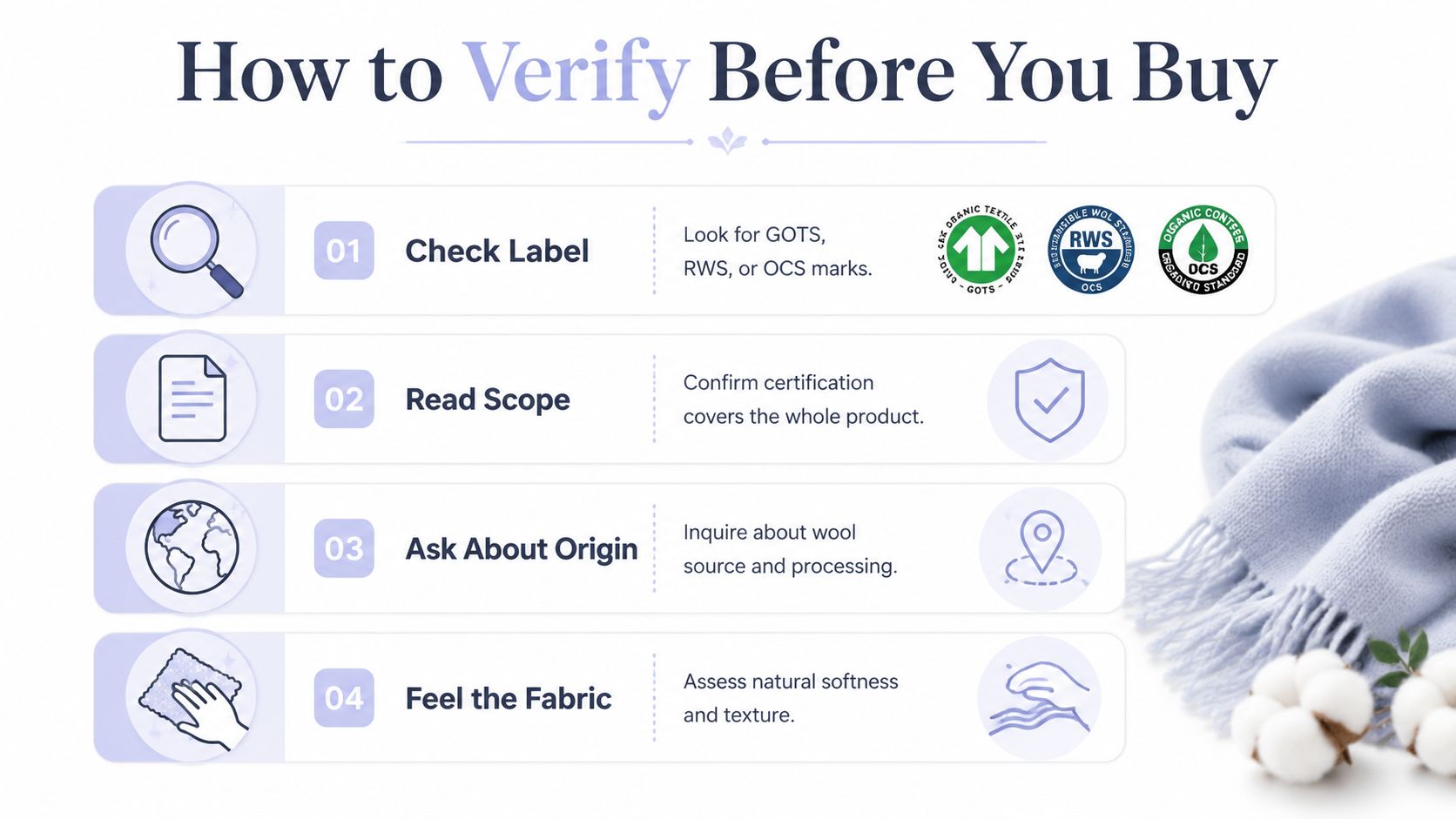
- Check the label. Look for a named standard such as GOTS, RWS or OCS. “Organic wool” printed in a product description is a claim, not by itself independent certification.
- Read the scope. Find out whether the certificate covers the fibre, the yarn, the fabric, the finished garment or only the supplier's general operations. A certified spinner doesn't necessarily mean the garment maker used certified wool in every component.
- Match the paperwork. A certificate number, QR code or issuing-body database entry should connect the brand or supplier to a current certification scope. Check that the business name, product category and material route make sense together.
- Ask about origin. A useful brand should be able to explain where the wool came from and where it was scoured, spun, dyed and finished. If the answer stops at “natural and sustainable”, ask one gentle follow-up question.
UK procurement guidance takes this evidence-first approach. It requires bidders to state the proportion by weight derived from organic production and to provide verification through recognised organic logos or approved national marks. UK public procurement guidance for textiles also records a pesticide-residue threshold of below 0.5 mg/kg for raw wool sold as organic.
Practical rule: if a label makes a precise claim, look for a precise document behind it.
The texture test still has a place. Wool's natural crimp can create bounce and spring, while finer fibre usually feels smoother. A fabric can be certified and still feel scratchy if its fibre is coarser or its construction doesn't suit sensitive skin.
Pause when a product uses several broad green words but names no standard, certificate or fibre percentage. Also pause when a brand presents RWS as proof of organic production, or recycled wool as if it were newly grown organic wool. Those standards may be valuable, but they answer different questions.
Styling Organic Wool in Real Wardrobes
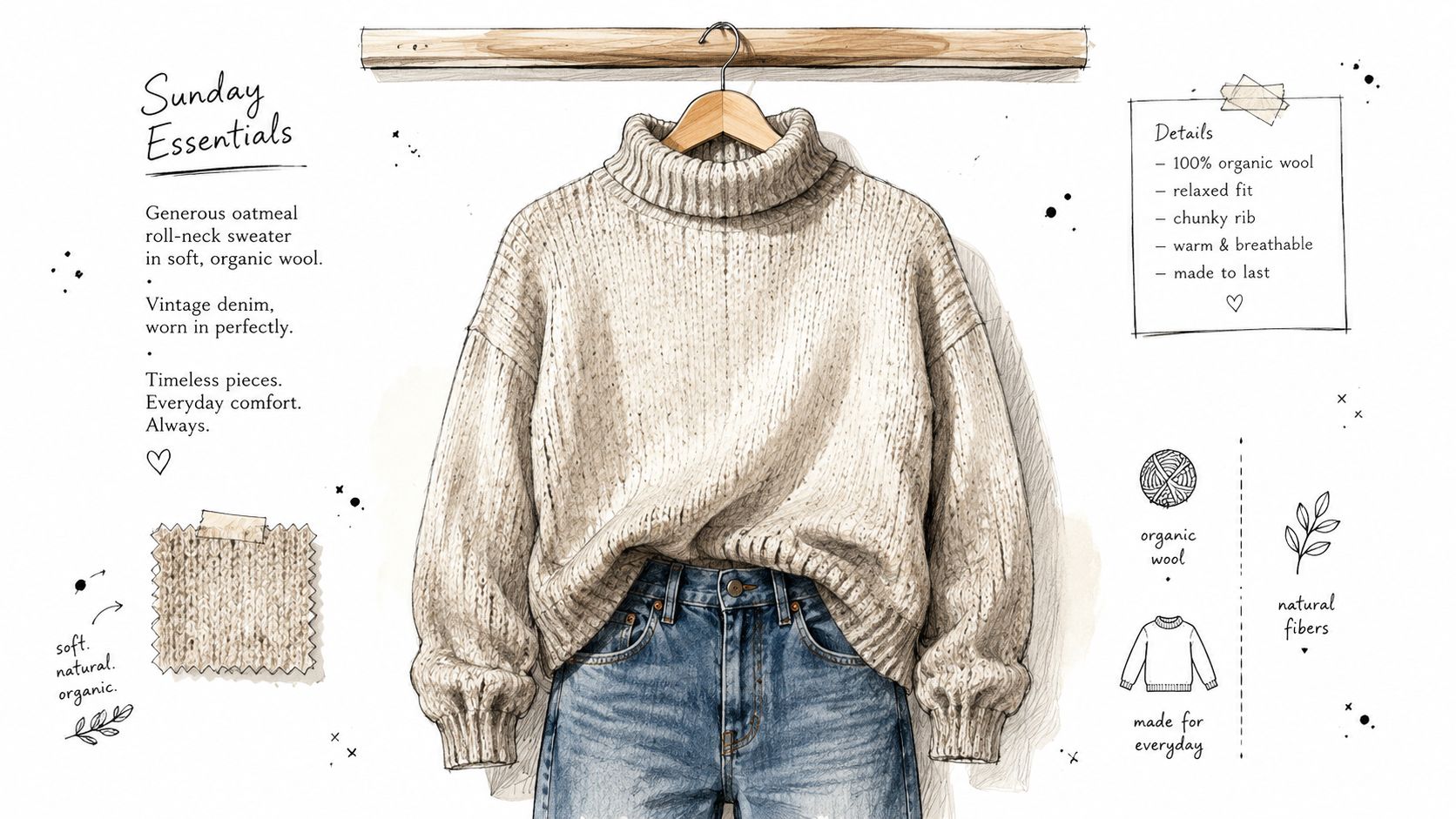
Organic wool earns its keep through ordinary wardrobe moments, not ceremonial sustainability poses. An oatmeal roll-neck over vintage denim is enough for a Sunday market, especially when the knit has generous proportions and the denim supplies a firm, faded counterpoint.
A fine-gauge organic merino turtleneck works beneath a linen waistcoat because the textures speak to one another. The smooth knit creates a clean line at the neck, while linen adds a dry, slightly rumpled surface. Keep the trousers wider and the knit fitted, or reverse the proportions with a relaxed top and a neater skirt.
Texture does the styling
An unstructured blazer in undyed wool can soften workwear without making it precious. Pair it with a crisp shirt, worn-in trousers and a shoe with a little weight. The absence of a strong dye story lets the weave, shoulder line and natural variation carry the outfit.
A fine-gauge knit dress can travel from autumn afternoon to evening with a change of boots and jewellery. Look for a fabric with enough recovery to hold its shape, then add a coat in a contrasting texture rather than another smooth layer.
For a more relaxed silhouette, try a slouchy cardigan in undyed Shetland-type wool with wide trousers. Balance the volume by showing a wrist, ankle or a narrow strip of shirt at the collar. If you're drawn to cardigan proportions and layering ideas, these notes on cardigans offer another route into the shape.
Buy for the life you'll lead
A felted organic wool coat can justify its place for years when the cut works with the clothes you already own. Check the shoulder, sleeve length and fastening before falling for the colour. A beautiful coat that only suits one outfit is still a costly lonely lighthouse.
The most useful sourcing question is simple: does the brand explain both the fibre and the construction? Look for clear composition, certification details, country information and care instructions. A label that distinguishes organic wool from recycled content is giving you better information than one that gathers every virtue into one cloud.
Mixing textures keeps organic wool fabrics from looking overly earnest. Combine a nubby knit with polished leather, brushed cotton with fine merino, or felted wool with crisp linen. The result feels lived-in, which is where conscious clothes usually look happiest.
Caring for Organic Wool So It Lasts
Care begins before washing. Air a wool garment after wearing it, preferably somewhere dry with moving air, and spot-clean small marks rather than treating every outing as a laundry emergency. Wool often needs time more than it needs soap.
When washing becomes necessary, use cool water and a pH-neutral wool detergent. Support the garment rather than stretching it, press water out gently, then roll it in a towel to remove excess moisture. Reshape it and dry it flat, away from direct sun and strong heat.
A seasonal wool ritual
- Between wears: Air the garment and brush away surface dust with a soft clothes brush.
- For small marks: Dab with cool water and a suitable detergent. Don't rub hard, because agitation encourages felting.
- For a full wash: Hand-wash carefully, rinse without temperature shocks and avoid wringing.
- For drying: Lay flat on a clean towel or mesh surface, restoring the shoulders, cuffs and hem to their intended shape.
- For storage: Choose a breathable cotton bag rather than plastic, and use cedar or lavender as a deterrent.
Moths prefer quiet, undisturbed places, so inspect stored wool during warmer months. Clean garments before long storage, because food and body oils can attract trouble. A quick check now is much kinder than discovering a wardrobe has been nibbled into tiny holes later.
A pulled thread doesn't have to become a disposal decision. Thread a blunt needle with leftover yarn, bring the loose loop gently to the reverse side and secure it with a few small stitches. For a hole, work simple running stitches across the gap in one direction, then weave across them in the other direction. The repair can remain visible, like a little map of the garment's travels.
For pills, use a cashmere comb with light strokes, keeping the fabric flat. Structured knitwear that needs pressing or shaping may be better handled by a professional green dry-cleaning service. More everyday guidance appears in this knitwear care guide, especially useful when a favourite jumper has become part of the family.
A Gentle Parting and Quick Answers
Organic wool is easiest to understand when you follow its thread. The sheep, pasture, fleece, mill, dye bath, certificate and care label all belong to the same story. A trustworthy garment doesn't need to shout. It needs to leave a trail you can follow.
Keep these five reminders close:
- Organic means more than natural. It concerns approved production and processing conditions.
- GOTS and RWS answer different questions. One centres on organic fibre and textile processing, the other on responsible wool and welfare requirements.
- Certification needs paperwork. Look beyond a beautiful logo to scope and traceability.
- Feel is still personal. Fibre diameter, breed and construction affect softness.
- Longevity is part of the purchase. The gentlest garment is often the one you wear, wash carefully and mend repeatedly.
Frequently asked questions
Does GOTS cover the same things as RWS?
No. GOTS covers organic fibre requirements and textile processing. RWS focuses on responsible wool production, including animal welfare and land-management requirements. One doesn't automatically substitute for the other.
Is organic wool automatically cruelty-free?
No label should be treated as a complete moral shortcut. Organic wool includes defined welfare requirements, and mulesing is prohibited in the cited GOTS-linked requirements, but shoppers should still check the exact certification and supply-chain documentation.
How should I read a care label?
Start with fibre composition, then check washing, drying and pressing instructions. A wool label tells you how to protect the fabric, while a certification mark tells you something about its production route. They're useful companions, not interchangeable evidence.
Why can organic wool cost more?
Certified farming, segregation, documentation and controlled processing add work across the chain. Price also reflects breed, micron, spinning, fabric weight, labour and garment construction, so certification is only one part of the explanation.
What's the difference between organic and recycled wool?
Organic wool comes from sheep raised under approved organic standards. Recycled wool contains recovered wool from existing material. They address different stages of a textile's life.
Is organic wool suitable for sensitive skin?
It can be, especially when the fibre is fine and the fabric is smoothly constructed, but organic certification doesn't guarantee a sensation-free surface. Try the fabric against your skin, check the fibre description and choose a lining or base layer when needed.
Choose with curiosity rather than perfectionism. Ask where the fleece began, follow the maker's evidence, and give the finished cloth the patient care it deserves. Then the garment carries more than warmth. It carries a small, durable connection between flock, field and hand.
If you're ready to bring organic wool fabrics into your wardrobe, choose one well-documented piece, check its certification scope, read the care label and plan how you'll wear it across seasons. Let your next purchase begin with a question, and end with a garment that stays in your life long enough to tell the story properly.