

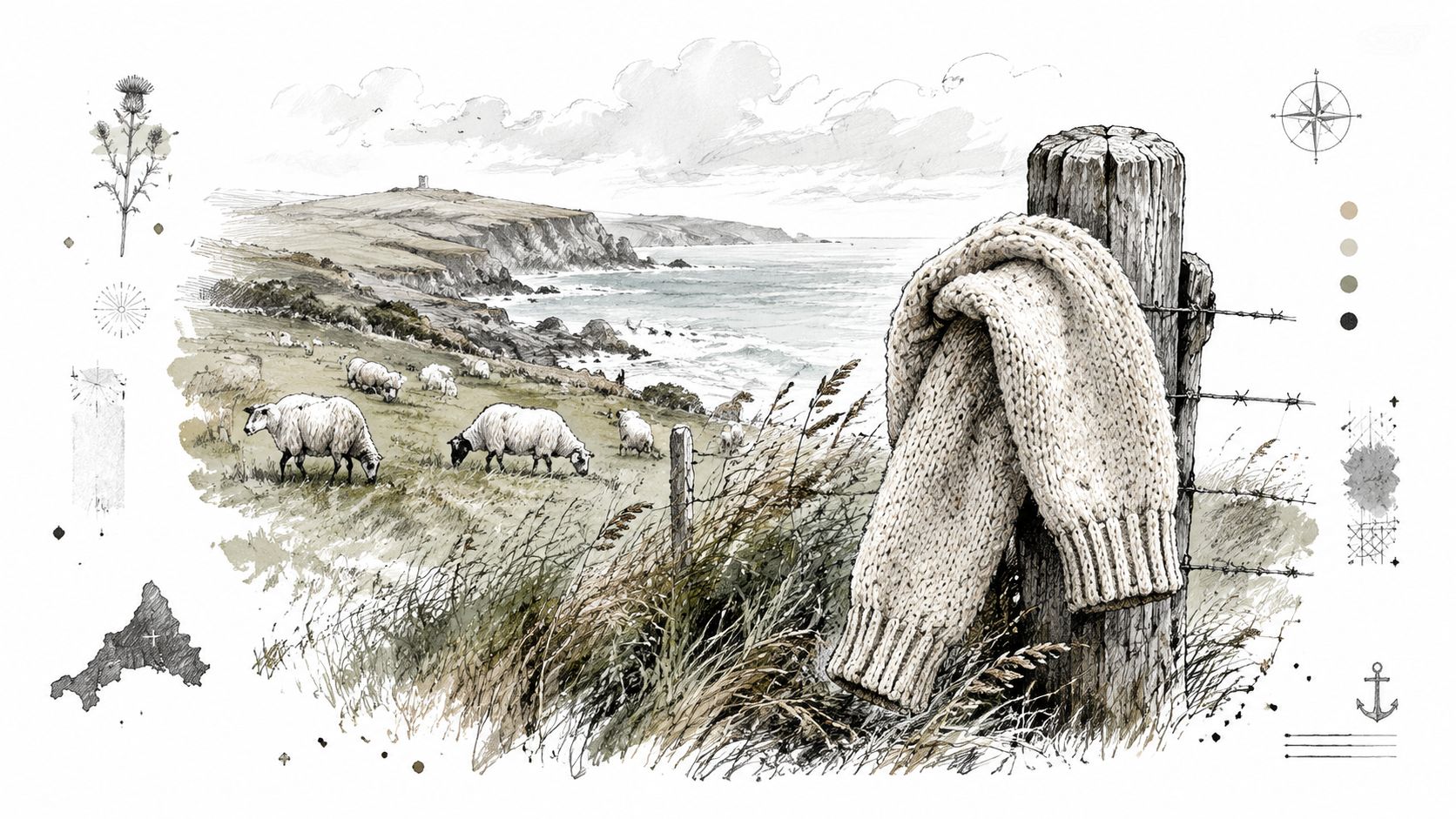
On a grey Cornish morning, a sheep-grazed headland smells of salt, wet grass and rain waiting its turn. A wool jumper draped over a gate seems simple, but its story begins long before the first loop of yarn meets a knitting machine.
What an Organic Wool Jumper Really Is
An organic wool jumper is made from wool produced within an organic farming and textile system. That starts with sheep raised on organically managed land, then follows the fibre through shearing, scouring, spinning, knitting and finishing. The jumper earns its description through that connected journey, not through a single green symbol on a swing tag.
Organic farming generally avoids synthetic pesticides, herbicides and fertilisers on pasture, while organic livestock systems also work within defined welfare and management requirements. The important point for shoppers is traceability. You should be able to ask where the wool came from, how it was cleaned, who spun the yarn, where the jumper was knitted and which certification covers each stage.
The UK has a documented organic farming base behind this story. In 2025, 617 thousand sheep were reared organically, representing 2.0% of the total UK flock, alongside 540 thousand hectares of organically farmed land and 5,004 registered organic producers and processors. Permanent pasture made up 64% of all UK organic land, covering 346 thousand hectares, an area that naturally aligns with sheep-rearing systems. These figures, documented through UK wool-processing and fibre information, show that organic wool can be rooted in a recorded farming infrastructure rather than existing only as a charming label.
You may also meet terms such as GOTS-organic merino, which refers to merino wool processed within a certified textile chain, or British organic lambswool, which describes a particular type of sheep wool alongside its country and farming claims. Alpaca is different again. Its fibre has a distinct feel and structure, and an alpaca garment shouldn't automatically be treated as organic wool because both fibres are natural.
A useful test: Ask whether the brand can show the wool's origin and the certification trail from pasture to finished jumper.
“Organic” on a tag can therefore mean several things. It may refer to the raw fibre, the finished garment, or a blend containing only some organic material. The label becomes meaningful when the brand explains the complete chain of custody. For a wider introduction to organic fabrics in the UK, look for the same distinction between natural, organic and certified.
Certifications and Labels Worth Trusting
Certification is the part of the organic wool conversation that turns a pleasing story into something you can check. The three names most likely to appear around a certified textile purchase are GOTS, OCS and OEKO-TEX, although they don't all verify the same thing.
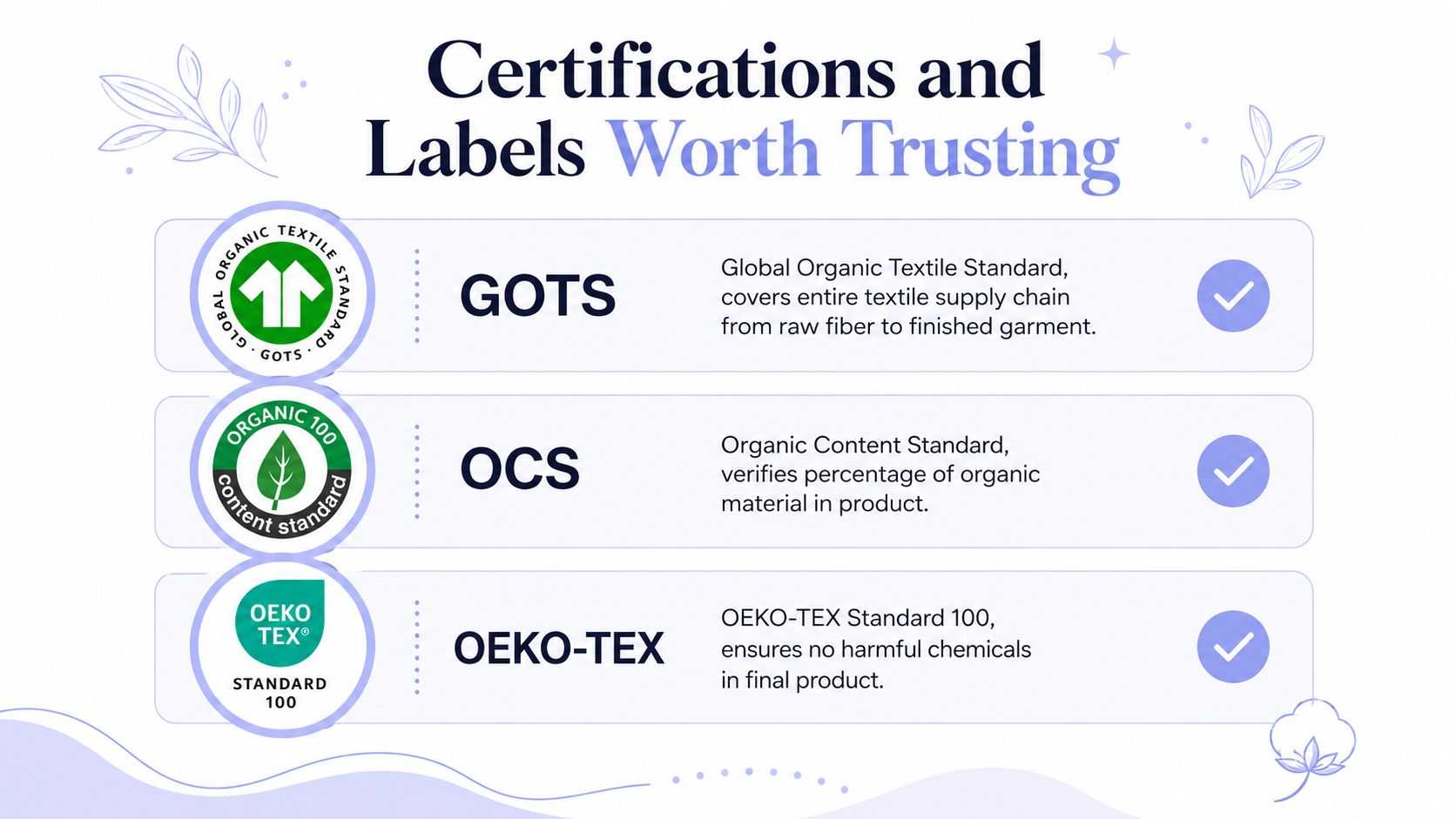
GOTS covers the textile journey
The Global Organic Textile Standard covers the post-harvest textile chain, including spinning, knitting, dyeing, finishing and labelling. A textile needs at least 70% certified organic fibres to carry the GOTS label, while the stricter “Organic” grade requires at least 95% certified organic fibres. Those thresholds come from GOTS certification guidance for UK shoppers.
For a jumper, that means the wool's farm origin isn't enough by itself. The knitting and finishing stages also need to sit within the certified chain if the finished garment is presented as GOTS-certified. Ask for the brand's licence details and, where relevant, a transaction certificate linking the material to the specific supply chain.
OCS tracks content
The Organic Content Standard verifies organic material content and chain of custody, but it doesn't provide the same broad processing requirements as GOTS. OCS can verify products made with 100% organic material or blended items containing a minimum of 5% organic content, as explained in UK organic textile certification education. A brand should therefore state which standard applies and what it covers.
Read the legal fibre label
UK textile-labelling rules require fibre content to be stated clearly. If a garment contains two or more textile components with different fibre contents, each component's composition must be shown under the UK Textile Products regulations. Claims such as “100%”, “pure” or “all” can only describe a product made exclusively from one fibre, and consumer-facing information must be durable, legible and visible before purchase, as outlined in UK fibre-labelling guidance.
Use this quick label check:
- Find the exact composition. Look for the percentage of wool and every other fibre.
- Identify the standard. A leaf icon alone isn't certification proof.
- Check the paperwork. Ask for a GOTS licence, transaction certificate or OCS documentation.
- Ask about processing. Find out whether scouring, spinning, knitting and finishing are covered.
- Separate claims. “Natural wool” describes fibre; “organic” requires evidence.
Ethical standards can also sit beside fibre certification. For example, shoppers comparing animal-welfare claims may want to understand whether a brand is Leaping Bunny certified, although that certification addresses a different concern from organic textile content. Similarly, ethical manufacturing standards are easier to assess when a brand explains the specific standard rather than gathering every reassuring word under one leafy umbrella. The Lobster Bisque Dress, for example, is described as 100% organic linen with a soft organic cotton lining, which is a fibre-composition statement rather than a wool certification claim.
Why Organic Wool Performs Season After Season
Wool works well in a jumper because its structure manages both warmth and moisture. The crimped fibres create small pockets of still air, while wool's hygroscopic nature allows it to interact with humidity around the skin. That combination helps explain why a wool layer can feel useful during a cold commute, a heated office and a windy walk home.
Research involving British Wool, the International Wool Textile Organisation and Bangor University's BioComposites Centre compared wool with down, feather-and-down and synthetic fills. Wool retained heat 17% better than down, 25% better than synthetic fill and 30% better than feather-and-down, while moving moisture away from the body up to 139 to 151% faster than synthetic and feather-and-down, and 50% faster than down, according to the UK wool moisture and insulation study summary.
These findings concern filling materials rather than a direct jumper test, so they shouldn't be treated as a promise that every knitted garment will perform identically. They do provide useful evidence for the fibre's insulation and moisture-management qualities. A jumper's gauge, density, fit and finishing still shape the experience.
Honest comparisons
Cotton feels familiar and breathable, but it absorbs moisture and can take longer to dry. That can make a damp cotton layer feel chilly when conditions change.
Acrylic can be soft and affordable, yet it is petroleum-derived and doesn't offer wool's same combination of moisture buffering and thermal regulation. It may feel warm in a still room, but it can become less comfortable across changing temperatures.
Recycled polyester makes use of existing plastic feedstock and can provide warmth when dry. It remains a synthetic fibre, however, and damp skin can feel clammy inside a dense polyester layer. Synthetic textiles can also shed microplastics during washing, a concern that makes care and fibre choice part of the same conversation.
Alpaca deserves its own note. Its hollow-core fibre structure can provide impressive warmth with a smooth, often less prickly handle, but it isn't interchangeable with wool. Fibre diameter, yarn construction and processing all affect how a finished jumper feels.
The practical conclusion is modest but useful. Organic wool doesn't need to be sold as magic. It already offers a strong evidence-based case for seasonless knitwear, especially when the brand matches the fibre and knit density to the intended use.
How to Choose a Jumper That Will Last
Treat the shop floor like a small investigation. Start with the label, then move to the fabric, the construction and finally the fit. A beautiful colour can't rescue a jumper that loses its shape after ordinary wear.
Begin with proof
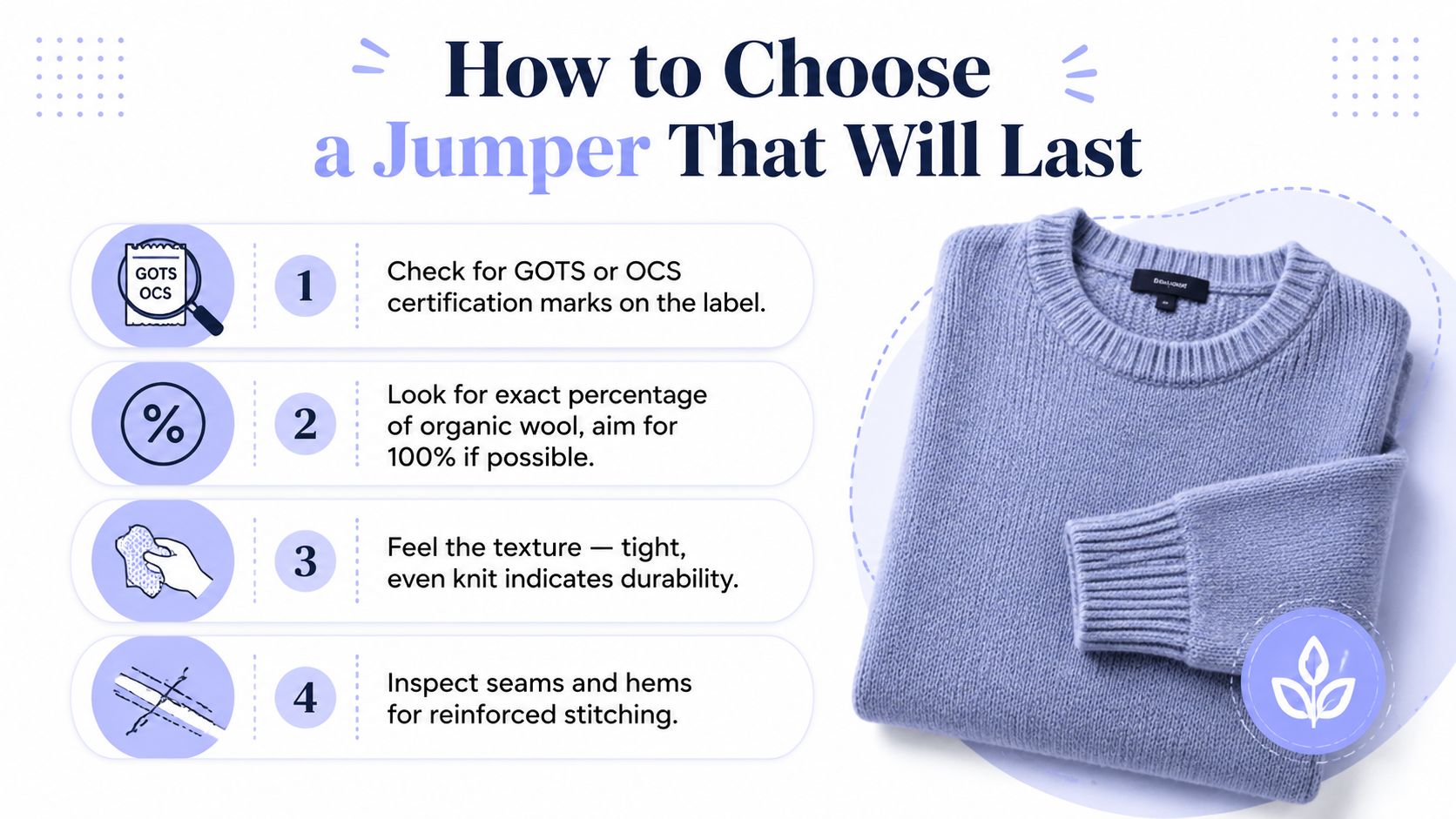
Look for a GOTS or OCS mark, the exact percentage of organic wool and the percentage of any other fibre. UK rules require fibre content to be shown, so a vague phrase such as “organic blend” should lead you to the composition label rather than ending the conversation.
If the product page names the country of fibre origin, spinner or mill, that's helpful context. It doesn't replace certification, but it gives you more places to ask precise questions. A transparent brand should be able to explain whether certification covers the finished garment or only the yarn.
Use your hands
Pull the knit gently sideways, then release it. Good recovery doesn't guarantee a perfect jumper, but fabric that stays visibly stretched deserves caution. Run your palm across the surface and look for loose, uneven or very short fibres, which can be more vulnerable to early pilling.
Hold the garment up to the light. A denser, even knit often holds its shape more reliably than a very open structure, although the right gauge depends on the design. Inspect the seams and hems for secure finishing, and look for full-fashioning marks that suggest the garment was shaped as knitted panels rather than cut from a large sheet.
Test movement, not just appearance
Lift your arms, sit down and reach forward. The shoulder seam should stay reasonably placed, while the body should move without riding up or pulling across the chest. Try the jumper with the sort of shirt or base layer you wear, because a perfect mirror pose tells you very little about a full day.
Ask about repair, take-back and resale options. A brand that has considered mending has usually considered the garment beyond its first photograph. If you're comparing a wool jumper with other wardrobe choices, a guide to sustainable fashion alternatives can help widen the decision without reducing it to a single fibre badge.
Shop-floor question: “If this jumper develops a hole or loses a button, what support do you offer after purchase?”
That answer can reveal as much about the garment's intended life as its yarn label.
Caring for an Organic Wool Jumper
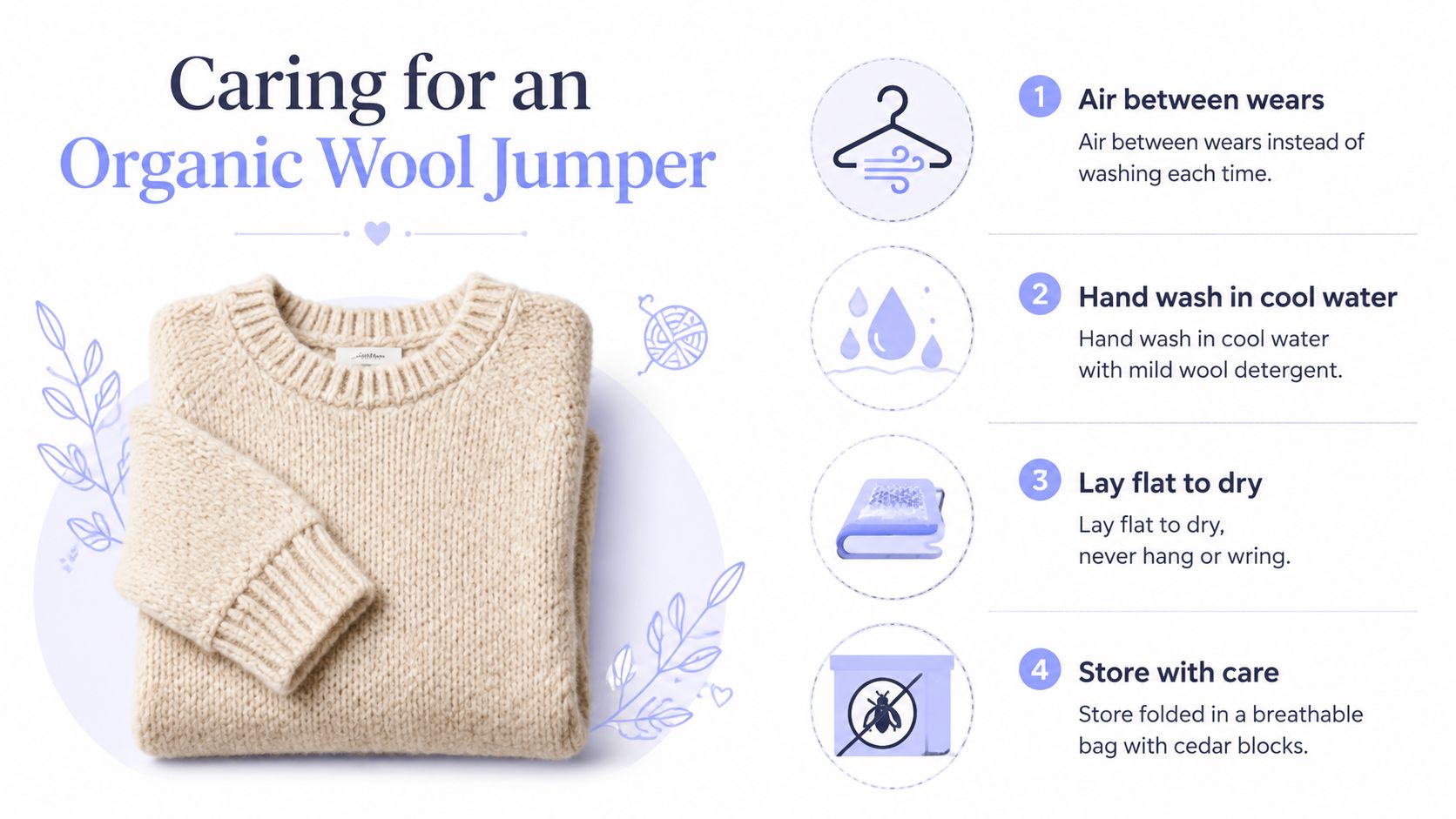
Wool is a performance fibre, so it often asks less of you than people expect. Airing a jumper between wears can be enough to refresh it, especially when there isn't a stain or visible soil. Wool's keratin structure helps it release odours during a brisk airing, which means a wash doesn't need to be the automatic finale of every outing.
When washing is necessary, use cool water and a pH-neutral wool soap. Press water out in a towel rather than twisting or wringing the garment, then dry it flat on a clean surface away from direct heat and strong sunlight. Heat, friction and sudden changes in moisture can encourage felting, while direct sun may affect colour.
Make storage part of wear
Fold knitwear instead of hanging it. A hanger can pull the shoulders into permanent points, particularly when the jumper is damp or heavy. For seasonal storage, use a breathable cotton bag with cedar or lavender sachets rather than mothballs, and make sure the garment is clean before it goes away.
Small repairs deserve speed. A snag or moth graze caught early can often be secured with a darning needle or taken to a repair circle before the opening grows. Mending isn't a punishment for buying clothes. It's the quiet skill that lets a well-made jumper keep its place.
Give the fibres a rhythm
Rotate two jumpers rather than wearing one continuously. Each garment gets time to air and recover its loft, while your wardrobe gains variety without needing constant additions. For more detailed knitwear guidance, see this practical resource on how to care for knitwear.
The best care routine is the one you'll follow. Air first, wash carefully, dry flat, fold properly and repair promptly. Those small habits turn a fibre's natural resilience into a longer, more useful life.
Styling a Wool Jumper Across the Year
An organic wool jumper doesn't retire in April. It changes partners.
In colder months, wear it over a long-sleeve cotton or merino base, then tuck it beneath a waxed cotton coat with raw denim and sturdy boots. The combination works because each layer has a job. The base layer manages contact with the skin, the jumper provides adaptable insulation, and the outer coat handles wind and rain.
Spring asks for less bulk, not less wool. Pair the same jumper with linen trousers or a washed cotton midi skirt, push up the sleeves and add a silk scarf at the neck. The contrast between a textured knit and a lighter woven fabric keeps the outfit from feeling heavy.
Summer evenings are an underrated wool season, especially by the coast. Sea air can turn cool after sundown, so a fine jumper with wide-leg linen trousers and leather sandals becomes a practical layer rather than a winter costume. Wool's moisture-handling qualities also make it more comfortable than a thick, airless synthetic layer when temperatures move around.
Let colour do the organising
Undyed naturals, deep ocean tones and muted earth shades behave like neutrals. They move easily between denim, tailoring and weekend cottons, so the jumper earns more outfits without demanding visual attention every time.
Tonal dressing makes that flexibility even clearer. Keep the jumper, trousers and coat within a few shades of one another, then let the knit texture provide the interest. In autumn, layer the jumper beneath a sleeveless gilet or oversized shirt jacket for warmth without excessive bulk.
The result is a garment that works across the calendar because its styling logic changes. If you're choosing a thoughtful present alongside clothing, a collection of reusable gift ideas can help keep the same low-waste, useful-minded approach.
A seasonless jumper isn't one that ignores weather. It's one that adapts to it.
Common Myths Worth Putting Down
A green leaf on a swing tag isn't a certification system. It may signal a brand's intention, but it doesn't tell you whether the fibre is certified, how much organic material the garment contains or which processing stages were checked. GOTS and OCS give shoppers a more traceable starting point because each standard defines what it verifies.
The distinction matters in the UK. A survey reported that 56% of respondents didn't know how to identify whether clothing or textiles were certified organic, while 70% said they'd be less likely to buy from a brand found to be falsely claiming organic status, as reported in UK consumer research on organic textile transparency. The same source notes that UK organically farmed land reached 540 thousand hectares in 2025, up 7.3% year on year, while registered organic producers and processors numbered 5,004, down 2.5%. More organic land doesn't remove the need to inspect the chain behind a claim.
Natural doesn't mean automatically responsible
Wool is a natural fibre, but that fact alone doesn't answer every welfare or environmental question. Conventional sheep husbandry can involve practices such as mulesing, synthetic dip treatments and high stocking densities. A responsible buyer should ask about those issues instead of treating “wool” as a complete ethical description.
Blended construction adds another layer. Independent analysis of 13 major brands found 55% of wool items were blended with synthetic fibres, only 19% used reduced-impact fibres, and almost 90% used virgin wool, according to analysis of wool products and fibre choices. A blend may improve stretch or reduce cost, but it changes questions around biodegradability, recycling and care.
Alpaca isn't simply wool with a different accent
Alpaca and wool are both animal fibres, yet they involve different animals, fibre structures, lanolin levels, farming systems and labelling considerations. Alpaca's lower lanolin content can suit some wearers, but it doesn't make every alpaca garment organic. There isn't a single global alpaca organic standard that resolves every question, so origin and processing transparency matter more than category loyalty.
The Lavender Lobster's Way With Wool
The Lavender Lobster approaches knitwear through a broader question than “is this fibre natural?” Its designs are built around alpaca sourced from smallholder farms, with organic wool used where appropriate and fibre origin documented openly. That means certification should match the material reality rather than borrowing a wool-specific badge because it sounds familiar.
The model also treats production and ownership as connected. Pre-orders produce only against confirmed demand, which helps avoid making garments that have no committed wearer. A rentals layer gives one garment the opportunity to move through multiple wardrobes, extending its useful life beyond a single owner's season.
A jumper is a relationship
Mending and repair services frame a garment as a long-term companion rather than a seasonal purchase. That changes the practical questions a customer asks. Instead of only considering colour and neckline, she can ask how the piece will be repaired, how it will work with existing clothes and whether it can be worn in more than one season.
Seasonless styling supports the same intention. A single piece can move from a coastal autumn outfit to a layered spring look when its colour, fit and knit weight are chosen with care. The goal isn't to make every garment do everything. It's to make each considered piece useful often enough to justify its place.
Certification literacy remains part of that process. For a shopper comparing an organic wool jumper with alpaca knitwear, the right standard is the one that honestly covers the material and stages involved. A badge should clarify the supply chain, not decorate it like a tiny fashionable parrot.
The Lavender Lobster offers one route into that approach through its alpaca-driven collection, pre-order structure, rentals and repair-minded practice. Explore the collection with the same questions you've brought to this guide. Check the fibre, ask about origin, consider how you'll wear it across the year, and choose the garment whose full story you can understand.
Choose your next jumper by reading the composition label, checking the certification evidence and planning its care before you buy. If a brand can't explain where the fibre came from or how the finished garment was made, ask for that information, then spend your money with the maker willing to show the whole thread.