

A jumper arrived on my desk once with a softness that felt almost enchanted. I turned the cuff in my hand and realised that, lovely as it was, most of its life was still hidden from me.
That hidden life is what supply chain transparency tries to reveal. Not as a spreadsheet exercise, but as the unpicking of a garment's secret story.
Every Garment Has a Secret Story
A beautiful piece of clothing rarely begins in a shop. It begins much earlier, somewhere quieter. Perhaps on a damp British morning where an alpaca noses through frosted grass, or in a spinning room where fibre drifts through the air like thistledown, or at a knitting machine humming steadily while someone checks each panel for tension and touch.
By the time that garment reaches a wardrobe, most of those moments have vanished from view. We see colour, shape, drape. We don't see the farm, the dyer, the maker, the lorry route, the careful mending of a loose thread before packing. Clothes can become like seashells carried home from a beach. We admire their surface and forget the tide that brought them there.
That forgetting matters.
The tale stitched into the seams
When people talk about supply chain transparency, the phrase can sound cold, all clipboards and compliance. In practice, it's much more human than that. It's the decision to stop treating a garment like a magic trick. It's the willingness to say who made it, where its fibres came from, what standards shaped it, and where uncertainty still remains.
A cardigan's story might include a British alpaca farm, a spinner in one county, a knitter in another, then a final wash, finishing, packing, and delivery. A dress may have a very different path, with organic fibres grown abroad, woven elsewhere, cut in one workshop and finished in another. Every step adds a paragraph to the story.
Supply chain transparency turns “made with care” from a lovely sentiment into something a customer can actually inspect.
Why the secret story deserves daylight
For shoppers, this kind of openness creates connection. A garment no longer feels anonymous. It feels inhabited by real work, real places, real hands.
For brands, it asks for courage. Some chapters are neat and easy to share. Others are patchy. Some suppliers are proud to be named. Others need more conversation, better systems, or stronger standards first. Transparency doesn't mean pretending the story is perfect. It means telling it truthfully.
That honesty is what makes fashion feel less like smoke and mirrors and more like craft. If you're a thoughtful shopper, it helps you choose with clearer eyes. If you're a thoughtful brand, it gives you a way to build trust stitch by stitch.
Peeking Behind the Fashion Curtain
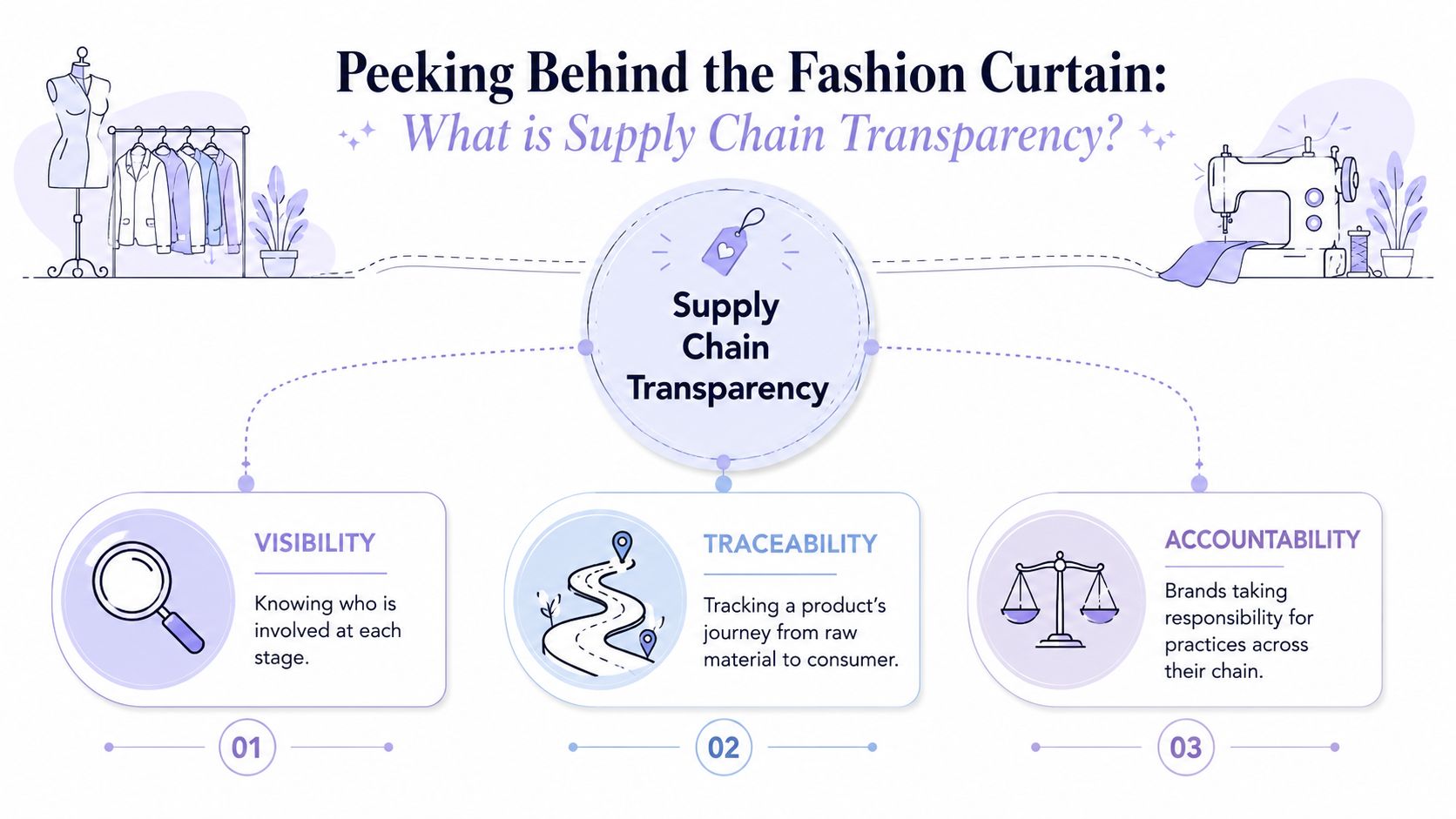
If supply chain transparency is the secret story, then traceability is the thread that lets you follow it, and sustainability is the reason you care where it leads.
I like to think of it as the recipe for your clothes. A recipe doesn't just tell you that a cake contains flour, butter, and eggs. A very good recipe tells you where the flour was milled, whether the eggs came from a nearby farm, who baked the sponge, and whether the kitchen is clean. Fashion works the same way.
The recipe for a garment
A transparent brand shares information openly. That might include the names of factories, where fibres were sourced, what standards suppliers follow, and how the brand checks that information.
Traceability is narrower. It's the practical ability to track a product through its stages, from raw material to finished piece. A brand may be able to trace a wool yarn back through spinner and farm, for instance.
Sustainability is broader still. It includes environmental care, working conditions, durability, waste, and long-term business choices. Transparency doesn't guarantee sustainability, but it makes sustainability claims easier to test.
What openness looks like in practice
The most useful transparency has texture. Not vague language like “ethically made” floating on a product page like perfume in the air. Specifics.
A shopper should be able to tell, at minimum, whether a brand is naming the people and places behind the product, or merely wrapping the garment in pretty adjectives. The difference is enormous.
Here's a simple way to separate the terms:
| Term | What it means | What it looks like |
|---|---|---|
| Transparency | Sharing information openly | Public supplier lists, reports, policies |
| Traceability | Tracking the product journey | Material origin records, batch tracking, QR links |
| Sustainability | Improving social and environmental outcomes | Better materials, fairer labour practices, longer-lasting design |
Where many brands still lose the thread
One of the clearest gaps appears between the first visible layer of production and the deeper origins of a garment. The gap between tier-1 factory transparency and raw material traceability hides modern slavery risks in the UK fashion supply chain. While 70% of UK brands disclose tier-1 suppliers, only 12% trace materials to raw origin, according to Unseen UK's analysis of modern slavery in fashion.
That means a brand may tell you where a piece was sewn, yet still know far less about the cotton field, wool processing, dye inputs, or subcontracted steps further back. The front cover of the book is visible. Several important chapters are still glued shut.
Practical rule: If a brand can name the final factory but can't say much about the fabric or fibre origin, the story is only partly told.
Why Transparency Weaves a Better World
The moral case for supply chain transparency begins with people, not paperwork. Clothes are intimate objects. We wear them on our skin, to work, to dinners, to funerals, to birthdays. It should matter a great deal whether the people who made them were safe and treated with dignity.
The scale of abuse behind opaque supply chains is sobering. The International Labour Organization estimates that 27.6 million people globally, including 3.3 million children, are in situations of forced labor, a figure highlighted in the UK government's practical guide on transparency in supply chains. When brands can't see into their own supply networks, exploitation finds dark corners to settle in.
For people
Transparency helps brands ask better questions and face sharper answers. Who is making this garment? Who is subcontracted? Who is invisible? If a supplier list is public, if audits are reviewed, if contracts include human rights expectations, then abuse becomes harder to hide.
That doesn't mean every published list solves the problem. It means silence stops being acceptable.
A clear supply story also changes internal behaviour. Buyers, designers, operations teams, and marketers have to work from the same map. That shared view creates accountability. It's much harder to gloss a campaign with gentle language when the underlying story is specific enough to be checked.
For the planet
Environmental claims need roots. If a brand says a fibre is responsibly sourced, there must be a way to connect that claim to place and process.
This is why transparent systems matter far beyond fashion. In sectors wrestling with materials, sourcing, and lifecycle impacts, the same principle applies. If you're interested in how another manufacturing field approaches openness, Crayex's work on sustainable film manufacturing is a useful parallel. Different product, same central lesson. Claims mean more when the chain behind them is visible.
A fabric cannot be called thoughtful simply because the label sounds poetic. Someone has to show the working.
For trust and resilience
Transparency also protects a brand's integrity. In the UK, the Modern Slavery Act has moved this from optional virtue to regulatory expectation. The Home Office updated its guidance so that commercial organisations with annual turnover of £36 million or more must produce and publish an annual transparency in supply chains statement, and failure to comply can result in a Section State injunction, as explained in Travers Smith's summary of the updated statutory guidance.
Trust is built in the same way a good coat is built. Layer by layer, with no corners cut where nobody's meant to look. Brands that want to make that trust visible often start by setting out their principles publicly, as on a dedicated sustainability page, then strengthening the evidence beneath those promises over time.
A Brand's Guide to Weaving Transparency
A brand doesn't become transparent in one grand flourish. It happens in stages, rather like knitting a cable jumper. You don't throw all the wool in the air and hope it forms a pattern. You follow the line of the stitch.
The first useful step is simple. Stop thinking only about the final factory. A real supply story begins earlier and branches wider.
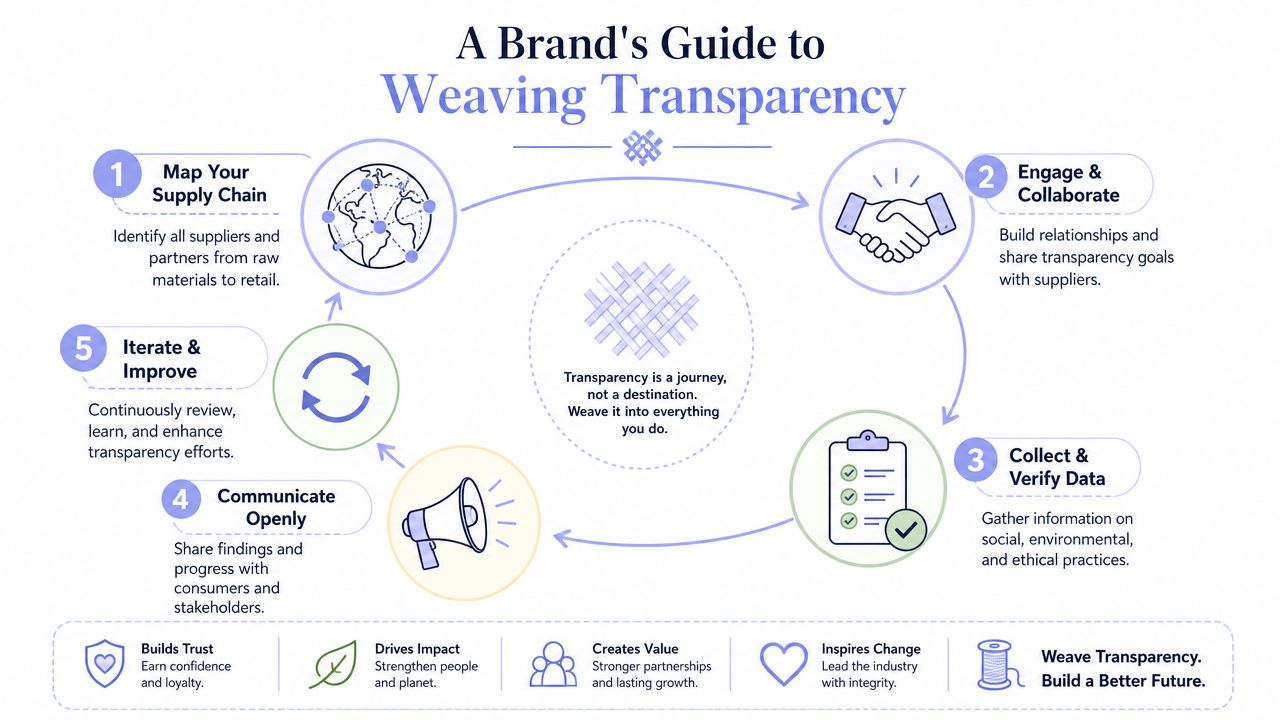
Step one, map the journey
Write down every known stop in a product's life. Fibre source. Spinner. Mill. Dyer. Factory. Finisher. Warehouse. Packaging partner. If there's a gap, mark it as a gap instead of pretending it isn't there.
That map becomes the draft manuscript of the garment's story. Without it, every later claim rests on fog.
Step two, meet the makers
Supplier relationships can't live entirely in inboxes. Visits, calls, audits, photographs, process notes, and repeated conversations matter because people often reveal the most important truths in the details. A workshop may meet a paper requirement while still relying on unclear subcontracting. A farm may have excellent animal welfare but weak record-keeping.
When you can't visit in person, bring independent checks into the process. Ask for evidence. Ask again when it changes.
Step three, collect proof that can travel
In the UK, environmental claims have to stand on more than mood boards. The Green Claims Code mandates that environmental claims must be verified and backed by transparent data. Brands are encouraged to disclose machine-readable supplier lists including details like worker demographics and the lowest wage paid per factory, as outlined in the UK sustainable fashion market report.
That sounds technical, but the principle is plain. If you say something meaningful, keep the receipts.
A small comparison helps:
| Brand behaviour | What it signals |
|---|---|
| “Responsibly made” with no detail | Marketing language |
| Named suppliers and documented standards | Evidence in progress |
| Public updates when information changes | Ongoing accountability |
For another angle on honesty in business communication, this practical pricing transparency guide is worth a look. It deals with pricing rather than garments, yet the lesson carries neatly across. Clarity builds confidence.
Step four, use modern magic carefully
Technology can help, as long as it isn't used like glitter to distract from weak fundamentals. QR codes, digital product passports, shared databases, and document platforms can make information easier to update and easier for customers to access.
A short film can often explain that journey more clearly than pages of policy language:
Still, a QR code is only as honest as the records behind it. Technology is the lantern, not the light source.
Step five, share the story plainly
Publish what you know. Say what you don't know yet. Update both.
Brands that want to move beyond aspiration often do well to define their values in public and connect them to product decisions, repairability, material choices, and supplier relationships. A thoughtful example of that broader mindset sits in this piece on what makes a conscious clothing brand.
The strongest transparency reports don't sound like victory speeches. They read like field notes from a brand paying attention.
How to Read a Garment's Story
Shoppers don't need a detective's pinboard to spot the difference between substance and theatre. Usually, the clues are right there on the brand's website, product pages, and labels.
A brand that has done the work tends to leave a trail. A brand that hasn't often speaks in clouds.
Start with what the brand publishes
The Fashion Transparency Index evaluates brands using 258 indicators, and points are awarded only for publicly disclosed information. It also sets out a useful benchmark for best practice. Brands should publish annually updated factory lists in machine-readable formats with details such as address, parent company, and worker counts.
That's a helpful shopper's rule too. If information isn't public, you can't assess it. You're being asked to trust a locked diary.
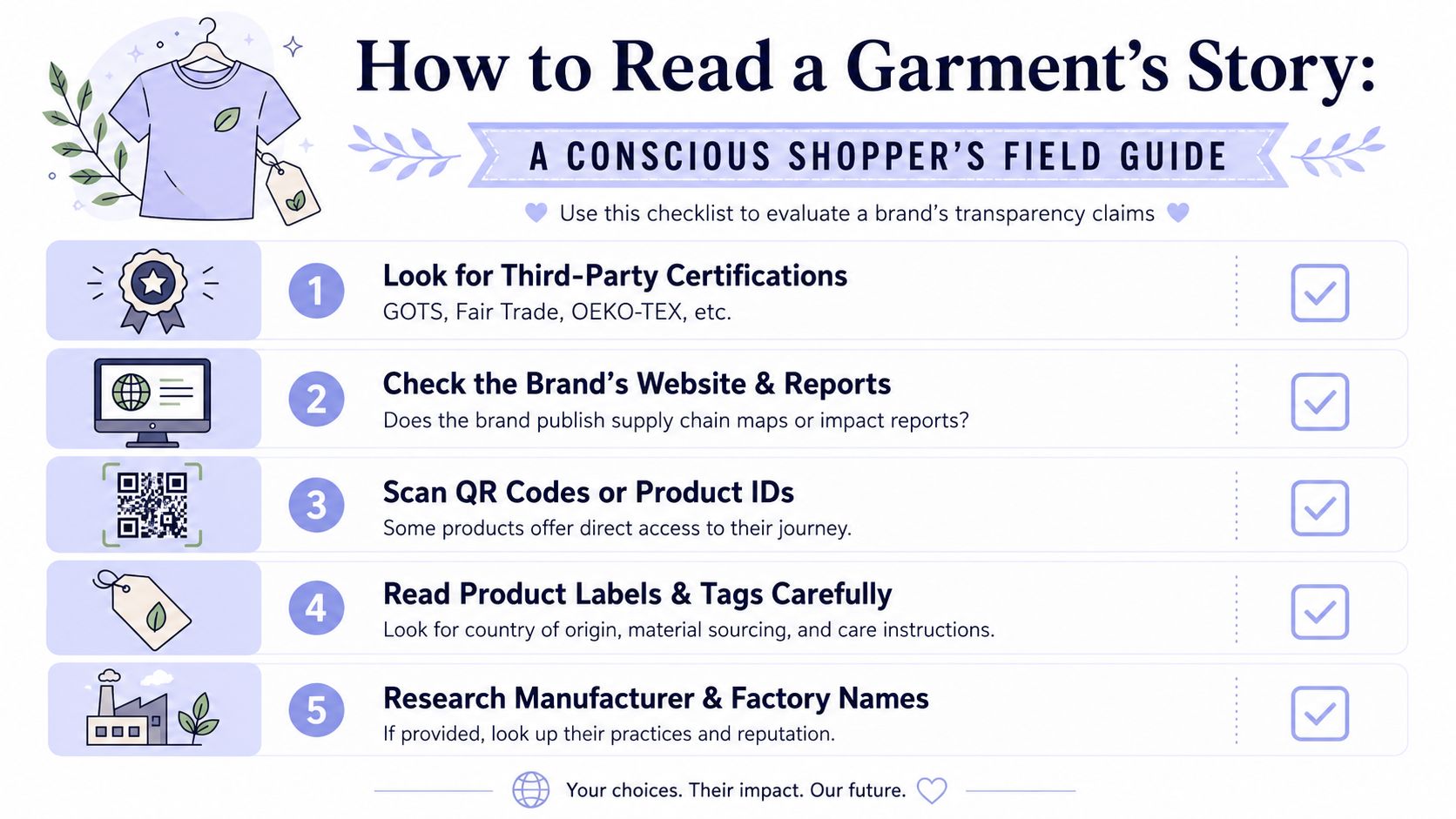
Five things to look for
- Named factories: Look for actual facility names and locations, not soft phrases like “trusted partners”.
- Material origin details: See whether the brand says where wool, cotton, linen, or alpaca fibre begins.
- Updated information: Check whether reports or supplier lists appear current rather than forgotten in an archive.
- Specific standards: Search for clear manufacturing expectations, audit references, or recognised certifications.
- Product-level clues: Labels, tags, and QR codes can reveal whether the story is tied to an individual item or only to the brand in general.
Red flags hidden in lovely language
A brand may write beautifully and still tell you very little. “Consciously crafted”, “thoughtfully sourced”, and “planet-minded” can all be true in spirit, but they aren't proof.
Look for the nouns. Factory names. Fibre names. Place names. Dates. Public policies. If the language never lands anywhere concrete, the story is still wearing a veil.
If a brand offers details that you could independently check, it's inviting scrutiny. That's usually a good sign.
For shoppers who want a stronger framework for assessing claims around labour and sourcing, guidance on ethical manufacturing standards can help turn instinct into a more careful practice.
Our Journey Toward a Clearer Story
No brand begins with a perfect map. Most start with a handful of close relationships, a few blank spaces, and a growing sense that the blank spaces matter.
That's especially true for smaller labels and independent makers. One season may be spent establishing trusted suppliers. Another may be spent learning how to document those relationships properly. If a brand works with natural fibres, local mills, and specialist makers, the story can be rich but scattered, like a box of old letters waiting to be sorted.
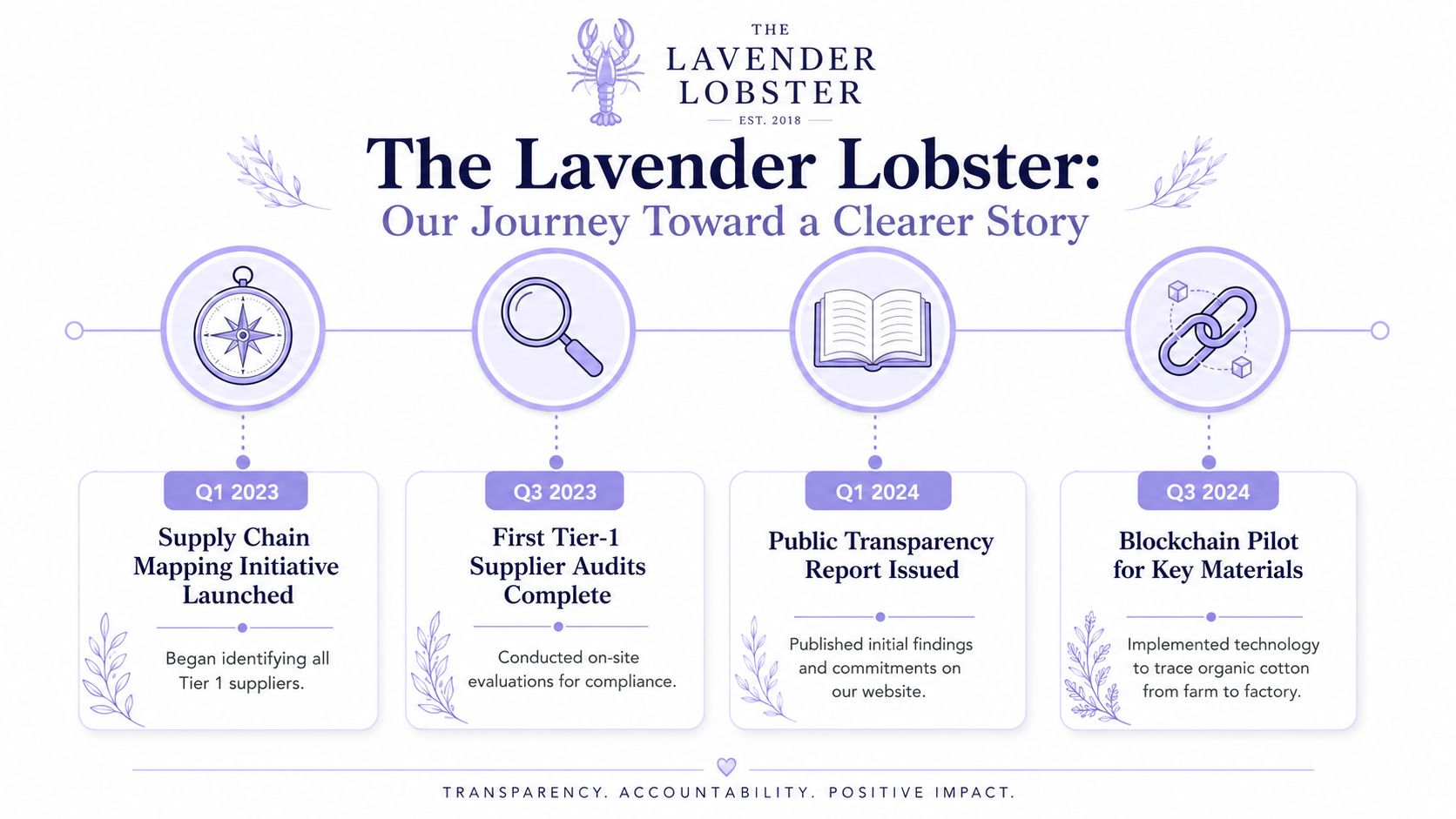
What a humble roadmap looks like
The most honest approach is to treat transparency as an unfolding plot, not a polished fairy tale. A brand might begin by naming tier-1 makers and documenting finished-garment production. Then it might move upstream into yarn sourcing, dye houses, and raw fibre origins. Later still, it might improve how this information is shared with customers through product pages, public reports, or digital tools.
That matters because stronger transparency usually requires deeper visibility. According to Asuene's overview of modern slavery and supply chain transparency, leading firms trace beyond tier-1 suppliers to include tier-2 and tier-3 subcontractors and raw material sources, often using third-party social audits or blockchain-based traceability systems to monitor conditions from origin to final product.
Making room for different kinds of fashion
Transparency doesn't belong only to newly manufactured garments. Circular and second-hand businesses need their own version of the practice too, especially when they're describing provenance, condition, repair, and sourcing choices. Anyone exploring that side of the industry may find this guide on how to start a UK vintage clothes business useful because it touches the practical realities of building trust around garments with previous lives.
A thoughtful public roadmap often sounds like this:
- First chapter: We can name our direct makers and explain our materials.
- Next chapter: We're documenting the processes behind those materials more carefully.
- Later chapter: We'll publish clearer updates and improve how customers can verify them.
That kind of language is modest. It's also believable.
Wearing a Story You Can Cherish
A transparent garment feels different because it carries more than design. It carries context. You know a little more about the field, the farm, the workshop, the spinner, the finisher, the decisions made in bright rooms by people whose names needn't disappear for the clothes to shine.
That's why supply chain transparency matters. It changes fashion from a trick of presentation into a relationship. It asks brands to be braver with the truth and shoppers to be more curious with their choices.
The hopeful part is this. Transparency doesn't require perfection before anyone speaks. It requires honesty, improvement, and the willingness to pull back the curtain inch by inch. A brand can begin with one fibre, one factory list, one supplier conversation, one clearer label. A customer can begin with one better question.
If you're choosing what to wear, choose stories that can bear daylight. If you're building a brand, write those stories plainly enough that someone else can follow the thread.
And if you'd like to see how whimsical design and responsible practice can live side by side, explore The Lavender Lobster and its collection of enduring pieces, from the Lobster Bisque Dress to the Après Ski Cardigan and Sailor Scarf, all shaped by a gentler idea of getting dressed.