

The till is beeping, the queue is growing, and your essentials have formed a tiny rebellion. Your phone is wedged against a tired purse, a loyalty card has slipped beneath your sunglasses case, and the keys have caught themselves in the strap of your tote. Somewhere between the stationery shop and the pavement, you're holding too many objects and somehow still searching for the one you need.
A wallet with key ring brings those loose pieces into one small, tactile anchor. It can hold cards, a folded note and keys on a single loop, giving your hand fewer things to remember and your bag a little less quiet chaos. The object is practical, but it can also carry colour, texture and a hint of mischief, like a tiny brass moon clipped to your everyday life.
The Quiet Chaos in Your Bag Right Now
The brown leather purse has softened at the corners. The tote smells faintly of rain, paper and the mint you forgot you bought. At the stationery counter, you pull out a receipt, a packet of pencils and one lonely glove before the house keys finally appear, still tangled in the canvas strap.
That moment isn't dramatic. It's tiring. Your everyday carry has outgrown the pocket, while the usual solutions ask you to choose between a bulky purse, a separate key fob and a pouch that disappears into the bottom of the bag.
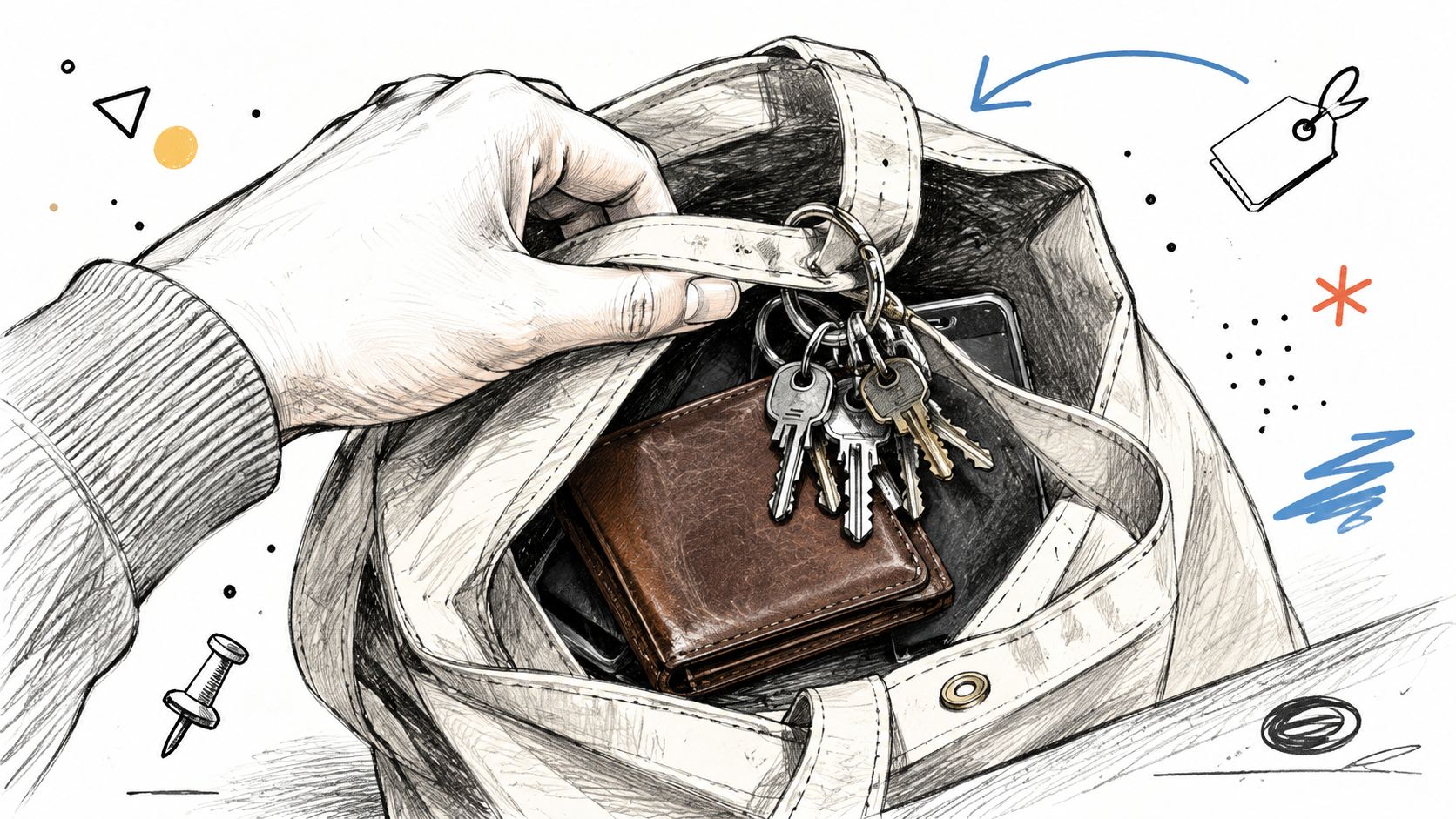
A wallet with key ring answers that particular friction with a simple arrangement. Cards stay in their slots, a banknote can fold into the main compartment, and keys hang from the attached loop instead of hiding among hand cream and receipts. Clip the wallet inside a tote, fasten it to a belt loop or let it sit at the front of a canvas tote bag, where your hand can find it without a rummage.
The small luxury: knowing exactly where the keys are before you reach the door.
The best version won't make your life look like a catalogue spread. It will make the next small movement easier, whether that's tapping through a station gate, opening a shared front door or paying for a notebook. The rest of this guide turns that little moment of friction into a considered, charming choice.
What a Wallet with Key Ring Actually Is
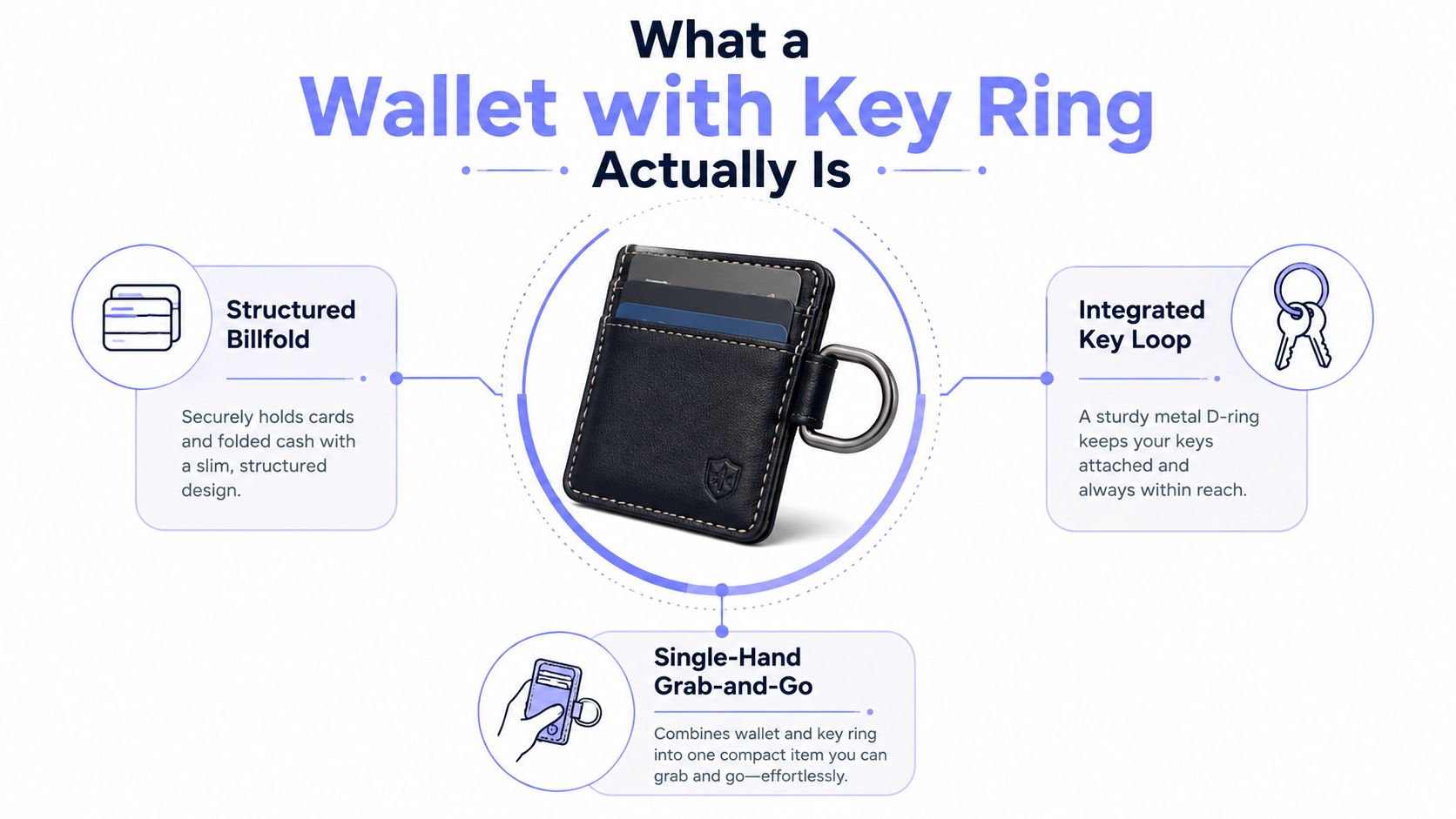
Think of it as a compact billfold or cardholder with a metal attachment built into the design. That attachment might be a D-ring, split ring or swivel clasp, holding house keys, a key fob or even a small bag charm.
The first format looks familiar. A bifold or cardholder keeps its card slots and folded-note space, while an integrated ring sits at one edge. The second is more pared back, often using a snap strap or wrap-around leather piece that threads keys onto the wallet's spine. Both designs create the same useful relationship: the thing that opens the door travels with the thing that holds the card.
The useful distinction
A keyring wallet isn't a full handbag in miniature. It won't replace a large purse if you carry cosmetics, receipts, coins and a small library. Nor is it automatically a tracker or digital wallet. It's a small carry system, designed to gather the essentials you reach for most often.
That distinction matters when you're shopping. A slim cardholder with a ring suits a light daily load. A zipped style gives more protection for coins or small objects. A snap-strap version can be especially pleasant if you like the satisfying ritual of unfastening, threading and closing the piece before leaving the house.
The word “wallet” also covers more than one shape. If you're organising papers for a parcel or office errand, a resource such as document enclosed wallets belongs to a different category entirely. A wearable wallet with key ring is for personal carry, not document dispatch.
The mood can be as gentle as the function. Pair one with a natural-fabric wardrobe, perhaps alongside The Lobster Bisque Dress, made from 100% organic linen with a soft organic cotton lining. The wallet becomes less like a gadget and more like a small coastal token, useful, touchable and ready to follow you out the door.
Key Features Worth Choosing Carefully
The right wallet with key ring depends on the life it has to accompany. A commuter who cycles through drizzle needs a different balance from someone who carries two slim keys and a contactless card to the village shop.
| Feature | What to Look For | Best For |
|---|---|---|
| Material | Full-grain leather, vegan leather, waxed canvas or recycled nylon | Matching texture and weather needs |
| Ring type | Split ring, D-ring, swivel clasp or lobster claw | Choosing between permanence and quick removal |
| Construction | Edge-painted seams, rivet reinforcement or secure stitching | Frequent handling and loaded bags |
| Security | Zipped coin pocket, hidden card slot or screw-closed ring | Keeping small contents contained |
Material. Full-grain leather develops a changing surface and can feel warmer in the hand, while vegan leather, waxed canvas and recycled nylon offer different approaches to texture, maintenance and animal-free design. Look for precise labelling rather than poetic material language. UK guidance says product labels must not mislead shoppers about what an item is made of, how it was made or what it can do, as explained in the government's product labelling guidance.
Ring type. A split ring is a dependable choice when keys can stay attached, but it takes more effort to remove them. A swivel clasp or lobster claw gives quicker access, which is handy if you move the wallet between bags. A D-ring creates a stable anchor, especially when the wallet is clipped inside a tote.
Construction. Edge-painted seams can protect exposed leather edges, while reinforced stitching or rivets help at the point where the ring meets the wallet. Run a finger over the join before buying. That small patch takes repeated tugging, twisting and the weight of every key.
Security. A zipped pocket prevents coins from escaping into the lining, and a hidden card slot can reduce accidental slips. For a ring that needs to stay attached, a screw-closed fitting offers a more deliberate fastening than a simple open clasp.
Practical rule: choose the feature that solves your most common nuisance, not the feature list that looks longest.
For UK use, materials matter in a particularly unglamorous way. Key-holding suppliers commonly use stainless steel or aircraft cable because corrosion resistance, tensile durability and tamper detection affect daily reliability. A tamper-resistant key-fob example shows how flexible cable and a locking mechanism can work together, while stainless-steel interlocking rings are used where secure key retention is the priority.
Who Truly Needs One and When It Shines
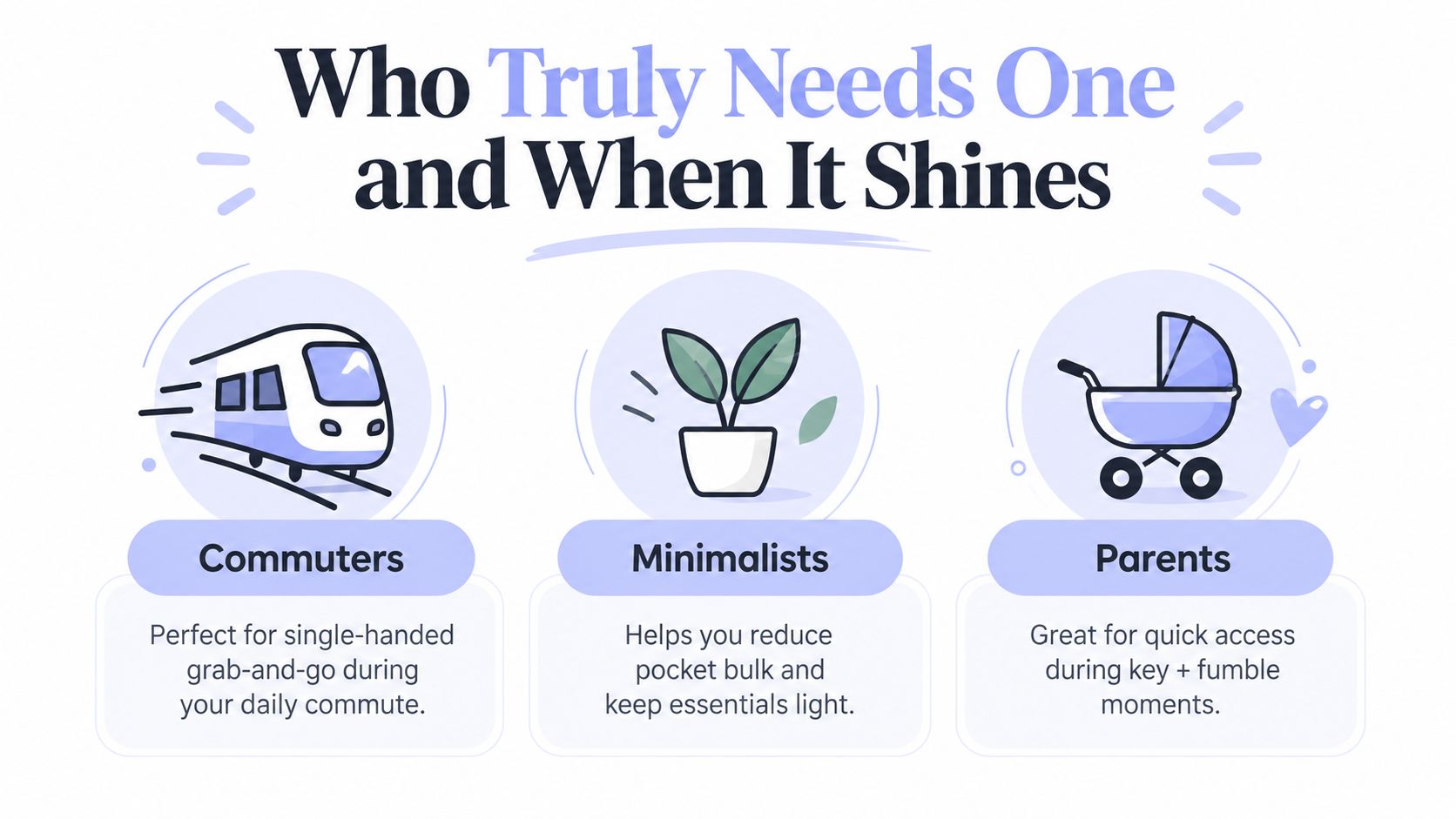
A wallet with key ring earns its place most clearly in commuting, travel and gifting. Those situations create repeated moments where one-handed access matters more than having every possible compartment.
The Northern Line is a useful test. You're balancing a tote, a coffee and your phone, while a station gate waits for a card. A compact wallet with the house keys attached can sit at the front of the bag, so you can retrieve the card and keys together instead of fishing through fabric with your elbow pinned to your side.
Three lives, three useful moments
For commuters, the appeal is alignment. A house key, travel card and folded banknote can occupy one grab point, which reduces the number of objects competing for attention at a gate or front door.
For travellers, a detachable ring is the star. It can move from a day bag to a belt loop, keeping door keys and small essentials close while passport-adjacent items remain in the place you've chosen for them. At a security checkpoint, a smaller organised bundle is easier to handle than a loose collection of pockets and pouches.
For gift-givers, the object arrives with a little of the recipient's story already attached. Their existing keys personalise it without embroidery, initials or guesswork. A wallet with key ring can suit a new job, a housewarming or a shared-living milestone because the practical meaning changes with the keys it carries.
Parents and minimalists may also appreciate the same quick-access shape, especially during the famous key-plus-fumble moment outside a nursery, flat or car. The point isn't that everyone needs one. The point is that it shines when the distance between “I have it” and “I can reach it” keeps causing irritation.
Here's the object in motion, with a visual explanation of its everyday role:
Styling and Gifting with a Whimsical Touch
On a Cornish morning, a cream linen midi dress moves around battered Converse, while a clotted-cream leather wallet ring swings from a canvas shopper. The metal catches the pale light for a second, like a tiny piece of seaside treasure, then disappears among a paperback and a packet of oat biscuits.
The styling works because the wallet doesn't fight the outfit. It adds a useful point of texture, especially when the rest of the look is soft, washed and natural. The same principle applies to a flower crossbody bag, where a small accessory can make practical carry feel more personal without becoming costume.
Three little wardrobe stories
At a Hampshire lunch, soft stone trousers meet a fisherman jumper and an oxblood keyring wallet clipped to a belt loop. The colour is deep but not formal, the sort of detail that looks as though it has been found in a wooden drawer and carried for years.
For a London birthday dinner, a black slip dress, gold hoops and a polished chrome wallet ring catch the candlelight. It replaces the need to carry a larger purse when all you want is a card, a key and enough room for the evening to remain pleasantly unencumbered.
A gift can follow the same mood. Wrap the wallet in unbleached muslin, tie it with a simple ribbon and add a handwritten tag for a new-job congratulations, a housewarming or an unexplained “just because”. The recipient's own keys complete the object, so the present feels personal without requiring you to know their exact taste in monograms.
The charm question
Bag charms have made visible personalisation feel playful again. UK fashion coverage has reported Pinterest searches for bag charms increasing sevenfold, while Lyst saw demand for bag charms and embellished bags rise 352% month-on-month, as reported by Harper's Bazaar UK. Those figures belong to the wider accessory conversation, but they help explain why a keyring wallet can feel more expressive than a plain cardholder.
Choose one with a contrasting ring, a woven tab or a colour that peeks out from the bag. The whimsy should remain wearable, seasonless and useful, not become another short-lived ornament waiting for a trend to move on.
Care, Longevity and Conscious Carry
Care works best as a ritual attached to an existing moment. Friday evening is ideal. Empty the ring, remove the cards and receipts, then wipe the leather with a barely damp cloth before buffing it gently and leaving it to air-dry away from radiators.
A radiator can dry leather unevenly and make the surface feel brittle. Give the wallet time to settle naturally while you make tea, put away the week's receipts or let a small imaginary lobster supervise from the windowsill.
A simple maintenance rhythm
- Every Friday: Empty the compartments and check that the ring attachment hasn't loosened, twisted or developed a sharp edge.
- Every few months: Work a pea-sized amount of neutral leather balm into the surface with a soft cloth. Use a light touch, and test an inconspicuous area first.
- When the metal feels stiff: Rub the ring with a jewellery polishing cloth. This helps keep the moving parts clean and turning smoothly.
- When the week is over: Store the wallet flat in a dust bag and let it rest overnight. If you own a second piece, rotate rather than overloading one item.
The ring deserves attention because it experiences a different kind of wear from the wallet body. Keys scrape, metal rubs against metal and damp weather can make neglected fittings feel rough. Stainless steel and aircraft cable are common choices in UK key-holding products because corrosion resistance and tensile durability support repeated use, but no material makes careless storage irrelevant.
A good care ritual is small enough to repeat and gentle enough to enjoy.
Conscious carry also means asking what happens after daily use. Vegetable-tanned leather can offer a material story that changes with handling, while repair-friendly stitching makes it easier to address a worn seam instead of discarding the whole piece. For end-of-life decisions, check local UK recycling routes and the maker's own guidance, because mixed materials, metal fittings and coated surfaces may need different treatment.
Product Page Pointers and a Final Thought
A product page should answer the practical question before it adds the sparkle. Use a title such as “Wallet with Key Ring for Everyday UK Carry”, keeping the focus phrase clear and compact, and write a meta description under 155 characters that names the material, attachment style and everyday purpose.
The page should also include:
- Materials: State the exact outer and lining materials.
- Ring type: Say whether it uses a split ring, D-ring, swivel clasp or lobster claw.
- Dimensions: Give measurements so shoppers can compare it with their existing bag or pocket.
- Origin: Explain where it was designed or made, using precise wording.
- Use and care: Show how the ring attaches, then add a short cleaning note.
Alt text should describe the image rather than decorate it. Useful examples include “brown leather wallet with keys inside a canvas tote”, “black cardholder with integrated D-ring” and “close-up of wallet ring attachment clipped to a bag”.
A short “why you'll love it” list can hold the warmer details, such as a tactile finish, a pleasing clasp sound or a colour that makes a weekday outfit smile. Natural search phrases including keyring wallet UK can appear where they help, rather than being scattered like confetti.
For a considered browse, place the piece beside other small carry ideas in The Lavender Lobster accessories collection. A wallet with key ring is a tiny, wearable anchor, not another object demanding attention. It keeps the essentials together, leaves room for personality and makes the front-door moment feel just a little less frantic.
Questions Worth Asking Before You Buy
Is it secure for Oyster and contactless cards?
It can be, provided the wallet has a properly sized card slot and closes securely. Keep cards flat, avoid overfilling the compartment and follow the card issuer's guidance if the design includes RFID-blocking material. A physical wallet complements digital habits rather than replacing them. UK Finance reports that 57% of UK adults used mobile wallets in 2024, up from 42% in 2023, and 65% were registered for at least one mobile payment service in 2025, as recorded in its UK mobile wallet update.
How do I stop the ring scratching my phone?
Use a swivel clasp or place the wallet in a separate tote pocket rather than letting keys and phone share the same loose space. A small fabric sleeve can soften contact, but the simplest solution is creating two neighbouring homes instead of one crowded one.
Which ring suits chunky Yale keys or slim smart keys?
Chunky Yale keys usually need a sturdy split ring or reinforced D-ring with enough clearance to turn freely. Slim smart keys may work better with a swivel clasp, especially if you want to remove them quickly without disturbing the cards.
Can I take it in hand luggage at UK airports?
A wallet itself is normally treated as a personal carry item, but airport security rules and directions can vary. Keep keys attached, place the wallet where it's easy to remove if asked and check the current guidance from your departure airport before travelling. For another small, calendar-friendly gift idea, Essentia Perfume's cologne calendar follows the same principle of making an everyday ritual feel a little more enchanting.
Choose a wallet with key ring based on the moment you want to make easier. Browse the materials, test the attachment point, select a colour that belongs in your wardrobe and give the piece a small Friday-evening care ritual from its first week. Then let it carry your keys, cards and a little wearable whimsy wherever the day takes you.