

You're in a fitting room with a navy wool jumper over one arm and a charcoal synthetic cardigan over the other. They cost the same. Both look polished in the mirror. The question isn't which feels nicest for five minutes under flattering lights. It's which one will still earn its hanger after next winter, several washes, damp commutes and the occasional forgotten coffee spill.
That's the useful way to approach wool vs synthetic fibres. Look beyond warmth and price, then follow each garment through a whole wearing cycle: comfort, moisture, odour, durability, care, microfibre shedding, repair and end-of-life recycling. My verdict is clear, but it isn't a blanket win. Wool is the stronger everyday choice for changing British conditions, while synthetics remain excellent for fast-drying travel pieces and high-output sport.
Two Jumpers, One Wardrobe Decision
The navy wool jumper has a quiet confidence. It sits neatly at the shoulder, feels springy rather than limp and promises warmth without looking bulky. The charcoal cardigan is lighter in the hand, smooth against the fingers and easy to imagine washing before a morning flight. You check the labels again, as though one of them might suddenly confess what happens after a year of real life.
A woman in her thirties could reasonably choose either. The cardigan may dry quickly in a hotel bathroom and shrug off rough handling. The wool jumper may feel more comfortable when the day swings from a cold platform to an overheated office. Neither fibre guarantees a perfect garment. Construction, fibre quality, fit and care matter as much as the label.
The British wool story also sits inside a market where natural fibres are no longer the default. The UK government's British Wool Review records that synthetic fibres made up 62% of world fibre production in 2020, compared with 24% for cotton and less than 1% for wool. The UK accounted for 3% of global wool production in 2019, so British supply is small beside the scale of synthetic production. The review links synthetic growth with pressure on wool prices and lower returns for producers, a reminder that fibre choice reaches into rural livelihoods and market structure. The University of Glasgow's wool history project provides that wider context.
This guide weighs the fibres as they behave in your wardrobe, not as they appear in a product description. You'll get practical recommendations for commuting, travel, sensitive skin, sport and office dressing, followed by wash-stage habits that reduce waste and help either garment last.
What Wool and Synthetic Fibres Actually Are
Start with the raw material, because the chemistry explains much of the behaviour.
Wool is a protein-based animal fibre. It includes British sheep wools such as Bluefaced Leicester and Shetland, as well as alpaca, a South American camelid fibre now increasingly farmed in the UK. Wool fibres have a scaly cuticle and natural crimp, meaning a fine wave along their length. Alpaca fibres are often valued for their softness and hollow core.
That crimp creates small pockets of still air between fibres, which is why a lofty wool knit can insulate without relying solely on thickness. A hollow core also helps alpaca hold air while keeping the fibre relatively light. The result is a material that feels warm, but not necessarily heavy or dense.
Synthetics are manufactured fibres, generally made from petrochemical-derived polymers. Polyester dominates synthetic knitwear, acrylic is engineered to imitate some of wool's softness and appearance, and nylon is frequently added to blends for strength and abrasion resistance. These fibres can be extruded into filaments or cut into staples before being spun or knitted.
Their plastic chemistry changes the way they handle moisture. Synthetics generally move water across the surface rather than absorbing vapour into the fibre, so a well-designed polyester layer can dry quickly. The same low absorption can leave perspiration sitting against the skin, especially when the fabric structure isn't sufficiently open or breathable.
Fibre vocabulary matters when you're comparing garments. “Wool blend” could mean a mostly wool knit with a little nylon for resilience, or a mostly acrylic garment with enough wool to support a cosy marketing line. Check the fibre percentages before you decide which properties you're buying.
The same principle applies to other textile objects made with care. The Sailor Hats are made to order from offcuts of larger garments, giving fabrics a second life, and each piece is individually made by UK seamstresses. For household wool items, specialist handling can also be sensible, so keep a carpet cleaner for wool rugs in mind when a delicate wool surface needs more than routine attention.
Head-to-Head Performance in Real Wear
The most revealing comparison happens on the body, not on a fibre chart. A jumper needs to cope with heat, movement, dampness and changing indoor conditions in the same day.
Warmth and breathability
Wool and alpaca trap still air through their crimp and loft. They're particularly good at keeping warmth close when you're standing on a windy platform or sitting still in a draughty room. A lofty polyester fleece can also perform strongly in calm, dry cold, especially when its construction creates plenty of air space.
Wool's advantage becomes more obvious when conditions change. Its protein structure can absorb water vapour and release it gradually, helping buffer humidity swings. Polyester and other synthetics can move sweat rapidly across the surface, but a dense or poorly ventilated knit may leave heat and perspiration feeling trapped.
The 2026 UK bedding study found that wool duvets had the lowest thermal conductivity among the materials tested and provided 25% better insulation than synthetic duvets. The study also found that wool transmitted moisture more efficiently through the filling, which supports the case for wool in bedding and other situations where thermal stability matters. The Wool Bedding Report is especially relevant to British homes, where damp and variable conditions are common.
Moisture and odour
Synthetic fibres win the first impression after a sweaty walk. Polyester wicks moisture along its surface and can dry quickly, which is useful when you need to wash a top overnight or keep moving during a run. In heavy rain or sustained perspiration, though, surface wicking can reach its limits and the fabric may feel wet against you.
Wool behaves better. It manages moisture within the fibre and can remain comfortable as your temperature rises and falls. Its keratin structure also binds odour molecules, whereas synthetics are more likely to retain oily smells. That matters in a work wardrobe, on a long journey and anywhere you'd rather not wash a garment after every wear.
Durability and hand-feel
Quality synthetics usually resist abrasion, snags and repeated machine washing. Nylon is especially useful in blends where a soft fibre needs reinforcement. Wool can pill, but its fibres have natural recovery and a well-made knit can remain wearable for years when washed gently and repaired early.
Feel is personal, but the difference is easy to notice in damp weather. Wool and alpaca tend to maintain a warm, dry hand-feel across changing temperatures. Synthetics may feel perfectly smooth when dry, then clammy when moisture collects at the skin.
For a breathable natural-fibre reference outside knitwear, The Lobster Bisque Dress is made from 100% organic linen with a soft organic cotton lining. It isn't a wool substitute, but it demonstrates the same design priority: comfort should come from the fibre and construction, not from a glossy promise.
Reading the Comparison Without Being Misled
A table helps you compare quickly, but it flattens the details that decide whether a garment feels good at eight in the morning or miserable by lunchtime.
Wool vs synthetic performance side by side
| Performance Factor | Wool, British Alpaca and Sheep | Synthetics, Polyester, Acrylic and Nylon |
|---|---|---|
| Warmth | Strong insulation from crimp, loft and trapped air | Strong in lofty fleece and structured knits, especially in dry cold |
| Breathability | Buffers moisture vapour and temperature changes | Depends heavily on knit structure, often moves sweat quickly across the surface |
| Moisture | Absorbs vapour and can stay comfortable as conditions change | Wicks on the surface and dries quickly, but may feel clammy when saturated |
| Odour | Naturally holds and releases odour molecules during washing | More likely to retain oily odours, especially after repeated wear |
| Durability | Can last well with gentle care and timely repairs | Usually strong against abrasion and frequent washing |
| Feel | Warm, springy and adaptable, with softness varying by fibre quality | Smooth and consistent, but can feel plastic or damp against the skin |
| Care | Needs cooler washing, careful drying and thoughtful storage | Easier to machine wash, but still benefits from lower heat and thorough rinsing |
The table can't tell you how much crimp and loft a particular jumper has. A lightweight, springy knit may insulate better than a heavier, tightly compressed one. Raw garment weight isn't enough. Nor is the word “wool” on the front of a label.
Merino shifts the wool verdict towards softness and next-to-skin comfort. Alpaca shifts it towards a smooth, light and often less prickly hand-feel. Acrylic can look convincing and feel soft when dry, but it doesn't reproduce wool's moisture buffering. Nylon adds resilience, which can make a carefully balanced blend practical for everyday wear.
A “contains wool” claim deserves scrutiny. A 70/30 wool-synthetic blend is not automatically a wool-led experience if the ratio is reversed. The larger fibre share usually determines what you feel, wash and live with, while the smaller share modifies durability, stretch or drying time.
Label-reading rule: Check the fibre percentages, then inspect the knit density, seams and care instructions. The word “wool” alone tells you too little.
A polyester mid-layer may feel dry at first on a crowded Northern Line journey, then hold perspiration as the carriage warms. A wool layer may feel less dramatically quick-drying, yet stay more stable when you step back into cold air. For Britain's stop-start weather, I'd choose wool for daily layering and reserve synthetic performance pieces for jobs where fast drying matters most.
Choosing the Right Fibre for How You Live
Your routine should decide the fibre, not a blanket rule about what is fashionable or virtuous.
For the daily commute
A commute that combines a cold platform, a warm Tube carriage and an overheated office is wool territory. Fine merino or alpaca can buffer those temperature swings more gracefully than a dense polyester cardigan. Choose a breathable knit with enough structure to hold its shape, then wear it over a light base layer rather than buying one bulky jumper to solve every temperature.
Recommendation: Choose merino for close layering and alpaca for a softer, lighter outer knit.
For travel
Travel rewards practicality. A synthetic top can be washed in a hotel sink, dry quickly and tolerate being folded into a crowded case. That makes polyester or nylon sensible for active itineraries, humid destinations and journeys where you know the garment will need frequent washing.
Wool earns its space when you want to pack fewer changes and expect variable temperatures. It's especially useful for flights, train journeys and sightseeing days where you alternate between stillness and movement.
Recommendation: Pack a quick-drying synthetic for high-use basics, then add one odour-resistant wool layer for changing conditions.
For reactive or sensitive skin
Don't assume every natural fibre will feel gentle. Coarse wool can irritate, while fine worsted merino and soft alpaca can feel smooth and comfortable. Acrylic may also feel soft initially, but some people find it traps heat or develops a static, clammy sensation.
Try the garment against the inside of your wrist or wear a thin base layer beneath it before committing. Construction matters too. Rough seams and loose fibres can cause irritation regardless of the fibre family.
Recommendation: Start with fine merino or alpaca, and reject any jumper that scratches in the fitting room.
For sport and high-output movement
Running, cycling and intense gym sessions belong to technical synthetics. Polyester can move sweat away quickly, while nylon helps in garments exposed to abrasion. A lightweight synthetic is also easier to rinse and dry between sessions.
Wool has a place in lower-intensity walking, stop-start outdoor activity and travel, but it isn't my first choice for a hard run in warm weather.
Recommendation: Choose a lightweight, well-ventilated synthetic for intense exercise.
For quiet office dressing
Office knitwear needs to look composed after hours of sitting, moving and talking. A structured wool blend resists odour and handles temperature changes better than many acrylic-heavy alternatives. Keep the silhouette clean, avoid excessive friction at the underarm and give the garment a day's rest between wears.
Recommendation: Buy a wool-led blend with a little nylon for resilience, then wash it only when it needs washing.
Care Habits That Make Either Fibre Last
The best fibre becomes a poor purchase if you wash it aggressively. Longevity starts with fewer unnecessary washes and ends with correct drying.
Give wool a slower routine
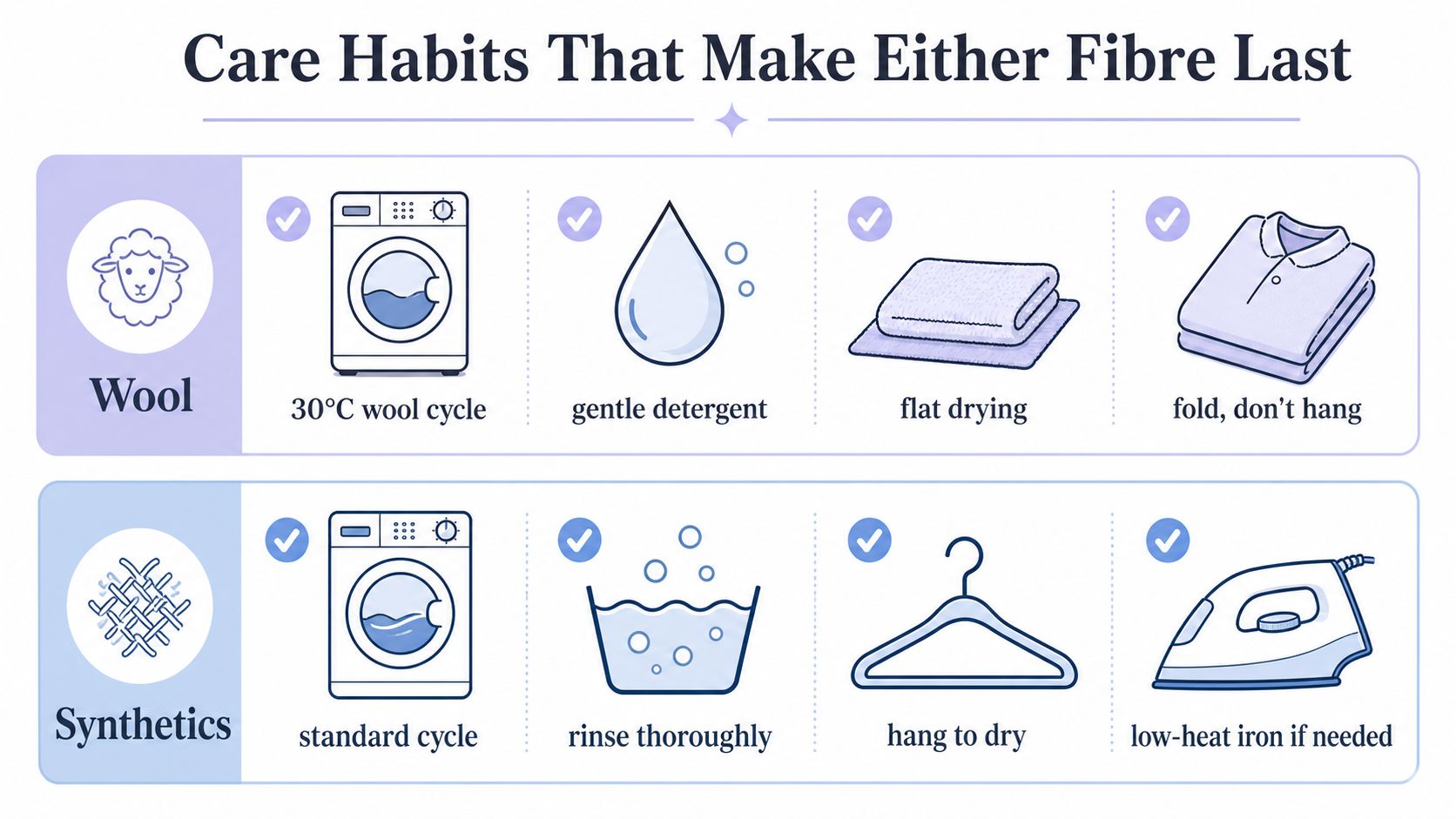
Wool doesn't need washing after every wear. Air the jumper thoroughly, spot-clean small marks and let the fibres recover before wearing it again. When it needs a full wash, use a 30°C wool cycle with a gentle detergent, then press out water without twisting and dry it flat on a towel.
Never hang a wet wool knit from the shoulders. Gravity pulls the damp fibres out of shape and leaves the familiar shoulder bumps. Once dry, fold it rather than hanging it, and store it clean with cedar to discourage moths.
A cashmere comb or knitwear shaver can remove pills without attacking the whole surface. Small holes are worth repairing early, before a tiny opening becomes a dramatic little constellation.
Keep synthetics clean without cooking them
Synthetics tolerate more routine washing, but cooler cycles and lower heat still make sense. Turn garments inside out to reduce surface friction and pilling, use a fast spin where appropriate and skip fabric softener. Softener coats wicking channels, which can make sweat management worse and encourage odour build-up.
A wash bag can help capture some loose fibres before they reach the drain, though it isn't a licence to wash synthetic clothing carelessly. Wash full loads when possible, avoid excessive heat and air-dry rather than tumble-drying whenever the care label allows.
For a fibre-specific reference, this knitwear care guide is useful to keep beside the laundry basket.
Here's the checklist I'd pin above the machine:
- Wash less: Air wool between wears and spot-clean first.
- Use low heat: Choose 30°C for wool and avoid unnecessary heat for synthetics.
- Dry with intention: Lay wool flat, and air-dry synthetics where practical.
- Protect the shape: Fold wool, and turn synthetics inside out.
- Skip softener: It can interfere with synthetic wicking.
- Repair early: Remove pills and mend small holes before they spread.
A short care routine is less glamorous than a new jumper, but it has better wardrobe manners.
The Full Cost of Cheap Synthetics
A £15 acrylic jumper looks inexpensive at the till, but its cost continues through replacement, washing and disposal. The label price tells you little about how often you will wear it, how it behaves in the wash or whether its fibres can be recovered at the end.
UK textile collection has improved, yet recovery remains limited. WRAP reports that reuse and recycling organisations handled 210,000 tonnes of used textiles in 2024, up 27% since 2019, while only 16% of fibres used by signatories were recycled. Brands and retailers nearly tripled collected volumes since 2019, but collection is not the same as fibre-to-fibre recycling. The UK textiles recycling briefing explains why blended garments are particularly difficult to separate. Wool-synthetic mixes typically go to landfill because their component fibres are hard to recover.
The wash stage adds another environmental cost. UK evidence submitted to Parliament estimates that clothing washes release 150 to 3,000 tonnes of plastic microfibres into aquatic environments each year, with around 4,000 tonnes generated annually in the UK. The Environmental Audit Committee also cites estimates that synthetic clothing can account for 20% to 35% of primary marine microplastics, and that a single 6 kg domestic wash can release up to 700,000 fibres. The parliamentary evidence and Fixing fashion report show why washing belongs in any fibre-cost comparison.
A more honest comparison
| Cost Factor | Budget Acrylic Jumper | Quality Wool or Alpaca Jumper |
|---|---|---|
| Purchase price | Lower at the till | Higher upfront in many cases |
| Washing | Often washed frequently because odour builds | Can usually be aired between washes |
| Wear experience | May feel smooth when dry, clammy when damp | More stable across changing temperatures |
| Repairs | Often replaced rather than repaired | Worth darning, de-pilling and maintaining |
| End of life | Blends can be difficult to separate and recover | Natural fibres can biodegrade, but blends still complicate recovery |
| Main question | How often will I replace it? | How many seasons will I wear it? |
This is household budgeting, not a morality test. A more expensive wool or alpaca knit can become the cheaper choice if you wear it repeatedly, care for it properly and repair it instead of replacing it.
Recycling is not a reliable escape route for a mixed-fibre jumper. Check the fibre composition before buying, then choose a garment you will keep long enough to justify its materials, labour and care.
Before buying another bargain knit, calculate cost per wear over five winters. Divide the price by the occasions you expect to wear it, then ask whether you will still want it next season. For practical ideas on buying fewer, more useful garments, these fast-fashion alternatives offer a useful starting point.
Where Alpaca Knitwear Fits, and Your Next Step
Alpaca makes sense for shoppers who want natural-fibre performance without the familiar heaviness of some wool jumpers. Its soft hand, hollow core and light feel suit refined layering, especially when you want warmth that doesn't turn an outfit into a woolly sleeping bag.
Ask three questions before you buy.
- How often will I wear it? A daily jumper deserves better comfort and recovery than a novelty piece worn once.
- What conditions will it face? A damp British commute, an overheated office and a long flight all demand different things.
- How long do I expect to keep it? If the answer is several seasons, fibre quality and repairability matter more than the first price you see.
The answers point towards a straightforward choice. Pick wool or alpaca for daily layering, variable temperatures, office wear and travel where odour matters. Pick technical synthetic for running, cycling, rough outdoor use and any situation where rapid drying is the main requirement. Choose a wool-led blend when you want a compromise, but read the ratio rather than trusting a front-of-garment claim.
Why British alpaca deserves a closer look
British alpaca knitwear sits between practicality and pleasure. It offers the natural insulation and moisture behaviour associated with wool, while its softness and lighter hand can make it easier to wear close to the skin. That doesn't make every alpaca garment superior. It makes alpaca a sensible fibre to investigate when traditional wool feels too coarse or bulky.
The Lavender Lobster's alpaca knitwear fits this discussion as an example of a small-batch, traceable natural-fibre approach. The useful question isn't whether the brand has a charming name, although it does sound like a seaside creature with excellent taste in knitwear. Ask whether the piece suits your routine, whether you'll care for it properly and whether it earns regular wear.
Choose one jumper already in your wardrobe today. Check its fibre composition, follow the appropriate wash and drying guidance, then notice how it performs through the rest of the season. That small experiment will tell you more about your ideal wool-versus-synthetic balance than another hour of scrolling through fibre claims.
Before your next purchase, measure the garment against your real life. Choose a wool or alpaca knit for adaptable everyday warmth, a technical synthetic for intense activity or rapid drying, and avoid blends whose fibre ratio and end-of-life route you can't understand. Then make the next practical move, inspect one jumper in your wardrobe, wash it according to its fibre, and decide whether it has earned a permanent place on the hanger.