

You can spot greenwashing in fashion long before you've finished your tea. It's the product page with the soft sage background, the little leaf icon, the words eco, conscious, and kind to the planet sitting neatly beside a dress you'd quite like to believe in. And then there's that tiny hesitation, the one most of us have felt but rarely follow through on. Something in the story sounds lovely, but not quite complete.
That hesitation is worth listening to. In the UK, environmental claims now sit under sharper scrutiny because the Competition and Markets Authority's Green Claims Code, introduced in September 2021, says claims must be truthful, clear, meaningful, and substantiated with evidence, and it expects brands to think about the full lifecycle of the product, not just the flattering bit (CMA Green Claims Code guidance, UN climate explainer on greenwashing). The old trick of dressing up a label with a green-looking image and a nice word is wearing thin.
So if you've ever hovered over a checkout button and thought, “This might be fine, but is it the whole truth?”, you're already asking the right question. That instinct is the start of learning how to spot greenwashing properly, not just the easy version, but the version that looks at the claim, the proof, and the business model behind it. A brand can be dressed in meadow-light language and still be hiding a very ordinary, very messy story.
The Moment You Almost Believed the Label
You know the moment. A beautifully styled product page, a whisper-soft palette, maybe a model standing in a field that has very little to do with the garment, and then the language lands, sustainable, responsible, eco-friendly. Your eye slows down for a second, because the whole thing feels gentle and reassuring. That is exactly when greenwashing likes to slip in wearing a velvet glove.
Why that little pause matters
Shoppers who have hovered over a checkout button and felt a hesitation already know the instinct that matters. If a claim feels fuzzy, selective, or more decorative than informative, that is not you being cynical, that is you noticing the gap between marketing and evidence.
The UK's Competition and Markets Authority's Green Claims Code is useful here because it does not reward vague charm. It expects claims to be truthful, clear, unambiguous, and substantiated, and practical guidance says a good claim should spell out the exact attribute, product scope, time frame, and methodology rather than relying on broad labels like “green” or “eco-friendly.” In plain English, if a brand is asking you to admire the vibe, but not showing you the receipts, you should be wary.
The shopper's quiet question
The question is not, “Does this sound nice?” It is, “Does this hold up if I zoom out?” That means looking beyond the single polished detail and asking whether the claim covers the product, the supply chain, the business model, and the way the brand operates.
Practical rule: if the story only works when you stop asking questions, it is not a strong sustainability claim.
A product can be made with a decent fibre and still be marketed in a way that overstates its environmental value. That is why the first job is to stay suspicious of anything that feels more like a mood board than a measurable statement. If the label is doing all the heavy lifting, something is off.
The Language and Imagery Red Flags
A label can sound clean and still tell you almost nothing. Eco-friendly, natural, green, kind, conscious, and even sustainable are weak claims if the brand does not say what part of the product is being measured, what it is being compared against, and what evidence supports the statement. A useful infographic on the language and imagery red flags makes the point clearly, common environmental words often look reassuring while staying vague enough to dodge real scrutiny.
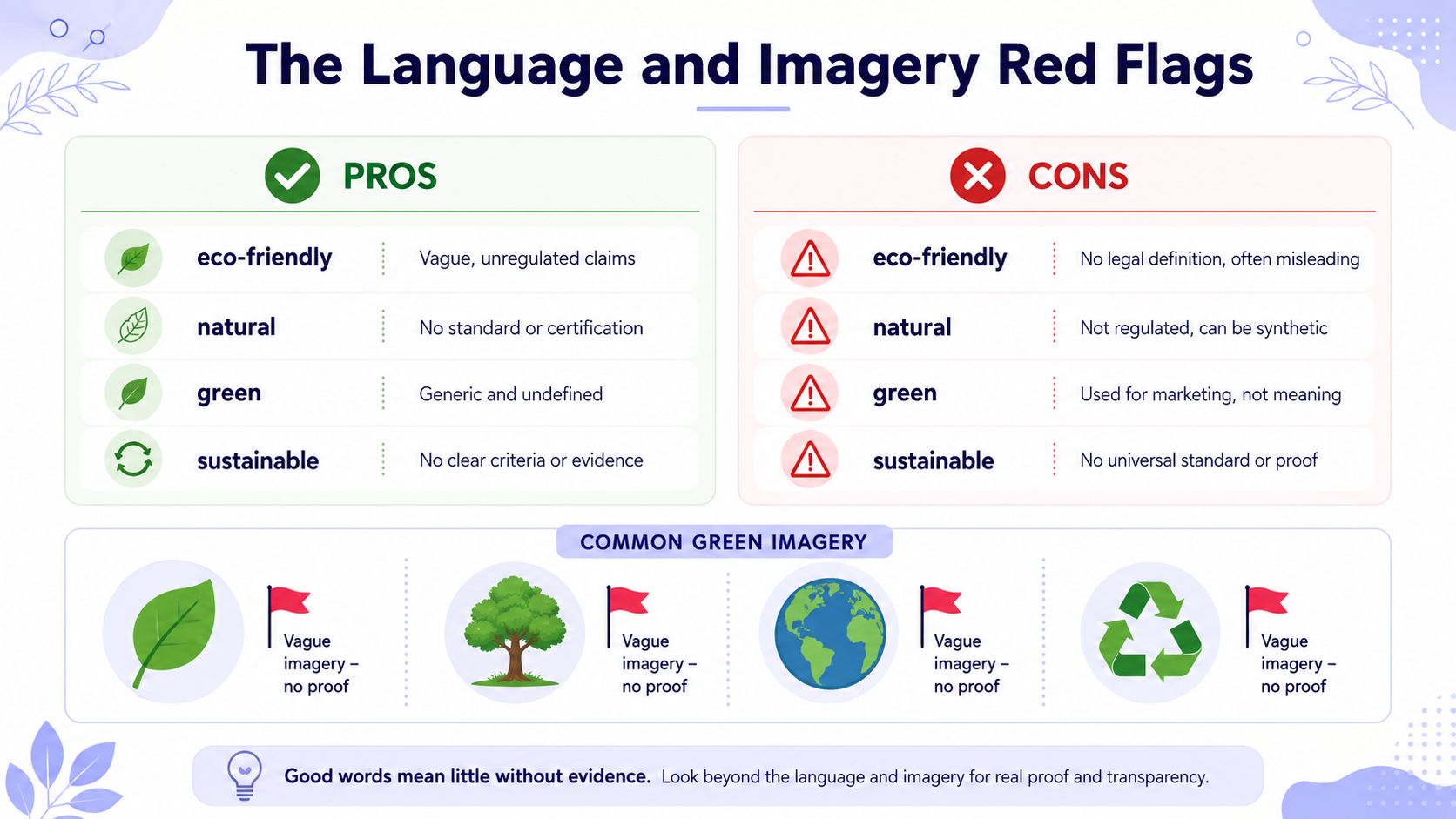
Read the words before you admire the styling
Here's what should make you stop and ask for specifics.
- Eco-friendly. What part of the product is eco-friendly, and by what measure?
- Natural. Does that refer to the fibre, the dye, the finish, or just the mood of the page?
- Green. Greener than what, exactly?
- Conscious. Is the claim about the product, the supply chain, or the brand's self-image?
- Sustainable. Sustainable compared with what, for how long, and based on whose evidence?
That is the whole trick. If the brand cannot answer in plain English, the word is doing marketing work, not evidential work.
The imagery tells on itself too
Leafy backdrops, recycled-looking textures, soft-focus meadows, globe icons, and children in fields are classic visual shorthand. They create a feeling of responsibility without proving anything. A pretty image does not become proof because it has a green tone.
If a product page uses those visuals, the brand still needs to explain the material content, the relevant standard, and the evidence behind the claim. A garment like The Lobster Bisque Dress is described as being made from 100% organic linen with a soft, organic cotton lining, which is a much better starting point because it names a specific fibre and a specific lining instead of a floating promise. Even then, you still need to ask what the claim covers and what it leaves out.
The fast skim test
Use this quick filter when you are deciding whether to trust the page.
- Specific attribute? Good.
- Named scope? Better.
- Baseline or comparison? Stronger.
- Independent proof? Best.
- Only green vibes? Walk away.
If you want the claim to hold up beyond the headline, check whether it also fits the supply-chain transparency story. A claim that only survives at the top of the page is usually weak. One more thing. If you are comparing brands in adjacent industries, even basic certification language should be specific, which is why references like R2 and e-Stewards certifications matter more than invented badges and leafy logos.
When a page leans heavily on atmosphere, treat it like a stage set. Charming, yes. Informative, no.
Reading Labels, Certifications and Supply-Chain Proof
Once you move past the words, the next question is simple, who is vouching for this? A brand-made badge is just decoration unless an independent body checks the standard behind it. That is why certifications matter, but only when they are real, relevant, and transparent.
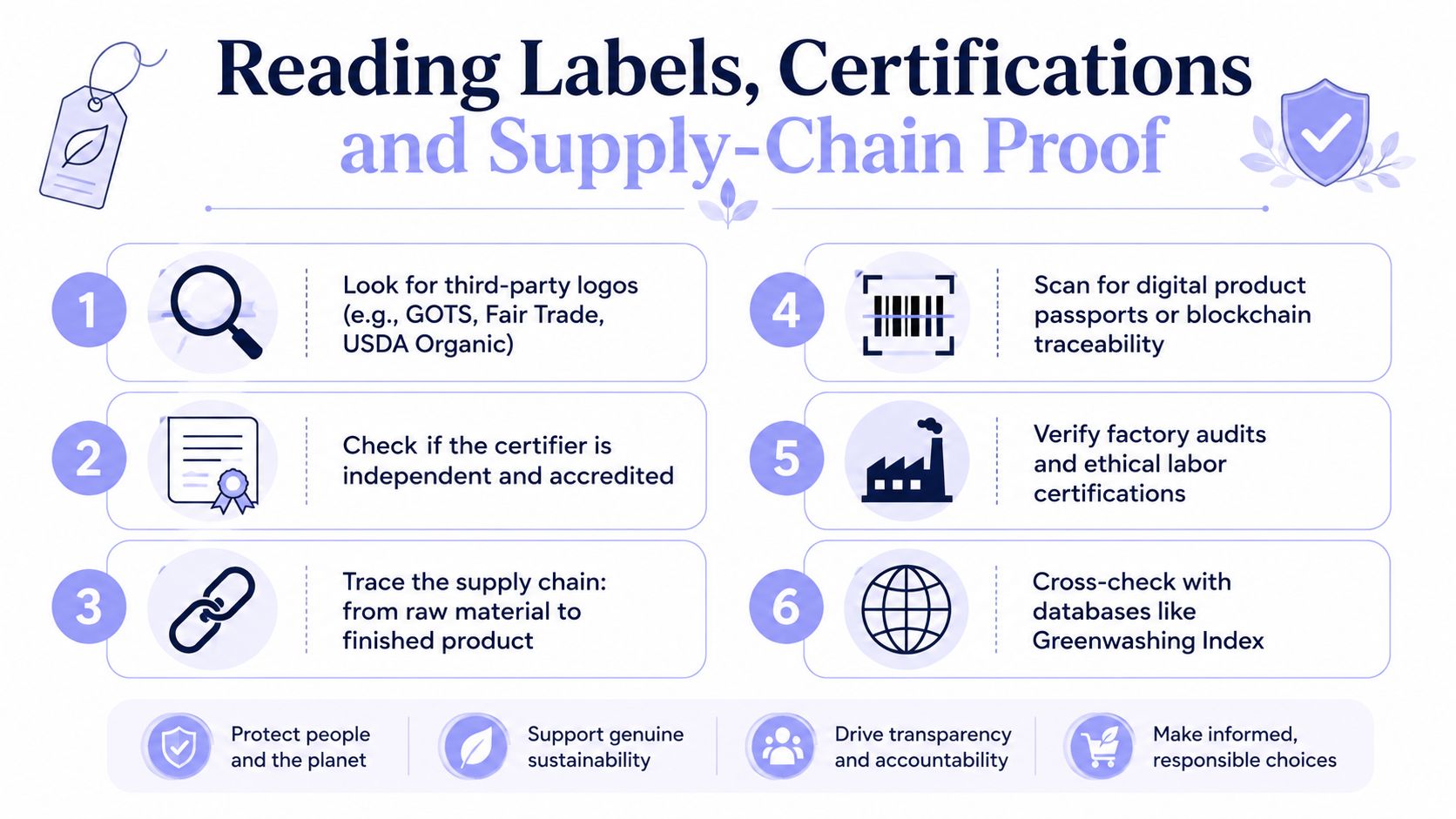
What a credible proof trail looks like
In fashion, names like GOTS, the Global Organic Textile Standard, the Responsible Wool Standard, and OEKO-TEX carry more weight than a self-invented leaf logo because they point to an external system, not just internal enthusiasm. A shopper reviewing a product page should be able to identify the exact fibre, the standard, and the scope of any environmental claim. Do not stop at the logo. A credible claim factsheet should tell you the scope, the time frame, the methodology or standard, the data sources, the comparison baseline, and any trade-offs or restrictions.
If those details are missing, the claim is flimsy. It may still be partly true, but you do not have enough information to know whether it means anything.
Use this rule: if you cannot tell what the claim covers, you cannot tell what you are being asked to believe.
Trace the fibre, not just the headline
Good supply-chain proof usually sounds boring, and that is a compliment. It names mills, makers, and standards instead of hiding behind glittery language. If a brand can tell you where the fibre came from, who processed it, and who made the garment, someone inside the company has done the hard work instead of improvising on a website.
The Lavender Lobster's own supply chain transparency note is the kind of thing worth looking for on any brand's site, because a transparent brand usually does not mind being inspected. The same principle applies when you are checking whether a third-party certification is independent. In ten seconds, ask three things. Who runs it? What does it check? Is it independent?
If you want another useful reference point, the certification overview from R2 and e-Stewards certifications is a handy example of why independent frameworks matter, because the entire point of certification is that someone outside the brand is doing the judging.
The Lavender Lobster's Sailor Hats are described as being made from offcuts of larger garments, with made-to-order production and each piece individually made by seamstresses in the UK. That is the kind of material-and-making story you can interrogate, which is exactly what you want from a claim.
Fashion Phrases That Sound True But Hide the Truth
Fashion marketing loves three words in particular, sustainable, conscious, and responsibly sourced. All three can be technically true and still mislead you, which is exactly why shoppers get tangled up. The phrase sounds responsible, the product page looks careful, and the claim may only describe one tiny part of the item.
Sustainable isn't the same as whole-product honest
A dress can be called sustainable because one component is organic cotton, while the rest of the item, the dye, the finishing, the transport, or the volume model, stays conveniently vague. That is the classic red-herring move. A real claim should tell you what part of the product it refers to and what it does not cover.
The UK's Green Claims Code pushes brands towards that fuller view, because it expects environmental claims to consider the full lifecycle rather than one flattering slice (BBC explainers on fashion greenwashing). If the claim only survives when you focus on the sleeve and ignore the coat, it is not a strong claim.
Conscious is often branding, not evidence
“Conscious” usually reads like a value statement, but it often means the brand wants you to infer good intentions without proving outcomes. A jumper can be “conscious” because the company signed a pledge, while the actual garment still sits inside a business model that pushes constant consumption.
That is why intent is not the same as impact. Good intentions do not replace traceability, standards, or measurable proof. A brand can sound thoughtful and still be relying on empty language.
Responsibly sourced needs traceability, not vibes
This one is the easiest to misuse. A wool coat described as responsibly sourced should come with traceable evidence about the fibre, the farm, the standard, or the chain of custody. If the brand cannot say where the wool came from, who checked it, and what “responsible” means in practice, the phrase is mostly a decorative ribbon.
A better place to test that promise is real ethical manufacturing standards, because sourcing claims should connect to how the garment was made. If the brand cannot link the material story to the making story, the claim stops at marketing copy.
A strong sourcing claim tells you the route, not just the destination.
The cleanest way to handle these phrases is to strip them back. Ask what exactly is being claimed, what evidence exists, and whether the product page links to anything more substantial than a marketing sentence. If the brand gets vague when you get specific, you have already learned something useful.
The same habit helps with the broader fashion ecommerce challenges that make vague sustainability copy so common online. When a site is built to move people fast, the small print is where the truth usually hides.
When the Sustainability Story Does Not Match the Business Model
A brand can use decent fabric and still tell a misleading story if the business model keeps driving volume for volume's sake. That is the part glossy campaigns try to hide. If a company depends on rapid inventory turns, constant drops, and endless novelty, one “responsible” product does not clean up the rest of the operation.
Look at the model, not just the label
Pre-order, rental, resale, and offsets all sound appealing, but they are not moral hall passes. Pre-order can reduce waste when it matches production to demand, yet it can also function as a polished marketing story if the brand still floods the market with too many styles and too much churn. Rentals can extend use, but only when garments are worn enough to justify the extra logistics. Offsets are the weakest of the lot when they are used to distract from emissions the brand could cut directly.
That is the key shopper question. Does the model reduce impact, or just rename it?
The German consumer guidance on greenwashing says evidence should be available where the claim is made, and that self-created labels need independent third-party certification in the proposed reforms discussed there. That pushes the focus away from pretty branding and toward proof you can check. See consumer guidance on greenwashing reforms.
Ask the awkward questions
If a brand says it is responsible, ask:
- What happens to unsold stock?
- What reduces your impact more, the product itself or the business model around it?
- What proof do you publish at the point of sale, not just in a sustainability page buried three clicks deep?
The operational side matters too. A look at fashion ecommerce challenges makes it obvious why online fashion systems reward speed, novelty, and volume, which is exactly why sustainability claims need extra scrutiny.
The visual story can feel convincing because the brand has wrapped itself in a better narrative. If the company still needs constant churn to survive, that story is a borrowed coat. For a calmer way to judge claims like these, the sustainable fashion tips page is worth keeping open while you shop.
Your Pocket-Sized Greenwashing Checklist
Before you buy, do this in order. It takes less time than a scroll through the new-in rail.
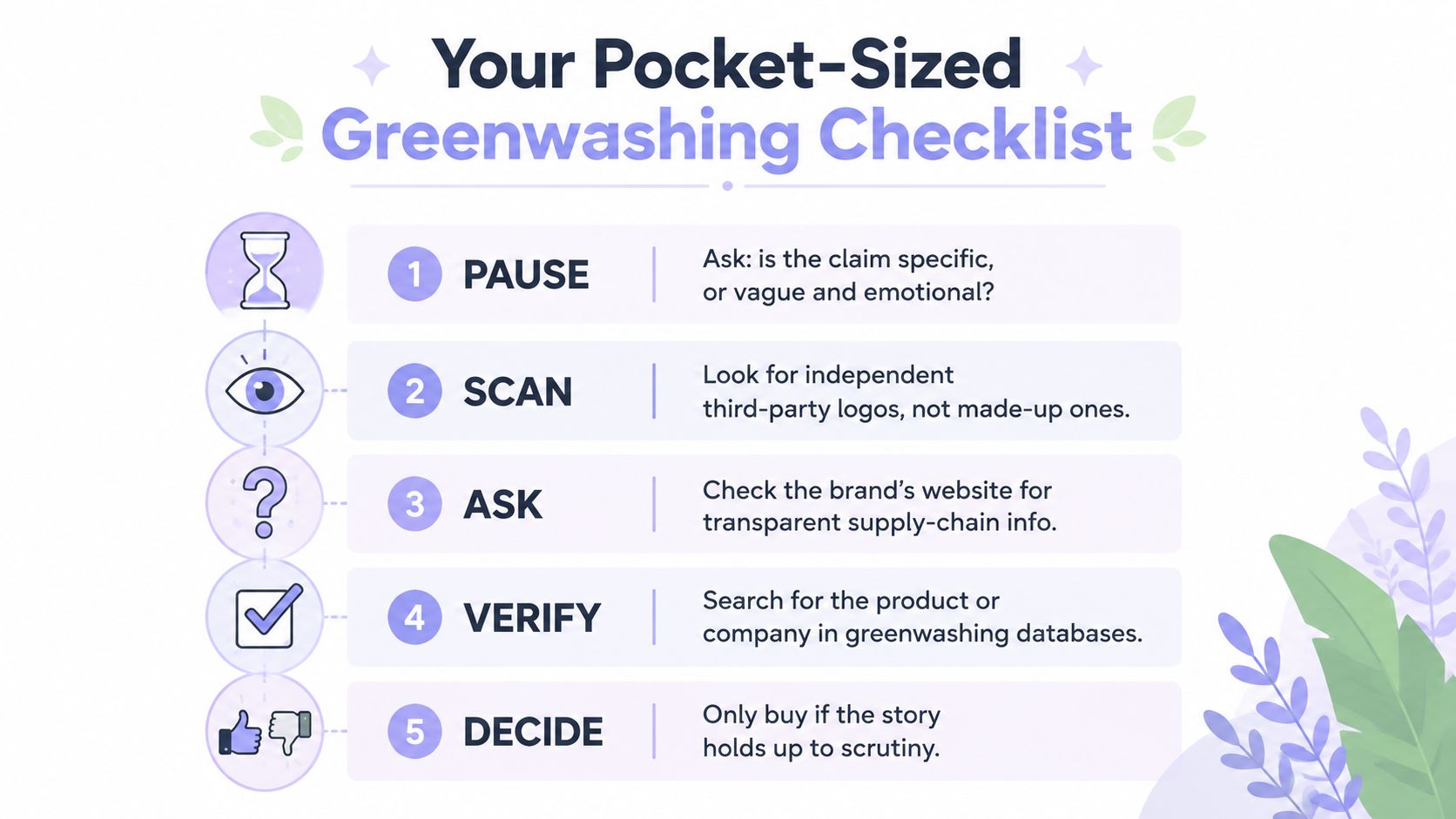
Pause, scan, ask, verify, decide
- Pause. Is the claim specific, or just emotional fluff?
- Scan. Is there an independent certification, or only a brand-made badge?
- Ask. Does the brand explain where the fibre came from and who made the garment?
- Verify. Can you find third-party proof or a traceable standard?
- Decide. Does the brand's wider model match the story it's selling?
If the answer to any of those is “not really”, don't donate your trust just because the product page is pretty. Pretty is not proof.
The quickest useful question is still this. Does this claim name what part of the product it refers to? If not, you're probably being sold a feeling, not a fact. For a broader shopping reset, the sustainable fashion tips page is worth keeping nearby, especially if you're trying to build a calmer wardrobe rather than just a cleaner basket.
A good sustainability claim should survive a bored, slightly sceptical reread. If it doesn't, it shouldn't make it into your wardrobe.
What to Do When You Catch a Brand in a Lie
If a brand's claim feels slippery, do not just roll your eyes and move on. Ask for the proof in writing. Keep it short and specific, something like, “Your claim says this item is sustainable. Please share the scope, baseline, methodology, and independent evidence behind that claim, in line with the UK Green Claims Code.”
That wording matters because it pushes the brand to answer the question, not the flattering one. You are not asking for a slogan, you are asking for the evidence behind the slogan.
Where to send the complaint
In the UK, misleading environmental claims can be reported to the Competition and Markets Authority and the Advertising Standards Authority. Both treat vague or misleading environmental language as a compliance risk, and the CMA Green Claims Code sets the standard brands are supposed to meet. If a company cannot support the claim, regulators should hear about it.
Spend like a sceptical romantic
Put your money with brands that make their claims easy to check. Look for natural fibres with traceable origins, small-batch production, seasonless design, and business models that reduce waste instead of just repainting it. The detail matters. That is where the truth usually hides.
A product like the Clubhouse Cocktail Napkins | Set of 4 shows the right kind of specificity, with concrete material and construction details, 100% flax linen, embroidered finish, and a specific woven look. It describes what the product is without pretending that the description itself proves a sweeping environmental virtue. That is the tone to favour.
The industry gets better one annoying, intelligent question at a time. Keep asking them. Your wardrobe, and everyone else's, gets cleaner when brands learn they cannot hide behind a pretty story when they owe you the map.