

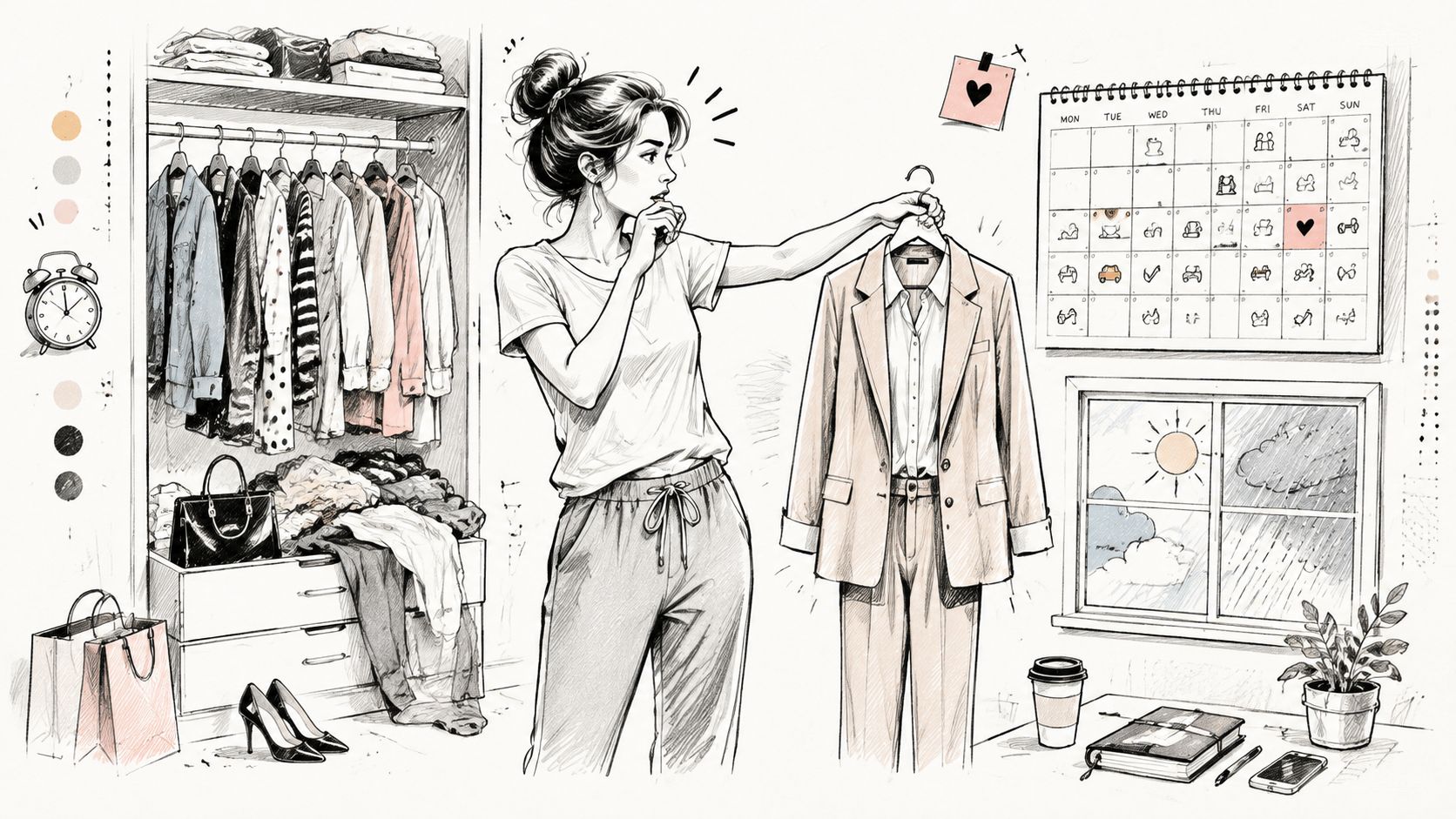
You're standing in front of an open wardrobe with ten minutes to spare. The calendar is crowded, the weather has changed its mind again, and every promising pair of trousers seems to need a different top, shoe, or emergency layer. Then you spot a matching knit set, already waiting on its hanger. The colour works, the proportions make sense, and the morning suddenly feels less like a small domestic storm.
That quiet relief is the core appeal of outfit sets for women. A coordinated top and bottom can give you a complete starting point, but the best sets aren't one-and-done costumes. They're useful wardrobe companions, ready to split apart, layer over, repair, rent, and wear again with a little imagination.
The Morning a Coordinated Set Saves the Day
The trousers on the chair are too formal for the school run but too rumpled for the meeting. A soft sweater looks lovely until you hold it against the trousers and realise the colours are arguing. Outside, rain taps against the window, while the forecast promises a brighter afternoon. The wardrobe offers plenty, yet nothing seems to answer quickly.
A coordinated two-piece does. The cool hand of knitwear meets your palm, the top and bottom share a quiet tonal rhythm, and the decision is already half-made. You pull on the set, add a coat, and leave the accessories for later. Even the cup of tea tastes less hurried.
Why the small shortcut matters
The value isn't only speed. A set gives your eye a clean line, which means you can choose one contrasting element instead of solving the entire outfit from scratch. Try a striped scarf, a weatherproof trench, or a pair of worn-in trainers. The matching pieces create calm, while the extra detail brings personality.
A set also earns its hanger space when your day has several chapters. A soft knit can feel polished at a desk, relaxed under a coat on a train, and comfortable enough for an early dinner. The same pieces move through the day without requiring a full change of clothes.
Practical rule: Let the set solve colour and proportion, then let one accessory provide the plot twist.
That might be a shell-coloured bag, a bright sock, or a slightly mischievous brooch. Seaside shades, chalky blues, sandy neutrals, and washed greens work particularly well because they feel considered without becoming stiff. The outfit looks composed, but never as though it's waiting for a ceremony.
What Outfit Sets Really Are and Where They Came From
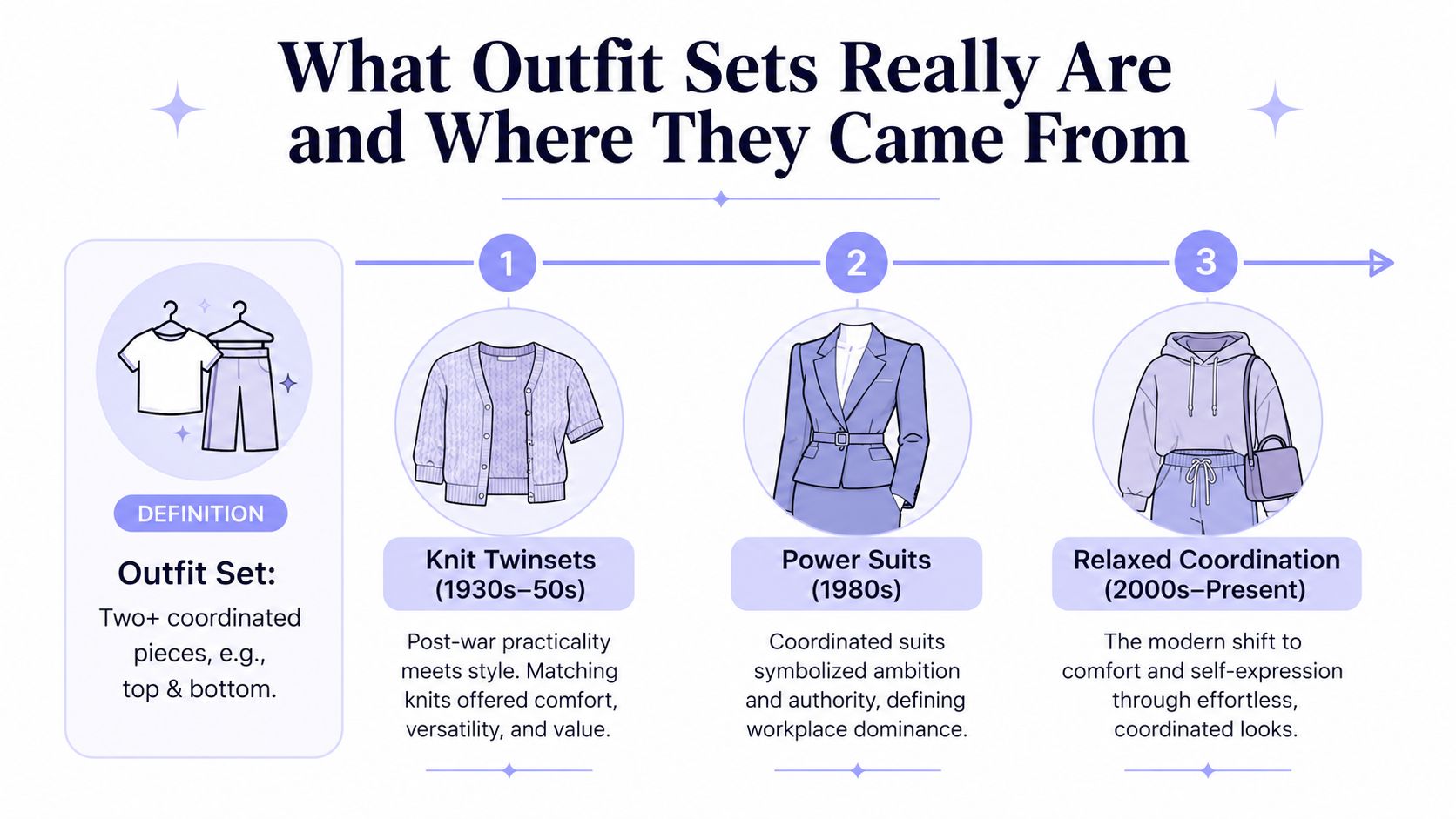
An outfit set is two or more garments designed to work together through shared fabric, colour, pattern, trim, or proportion. The familiar versions include a knit twinset, a trouser suit, a short set, a three-piece skirt suit, and the modern co-ord, where separates are sold as a deliberately connected pair.
The format carries a long memory. Dressmakers once created matching jackets and skirts for women who needed clothing that looked orderly, practical, and ready for changing weather. Later, lounge and beach pyjama sets brought coordination into more relaxed settings, while the twentieth century made the suit a symbol of professional presence. Today's relaxed tailoring keeps the polish but loosens the rules, with softer jackets, wider trousers, and comfortable knits.
The British thread
The UK has measured men's and women's clothing expenditure by country and region, and it has also published experimental regional clothing-and-footwear spending estimates for 2018, as recorded by the Office for National Statistics clothing expenditure series. Historical research using Stone and Rowe data records UK spending on women's outerwear and hosiery rising from £122.7 million in 1924 to £158.7 million in 1938, with per-capita spending moving from £6 in 1924 to £7 5s in 1938, as detailed in a UK academic thesis on historical clothing expenditure. These figures place coordinated dressing inside a longer outerwear tradition, rather than treating it as a fleeting social-media invention.
Designers propose sets as complete looks because fabric continuity protects the visual relationship between pieces. The neckline, waistband, sleeve, and trouser break can feel deliberate without the wearer having to calculate each connection. The useful question is what happens after the first wear. Can the top meet denim, can the skirt work with a cardigan, and can the trousers survive a change of shoes?
That's where a good set becomes more than matching clothing. It becomes a small wardrobe system, with the first outfit supplied and the later ones left open to you.
Sets or Separates
The alarm rings late, a train leaves soon, and the coordinated set hanging by the door removes several decisions. Pull on the matching alpaca top and trousers, add boots, then leave. On a slower morning, those same trousers can meet a crisp shirt, while the top softens a pleated skirt. A set earns its place when it handles both kinds of day.
A coordinated pair and a considered group of separates solve different wardrobe problems. Sets bring speed for travel, work trips, and days that move between settings. Separates create more combinations from a compact rail, especially when one vivid piece can change the mood of everything around it.
Knitwear makes the difference easy to see. Matching colour and texture create a calm first impression, while the individual pieces keep working after that first outfit. The value sits in the second and third stories, not only in the polished opening look. For more ideas on breaking pieces apart, see our guide to mix and match outfits.
Four buying questions
| Factor | Coordinated Set | Separates |
|---|---|---|
| Cost per wear | Strong when both pieces are worn together and apart | Strong when each item works with several existing pieces |
| Dressing speed | Fast, with colour and proportion already resolved | Slower, because each combination needs more decisions |
| Versatility | Depends on how successfully the pieces break up | Often broader from the first wear |
| Stylistic range | Coherent and polished, with room for contrast accessories | More experimental, especially for capsule builders |
Quality decides whether the set survives beyond its first outing. Thin fabric, weak fastenings, or awkward proportions will show whenever the pieces meet. Strong construction makes the pair useful in separate combinations too, and repairable knitwear can remain part of the wardrobe across changing seasons.
A useful catalogue can show how related pieces sit together. For a look at that approach, browse multi-SKU catalog AI. In a wardrobe, the same idea starts with connection, then depends on the clothes already in your closet. A seaside palette might pair the set with denim, a striped shirt, or a bright scarf, letting the mood shift without replacing the whole look.
Sets also suit a wardrobe built over time. Wear both pieces for a clean arrival, separate them for ordinary days, repair a favourite seam, and keep the pair useful as your style changes. Choose a coordinated foundation when you want certainty. Choose separates when you want improvisation. Buy the set only when each half can tell a second story alone.
Fabric First
A set gets worn repeatedly only when it feels good at the point of contact. The sleeve must glide over the arm, the waistband must settle without nagging, and the fabric must be comfortable across a warm room and a chilly platform. Fibre choice affects all of those moments.
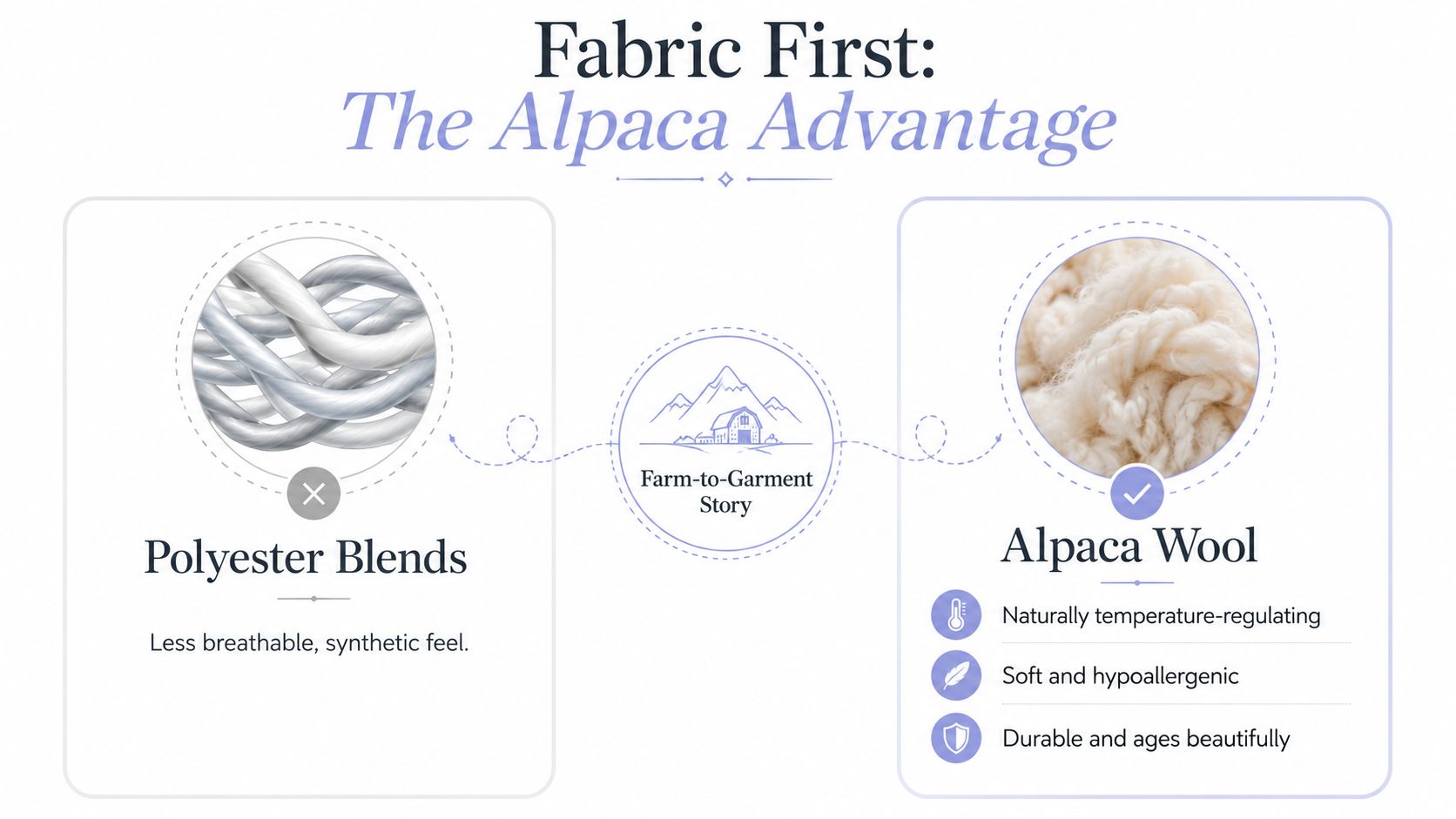
Natural fibres can offer breathability, temperature regulation, and a more expressive surface as they age. Cotton feels familiar and easy, linen brings crispness and a relaxed crease, and merino offers fine warmth with a smooth handle. Synthetic blends can add stretch, strength, or easy-care qualities, but the fabric's actual composition and construction matter more than a reassuring label.
Why alpaca changes the conversation
Alpaca has a hollow-core fibre structure, which helps it feel warm without becoming heavy. It's known for softness and can suit people who find some wool itchy, while its strength supports garments designed for repeated use. The fibre also gives knitwear a gentle drape, so a matching cardigan and trouser or skirt set can look fluid rather than bulky.
The Lavender Lobster works with British alpaca wool in pieces such as its Sailor Scarf, alongside a wider approach centred on natural and organic fabrics, considered construction, and season-spanning wear. The useful lesson isn't that every wardrobe needs alpaca. It's that a set deserves a fibre chosen for how you'll live in it, not only for how it photographs.
Look closely before buying. Hold the fabric to the light, flex the knit, inspect the recovery after a gentle stretch, and check whether the colour has depth rather than a flat surface. A beautiful shade should still feel inviting when you meet it on a grey morning.
The right fabric makes repeating an outfit feel like returning to a favourite room.
That's the sensory test. Does the hand feel soft but substantial? Does the drape move when you walk? Does the surface invite a second touch? If yes, the set has a better chance of becoming part of your life rather than a carefully folded ambition.
Styling One Set Across Seasons and Occasions
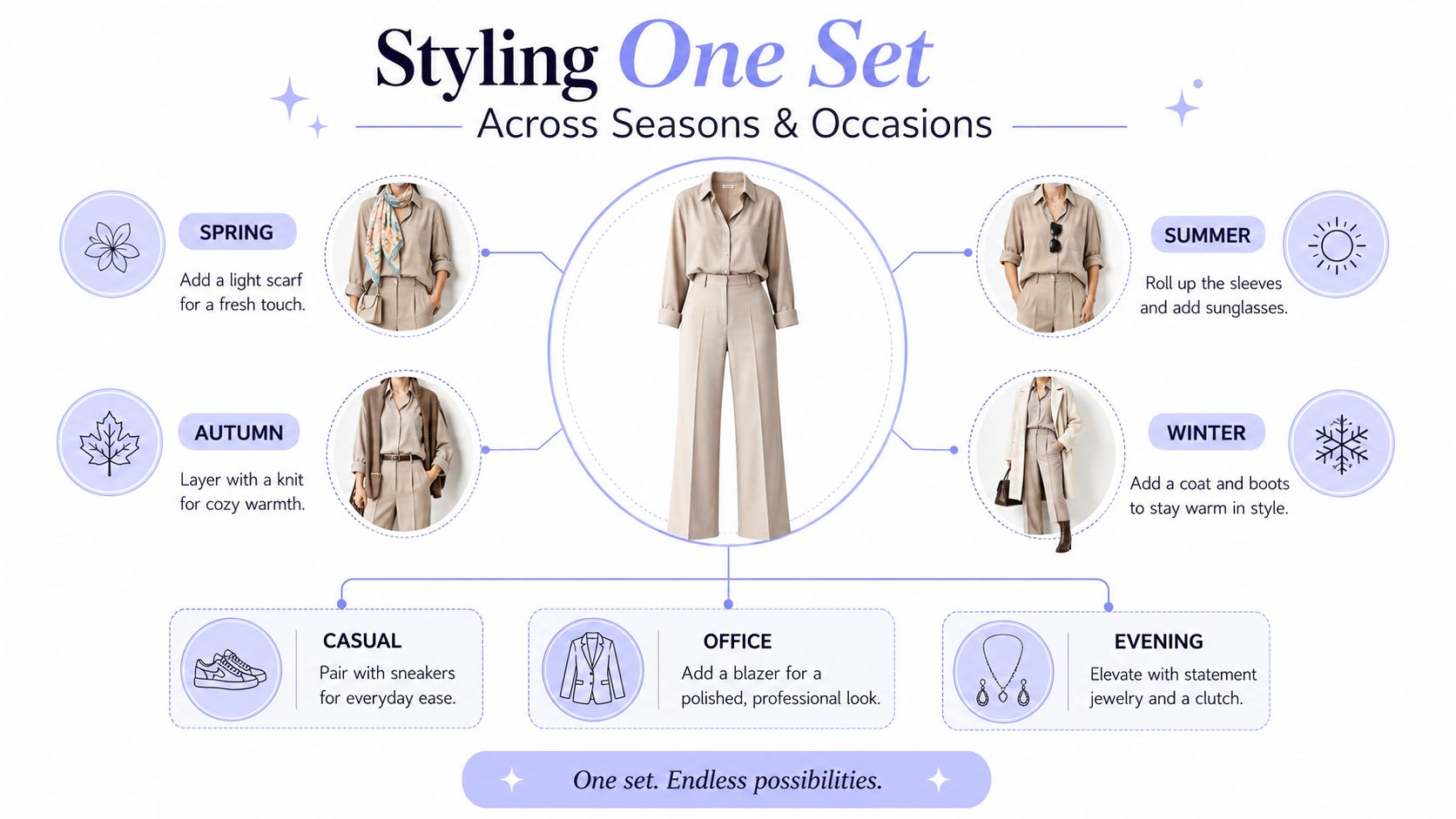
A neutral trouser set can begin with a spring scarf and end beneath a winter coat. The trick is to treat the matching pieces as the centre of an outfit, not its final punctuation.
In spring, wear the set with a lightweight scarf, a low-profile trainer, and a compact shoulder bag. As the day warms, loosen the styling rather than changing everything. Roll a sleeve, add sunglasses, and let the shared colour provide enough polish.
One base, several temperatures
Summer calls for a linen overshirt or a simple tank beneath an open jacket. A useful reference for pared-back layering is this guide to grey tank top style tips, especially when you want the set to feel less formal without adding visual noise. Swap structured shoes for sandals or clean trainers, then change the bag to shift the setting.
Autumn is the season for texture. Add a fine knit, a suede shoe, or a softly structured blazer. Relaxed tailoring works particularly well here, especially when fluid trousers meet an oversized jacket rather than a sharply fitted one. The result has shape, but it doesn't look over-rehearsed.
Winter asks for warmth without hiding the outfit completely. Layer a substantial alpaca cardigan, a long coat, and boots, keeping one matching edge visible at the neckline, cuff, or trouser hem. Tonal dressing gives the layers a calm quality, even when the fabrics change.
For more ideas on separating and recombining two-piece looks, explore mixing matching top and bottom sets.
The same set can serve three occasions:
- Casual: Add trainers, a canvas tote, and a relaxed outer layer.
- Office: Introduce a blazer, a belt, and a more structured shoe.
- Evening: Change to jewellery, a smaller bag, and a polished heel or flat.
This is how you avoid the overly “matchy-matchy” effect. Keep the set's foundation, then interrupt it with one different texture or shape.
Watch the styling guide here for a visual approach to moving a coordinated look through different settings:
Buying to Last
A set earns its place when you can still reach for it after your routine changes. I've kept coordinated pieces through busy workweeks, slow seaside weekends, and evenings when a familiar cardigan felt better than something new. The goal is a fabric, cut, and construction that can adapt without losing its charm.
Begin with the seams. Look for an even finish, firmly attached buttons, and hems with enough allowance for adjustment. A straightforward trouser line or softly shaped alpaca cardigan can outlast a novelty silhouette, while a small shell, stripe, or other whimsical detail keeps the piece from feeling anonymous.
The ownership routine
Care starts before the first wash. Follow the label, wash gently and cold where appropriate, dry knitwear flat, and fold sweaters instead of hanging them from the shoulders. Those quiet habits protect shape and prevent the stretched cuffs and sloping shoulders that make a favourite garment look tired.
I keep repairs small and prompt. A loose button gets restitched before it vanishes, a pulling seam gets reinforced, and a snag gets attention while it is still easy to mend. UK longevity findings linked to WRAP report that a repair adds 1.3 years to a garment's average life, as summarised in the repair and clothing longevity findings. The same evidence records estimated average lives of 4.6 years for dresses and 4.1 years for jeans, while second-hand or vintage items are expected to last 5.4 years, compared with 4.0 years for new items.
For more practical guidance, read our guide to how to make clothes last longer.
Those figures place resale and rental within a garment's longer story. A set that no longer fits your week may suit someone else's, particularly when its fibre, labels, and care history are clear. Separate the pieces, repair them, and let the outfit keep travelling.
A long-life wardrobe isn't one that never changes. It's one that lets good pieces continue their journey.
Pre-Order, Rental, and Other Modern Ways to Shop
Pre-order, rental, resale, and archive shopping each answer a different wardrobe need. Before choosing, ask whether you want a garment made for your future use, borrowed for a particular moment, or discovered as an existing piece with a little history.
Pre-order can make sense for a considered alpaca set or a small-batch colour. Check the expected production window, whether payment is taken in full or in stages, what happens if delivery changes, and when final payment is due. The UK's Consumer Contracts Regulations still apply to pre-ordered online goods. Consumers generally retain a 14-day cooling-off period, with the cancellation window usually beginning when the item is received rather than when it's ordered, as outlined in this UK guide to refunds for pre-ordered online goods.
Read the label, then read the terms
Fibre composition is another practical checkpoint. UK textile labelling rules require multi-component garments to show the fibre content of each component separately. Blended fibres must appear in descending order by weight, and where no fibre reaches 85%, the relevant percentages must be stated, according to UK textile labelling guidance. A top and bottom may look like one outfit, but their linings, trims, and separate construction still matter to the label.
Organic claims need similar care. GOTS requires products labelled “made with organic materials” to contain at least 70% certified organic fibres, while the stricter “organic” grade requires at least 95%, with the standard covering processing stages from spinning and weaving through dyeing and manufacturing, as set out in the UK government response on GOTS.
Rental suits one-off occasions or experimentation. The UK online clothing rental market is forecast at USD 313.2 million in 2026, with a projection of USD 812.4 million by 2036 at a 10% CAGR, according to the UK online clothing rental market forecast. Ask about cleaning, damage waivers, return timing, and late fees before booking.
Resale platforms, sample sales, and brand archives offer another route. UK resale and rental recommerce has been reported at £6.99 billion and 1.6% of total retail, according to FashionUnited's UK clothing rental coverage. Choose pre-order for an investment piece, rental for a single event, and resale when you're testing a shape without committing to a brand-new wardrobe chapter.
A Wardrobe That Feels Like You
Five years from now, you open a shelf and find the same alpaca knit waiting there. It still has that gentle softness, the colour still reminds you of sea glass after rain, and the sleeves carry the slight memory of the places you've worn it. You pair it with something newer, and the old piece doesn't look dated. It looks like yours.
That's the quiet promise of a well-chosen set. Natural fibres, thoughtful construction, repairable details, and flexible shopping formats give clothing more ways to remain useful. The matching top and bottom may have started as a shortcut on a crowded morning, but they can become separate characters in a much larger wardrobe story.
The Lavender Lobster's seaside whimsy offers one way to approach that story, through playful details alongside natural fabrics and season-spanning design. Your own version might include a storm-blue cardigan, a softly shaped trouser, or a tiny lobster-red accent that makes a practical outfit smile.
Choose the set you can imagine wearing in more than one season, in more than one arrangement, and through more than one version of yourself. Then give it a real chance to stay with you, care for it, repair it, and pass it on when its next chapter arrives.
Choose your next set with the future wardrobe in mind. Explore seasonless womenswear, compare the fibre details, and select a coordinated piece you'll be happy to wear together, separately, and often.