

You've packed the dress, folded the tissue, sealed the mailer and sent it sailing into the rain. By lunchtime, the packing bench is covered in offcuts, transparent sleeves, sticky tape and one suspicious little pouch that nobody remembers ordering. The parcel looked polished. The waste stream tells a less flattering story.
For a small UK womenswear label, plastic free packaging isn't a mood board exercise. It affects garment protection, fulfilment time, storage space, customer returns, packaging compliance and the story your brand tells. The right swap can remove a stubborn piece of waste. The wrong one can replace a visible plastic problem with a less obvious recycling failure. A paper mailer that splits around a zip, or a compostable film that no local facility accepts, isn't progress just because it arrived with a leafy logo.
The practical answer is to design the whole journey, from stockroom shelf to customer's hallway and back again. That means choosing materials with a real end-of-life route, vetting suppliers properly and testing the finished parcel rather than admiring a sample on a sunny studio table.
The Fashion Brand Packaging Problem You Actually Live With
At nine in the morning, the studio is quiet apart from the kettle and the rustle of garment bags. Then the packing run begins. A blouse arrives in a clear polybag, inside a carton, with tissue around the collar, a swing tag on a plastic loop and a silica pouch tucked beneath the fold. A second layer protects the garment from damp. The outer mailer is generously sized because nobody wants a sleeve to catch on the courier label.
By the end of the run, the bin looks like a small transparent tide has come in. The individual pieces are light, but they multiply quickly across dresses, knitwear, accessories and returns. Polybag covers, film sleeves, windows, adhesive strips and oversized mailers often exist because each person in the chain solved one narrow problem. The customer receives one garment. The brand has created a little packaging system around it.
Returns reveal the weakness in that system. Cellophane tangles around a folded cardigan. A paper envelope arrives softened at the corners. A biodegradable mailer has been placed in a household recycling bin, where it doesn't belong, because the disposal instruction was either vague or missing. The packing team then reaches for more tape, another sleeve or a replacement mailer. The supposedly greener format has created extra labour and another material decision.
Practical rule: If a packaging change makes the packing bench slower, the return process murkier or damage more likely, it hasn't been designed yet.
Fashion also has a visual trap. Premium presentation can encourage layers that photograph beautifully but travel badly through real collection systems. A glossy box, laminated card, metallic sticker and plastic window may feel luxurious at the unboxing moment, yet each added finish makes separation and recovery harder. A beautiful parcel still needs a boringly clear afterlife.
The UK's packaging system is moving toward more accountability. Packaging EPR came into force on 1 January 2025, bringing more detailed reporting of packaging placed on the market, while household plastic waste remains heavily tied to food and drink packaging. The Big Plastic Count estimates that UK households throw away 82 billion pieces of plastic packaging a year, with 82% of household plastic waste coming from food and drink packaging. That context matters for fashion labels. Removing the outer mailer is useful, but it shouldn't distract from examining every plastic component around the garment.
Plastic free packaging is therefore a practical response to an everyday operational headache. It can reduce dependence on virgin plastic, simplify customer disposal and sharpen the brand experience, but only when the entire pack works together.
Choosing Materials That Fit Your Garments and Values
Start with the garment, not the material catalogue. A fine knit, a structured linen dress and a set of accessories have different protection needs, so one universal pack usually creates either waste or damage.
Paper and card as the dependable baseline
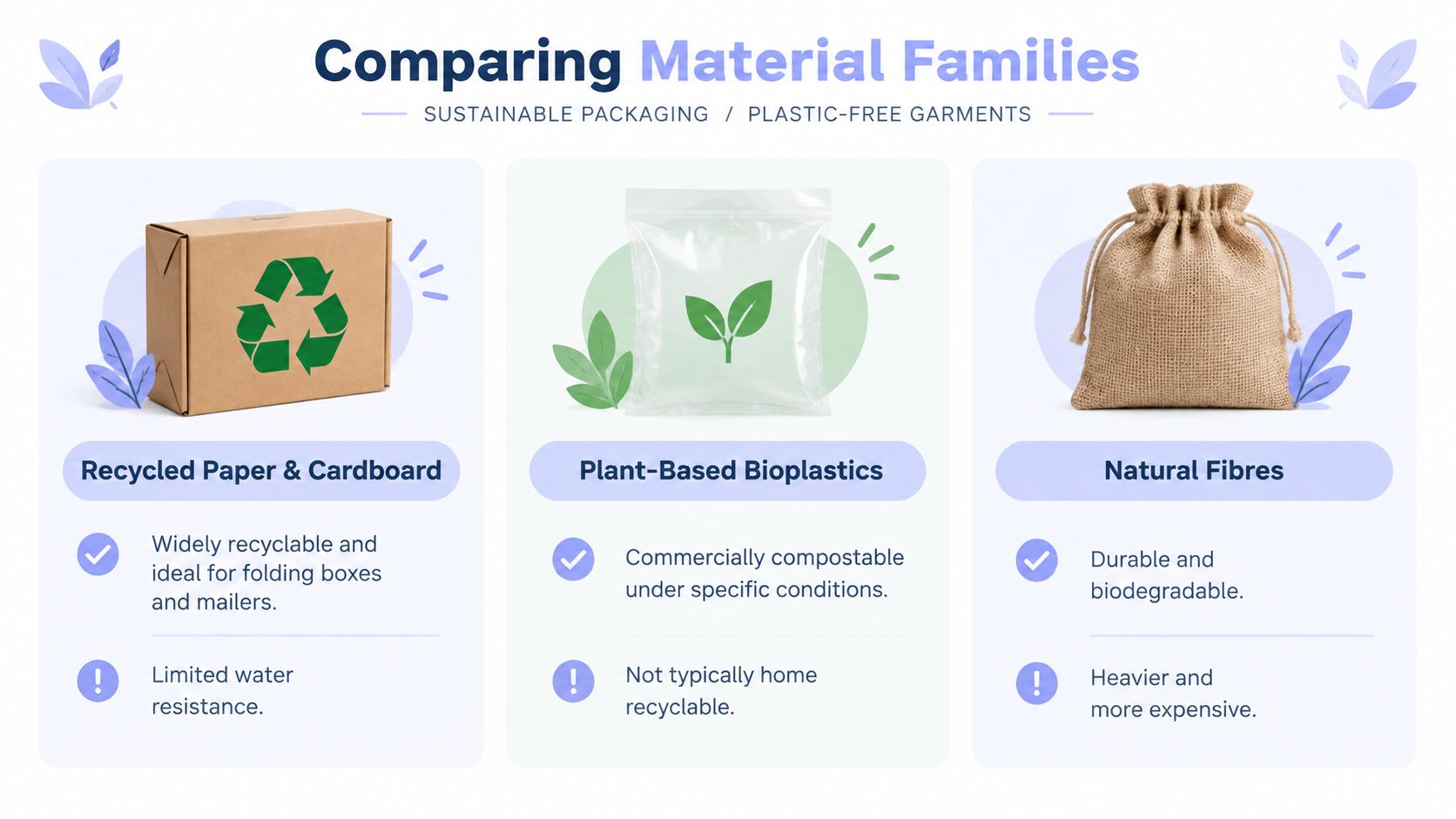
Recycled kraft paper is often the easiest place to begin. It suits mailers, folding cartons, tissue and inserts, prints cleanly and usually has a familiar route through paper recycling. Its limitations are equally real. It offers less moisture resistance than a plastic film, and a fragile paper mailer may fail when exposed to rain, rough handling or a sharp zip.
Virgin kraft can provide strength and consistency when recycled fibre alone doesn't meet the performance brief. That doesn't make it automatically preferable. Ask about fibre sourcing, coatings and the actual recycling instruction before placing a branded order. A recycling symbol isn't a magic passport. If the pack combines paper with plastic, foil, a difficult adhesive or a non-recyclable window, the logo may create more confidence than clarity.
Use tissue paper to protect delicate knits and dyed garments from abrasion, but choose the lightest grade that still prevents creasing and snagging. Corrugated inserts can support structured pieces without adding a second outer box. Unbleached paper brings a softer, natural look, though the right choice depends on colour transfer, print requirements and the garment's finish.
Plant-based materials need a real route
Corn-starch mailers and PLA films can be useful in controlled systems, but “plant-based” doesn't mean “put it in the garden bin”. Commercially compostable packaging generally needs the heat, moisture, time and processing conditions of an industrial composting facility. It may behave much like conventional plastic in a household bin, and it can contaminate recycling if customers mistake it for ordinary film.
Check whether the relevant packaging is certified for industrial composting, and communicate the disposal route in plain English. For an accessible overview of material choices, this UK eco-friendly packaging guide 2026 from Monopack ltd offers useful background. You'll also find that the same principle applies to clothing materials and packaging alike, materials need a credible journey after use, not just an appealing origin story. A brand exploring that wider relationship can also point customers towards its UK guide to eco fabrics.
Reuse only when reuse is plausible
Cotton totes, muslin dust bags and rigid boxes can work for repeat journeys, gifting or a rental model. They're not automatically low impact. Natural-fibre packs use more material, occupy more storage space and weigh more in transit. A reusable option earns its place when customers keep and reuse it, or when the brand has a credible return loop.
The same circular instinct can inform the product itself. The Sailor Hats are made to order from offcuts of larger garments, with each hat made individually by seamstresses in the UK. That kind of material planning is separate from packaging, but it encourages the right question: where can a useful second life replace a fresh input?
Choose the material that matches garment sensitivity, brand voice and local end-of-life reality. If the answer depends on a facility your customers can't access, keep looking.
Finding and Vetting the Right Packaging Suppliers
Supplier choice changes with scale, but the questions shouldn't. A small label needs a partner who understands short runs, artwork changes and the occasional urgent launch, not a warehouse full of materials that look sustainable on a screen.
Four useful supplier paths
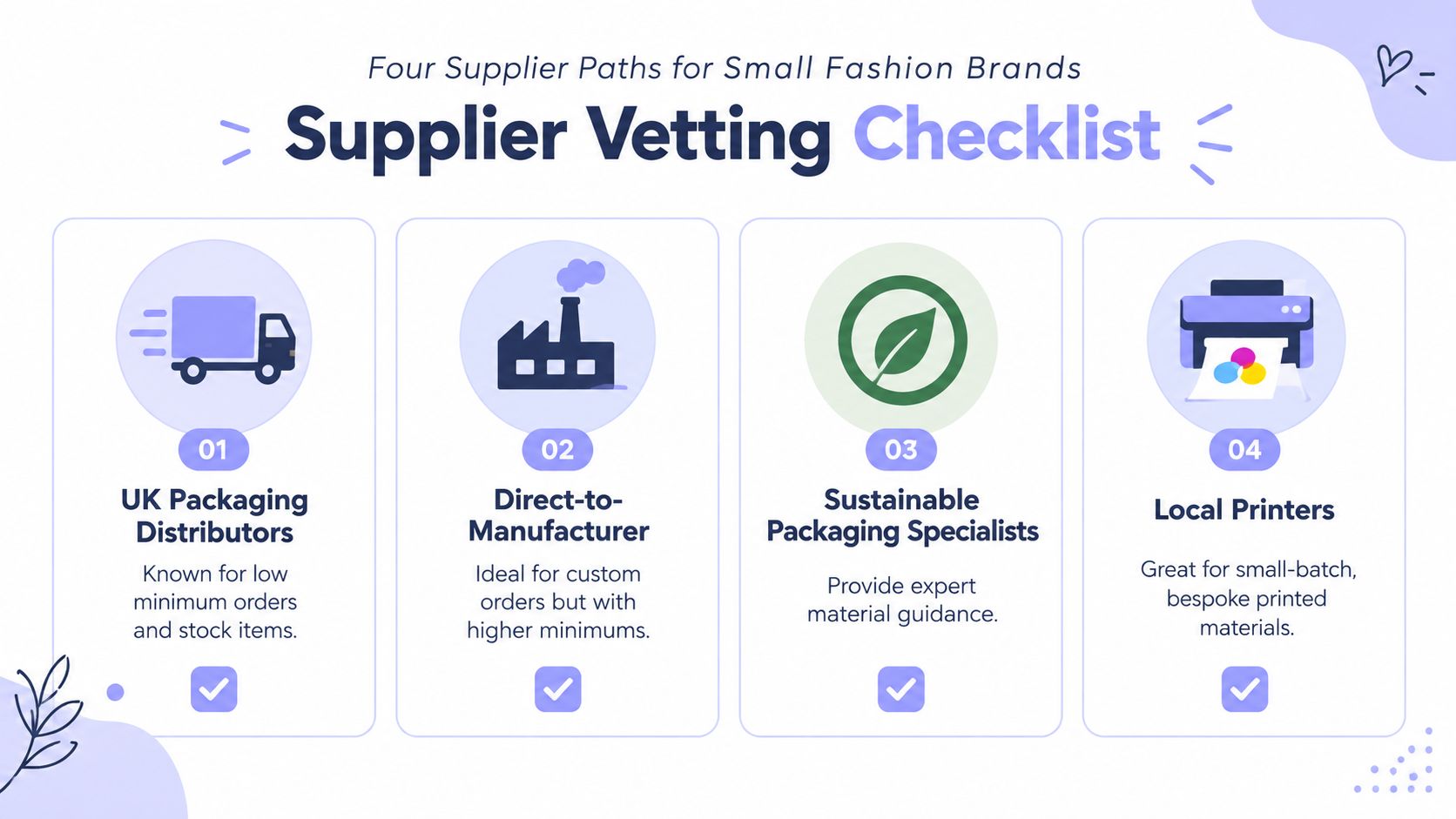
UK packaging distributors usually suit emerging brands that need stocked mailers, boxes or tissue in modest quantities. They can offer faster delivery and lower minimum orders, but customisation may be limited. Ask whether the stock item has a fibre certification, what adhesives or coatings it uses and whether the supplier can provide a current specification sheet.
Sustainable packaging specialists can be helpful when the material decision is complicated. They should explain the difference between recyclable, industrially compostable and home-compostable formats without making you do the detective work. Request evidence for FSC or PEFC paper, the Seedling logo for industrially compostable packaging and home-compostable certification such as TUV Home where relevant.
Trade printers are often the sensible route for branded tissue, stickers, cards and packing slips. They can handle small-batch artwork and recycled stock, although printed embellishments may introduce foils, laminates or adhesives that undermine the intended route. Ask for an uncoated, paper-compatible specification before approving the artwork.
Direct-from-mill suppliers make more sense for established brands ordering pallets and planning further ahead. They can offer deeper customisation and material control, but minimums, storage demands and lead times rise. A mill origin, chain-of-custody evidence and clear delivery terms matter more than a charming product photograph.
Sample before you commit
Request samples in the size and finish you intend to buy. Test them with the actual garment, label, tape and courier label, not a spare scarf that has never met a rainy doorstep.
- Ask for documents: Check certification numbers, material composition, recycled-content evidence and disposal instructions.
- Test the weak points: Pull the seals, fold the corners, expose the sample to ordinary handling and check whether ink, adhesive or coatings interfere with recycling.
- Call a reference: Ask another small brand about delivery reliability, damaged batches, artwork corrections and how the supplier handled a problem.
- Read the claim carefully: “Eco”, “green” and “biodegradable” without traceability are warning signs. So is compostable packaging sold without a clear facility or standard.
Small-batch production also rewards this discipline. A label refining its approach can learn from small-batch production practices, especially the value of controlled quantities and careful iteration. The packaging must support that rhythm rather than force a large speculative order.
For a garment such as The Lobster Bisque Dress, described as 100% organic linen with an organic cotton lining, the supplier conversation should focus on crease protection, breathable presentation and a pack that doesn't add unnecessary layers.
The Real Costs and Sustainability Trade-Offs
The cheapest packaging line on an invoice can become the expensive option once you include storage, packing time, failed seals, courier damage, replacement shipments and customer service. A paper mailer that costs less per unit but fails around a metal zip may be poor value. A heavier rigid box may protect the garment beautifully while increasing shipping weight and occupying half the stockroom.
The same whole-system test applies to sustainability. Recycled paper is usually familiar to paper recyclers and straightforward to print, but fibre sourcing, coatings and mixed components change the outcome. Home-compostable formats may avoid some mixed-plastic confusion, yet they can cost more, degrade slowly in cold or dry conditions and lack acceptance from local authorities or commercial composters. Reusable packs can perform well across repeated journeys, but only if customers return or reuse them.
| Material | Main Benefits | Costs and Trade-Offs | Best Use |
|---|---|---|---|
| Recycled kraft paper | Familiar paper route, printable, suitable for mailers and boxes | Moisture resistance can be limited, coatings and mixed parts complicate recovery | General garment shipping and folding cartons |
| Virgin kraft paper | Consistent strength and clean appearance | Fibre sourcing needs checking, and it may use more newly sourced fibre | Protection-critical packs where recycled grades fail |
| Corrugated card | Strong structure, useful for shaped garments and inserts | Takes storage space and adds material weight | Structured dresses, gifting and multi-item orders |
| Industrially compostable film | Can suit a controlled composting route | Not typically home recyclable, and infrastructure may not accept it | A clearly communicated specialist disposal system |
| Cotton or muslin | Reusable, tactile and suitable for dust protection | Heavier, costlier and dependent on genuine reuse | Rental, repeat delivery, gifting or return-loop models |
Measure failure rate and customer friction, not just material weight. If a lighter pack increases returns because garments arrive damp or creased, the apparent saving has moved elsewhere in the system. Likewise, a premium certification only buys a better outcome when the local infrastructure accepts the resulting material.
Freight choices belong in the same calculation. Right-size cartons, consolidate sensible deliveries and avoid shipping air, then use practical freight carbon reduction steps to examine the wider movement of packaging and stock. A beautiful pack that spends its life crossing unnecessary distances is still an unfinished design decision.
A material is only as sustainable as the system that carries it, uses it and receives it afterwards.
Designing Packaging That Works With UK Rules
Begin with the least complicated format that protects the garment. In practice, a clear, fibre-based mailer or box is often easier to understand and process than black plastic, metallised film, multilayer laminate or paper bonded permanently to plastic. The aim isn't to make a theoretical laboratory object. It's to create a pack that collection, sorting and reprocessing systems can handle.
UK packaging compliance now uses a staged recyclability assessment across material type and end-of-life performance. From 1 January 2025, liable producers must assess household packaging and report the result under the government methodology. For plastic packaging to qualify as widely collected at kerbside, it must be collected by 75% of local authorities, while current government guidance says no plastic flexible packaging exceeds a 14% collection rate. That makes flexible mailers and sleeves a high-risk choice, even when their material sounds technically recyclable. See the UK recycling assessment methodology before signing off a claim.
Build the pack as one material system
Keep the label, tape, adhesive and coating compatible with the main material where possible. Avoid a plastic window in a card box, unnecessary lamination, metallic finishes and seals that must be peeled away before recycling. If a window is essential, test whether it can be separated cleanly and whether the finished component still follows the route you intend to communicate.
Use the assessment as a design checklist:
- Choose the main material first: Mono-material paperboard or paper usually creates fewer separation problems.
- Control the print finish: Prefer inks and dyes that won't make the paper unsuitable for its intended route.
- Specify compatible closures: Paper tape and compatible adhesives are simpler than a mixed-material sealing system.
- Audit the finished pack: Test the actual printed, folded and sealed version, not an unprinted substrate sample.
The policy ladder is becoming more demanding. Under the Producer Responsibility Obligations regulations, plastic packaging recycling targets rise from 55% in 2025 to 65% in 2030, with annual steps in between, as set out in the UK legislation schedule. Packaging labels are also being phased in. All packaging except plastic films and flexibles must carry “Recycle” or “Do Not Recycle” by 31 March 2026, while plastic films and flexibles have a deadline of 31 March 2027, according to this UK packaging labelling overview.
For wider context on how material bans shape packaging decisions, this explanation of banned plastics in foodservice is useful. The principle transfers neatly to fashion: remove the awkward component before decorating it.
Shipping, Returns, and the Operational Reality
A packaging decision starts before the order exists. Look at the garment type, order profile, fulfilment location and return route together. A structured dress may need more support than a soft knit. A multi-item order may use one carefully folded paperboard pack where separate sleeves would create unnecessary layers.
Test the outer format in ordinary conditions. Put a sharp zip, metal button or embellished edge inside a paper mailer. Handle it repeatedly, expose it to damp weather and check the seams after courier-style movement. If extra protection is necessary, add a paper-based insert or tissue layer with a clear purpose. Don't reintroduce a plastic sleeve because the first test failed.
Make the packing bench predictable
Write a short packing sequence and train everyone to follow it. The instructions should show the garment fold, tissue placement, seal position, label location and return method. Consistency prevents the familiar improvisation of extra tape, bubble wrap and “just in case” sleeves.
The journey should account for five moments:
- Storage: Keep packaging flat, dry and easy to count.
- Order picking: Make insertion quick enough that the team won't reach for a shortcut.
- Shipping: Balance protection, dimensions and weight rather than chasing the lowest material cost.
- Unboxing: Make opening intuitive and avoid disposable decorative layers.
- Returns: Let the customer flatten, reseal or reuse the pack where the carrier and format allow it.
A downloadable returns label can remove friction, but the physical pack still needs to survive the journey home. Set out the process plainly in your returns policy, including what customers should reuse and what they should remove.
Track damage, replacement shipments, packing time, customer questions and return condition after launch. A lighter parcel isn't a win if it creates more failed deliveries. Even a small accessory such as Clubhouse Cocktail Napkins | Set of 4, made from 100% flax linen with a pale blue plain weave and red stitched border, needs a pack that protects the embroidery without wrapping it in a nest of unnecessary film.
Your Plastic Free Packaging Launch Playbook
A small label doesn't need a grand sustainability department to improve its packaging. It needs a short sequence, one owner for decisions and enough real-world testing to catch the soggy corners before customers do.
Week one and the material shortlist
Choose the garment categories that create the most packaging waste or handling trouble. Shortlist a paper mailer, folding box, tissue and closure system. Request samples in the actual dimensions you need, then record protection, storage footprint, seal strength and disposal instructions on one simple sheet.
Don't approve anything because the colour matches your website. If a pack needs a plastic window, mixed laminate or an unclear compostability route, mark it as a problem to solve rather than a charming detail to defend.
Week two and supplier evidence
Brief two suppliers with the same specification. Ask for material composition, fibre or compostability certification, print details, minimum order, lead time and disposal guidance. Compare answers rather than comparing only unit prices. A supplier who cannot show traceability should not receive the benefit of the doubt because the sample is pretty.
Week three and real parcels
Send five real orders to real homes, including at least one return. Use the garments most likely to expose weaknesses. Ask recipients whether the opening was easy, whether the disposal instruction made sense and whether the pack arrived intact. Inspect every returned parcel at the packing bench.
Week four and clear customer language
Launch with the website, packing slip, insert card and customer email aligned. Keep the wording specific:
- On the tissue: “Please recycle this paper with household paper and card where accepted.”
- On the insert: Name the material and explain the intended route.
- On the packing slip: State what to reuse for a return and what to remove first.
Avoid “guilt-free” and don't claim 100% plastic free unless every component, including adhesive, label, ink system and fulfilment material, meets that description. Say “FSC-certified paper mailer” or “industrially compostable mailer” only when those descriptions are accurate and supported by documentation.
Prepare for the forest question without becoming defensive. Paper has an environmental cost, and the answer is not that paper is automatically harmless. Explain the fibre source, the format chosen, the reason mixed materials were avoided and the disposal route customers should follow.
Review the system quarterly. Check supplier documents, stock levels, damage, returns, customer questions and whether the local guidance has changed. Packaging should improve like a well-loved seaside jumper, gradually and without pretending the first version was perfect.
Choose one garment category today, remove one unnecessary plastic component and order samples from two documented suppliers. Test those samples through packing, delivery and return before changing your whole range. Your next packaging decision should leave the customer with a beautiful garment, a clear disposal instruction and far less mystery in the bin.