

You're probably sitting with a sketchbook, a spreadsheet, and a mild sense of doom.
One page holds the dress you can already see swishing through a late-summer garden party. Another tab tells you that many factories prefer quantities so large they'd swallow your cash flow whole. You want to make something lovely and lasting, not order a mountain of stock and hope strangers appear to rescue it.
That's where small batch production stops being a factory term and starts feeling like a lifeline.
For many founders, it begins with one garment, one fabric, one careful production run. It might be a cardigan in British alpaca wool, a dress cut from a natural cloth you fell in love with, or a seasonless blouse you want to refine before you ever consider scaling. Instead of asking, “How much can I produce?” the better question becomes, “How little can I make well, sell wisely, and learn from quickly?”
There's something radical in that. Fashion has trained us to think bigger means better. Yet the most thoughtful brands often start like a baker making the first tray of scones before dawn, checking the rise, adjusting the oven, trusting craft more than volume.
Small batch production isn't a romantic shortcut. It's work. It asks for patience, sharper planning, and steadier nerves. But it also gives you something mass production rarely does. Room to listen. Room to improve. Room to make clothing with a pulse.
A Whimsical Promise in Every Stitch
A new founder once described her first production meeting to me as “bringing a teacup to a shipyard”. She had three finished sketches, a tiny fabric budget, and the stubborn hope that women still wanted clothes made with tenderness. The factory she first contacted asked for quantities that made her stomach drop. She didn't need thousands of units. She needed proof that her idea had legs, pockets, and a future.
So she changed the shape of the question.
Instead of chasing scale first, she built a tiny run around one hero piece. She ordered swatches, tested fit on real bodies, and treated each sample like a conversation rather than a cost. The process moved more slowly, but it felt alive. She could still change a cuff, soften a shoulder, or rethink a hem before any serious money was locked into stock.
That's the quiet charm of small batch production. It lets fashion behave more like correspondence than broadcast.
Small runs give a founder something precious in the early days. The chance to notice what people actually love before committing to rails full of guesses.
There's whimsy in it, yes, but not the flimsy sort. More the practical magic of choosing intention over noise. When you make fewer garments, each one carries more weight. The fabric matters more. The finishing matters more. The story matters more.
For conscious founders and careful shoppers, that changes everything. A garment no longer arrives as anonymous product. It arrives as the result of decisions made close to the cloth. Someone chose not to flood the world with copies. Someone paused long enough to ask whether the piece was worthy of being worn again next year, and the year after that.
Small batch production begins there. Not with machinery, but with restraint. Not with hype, but with care.
What Is Small Batch Production Really
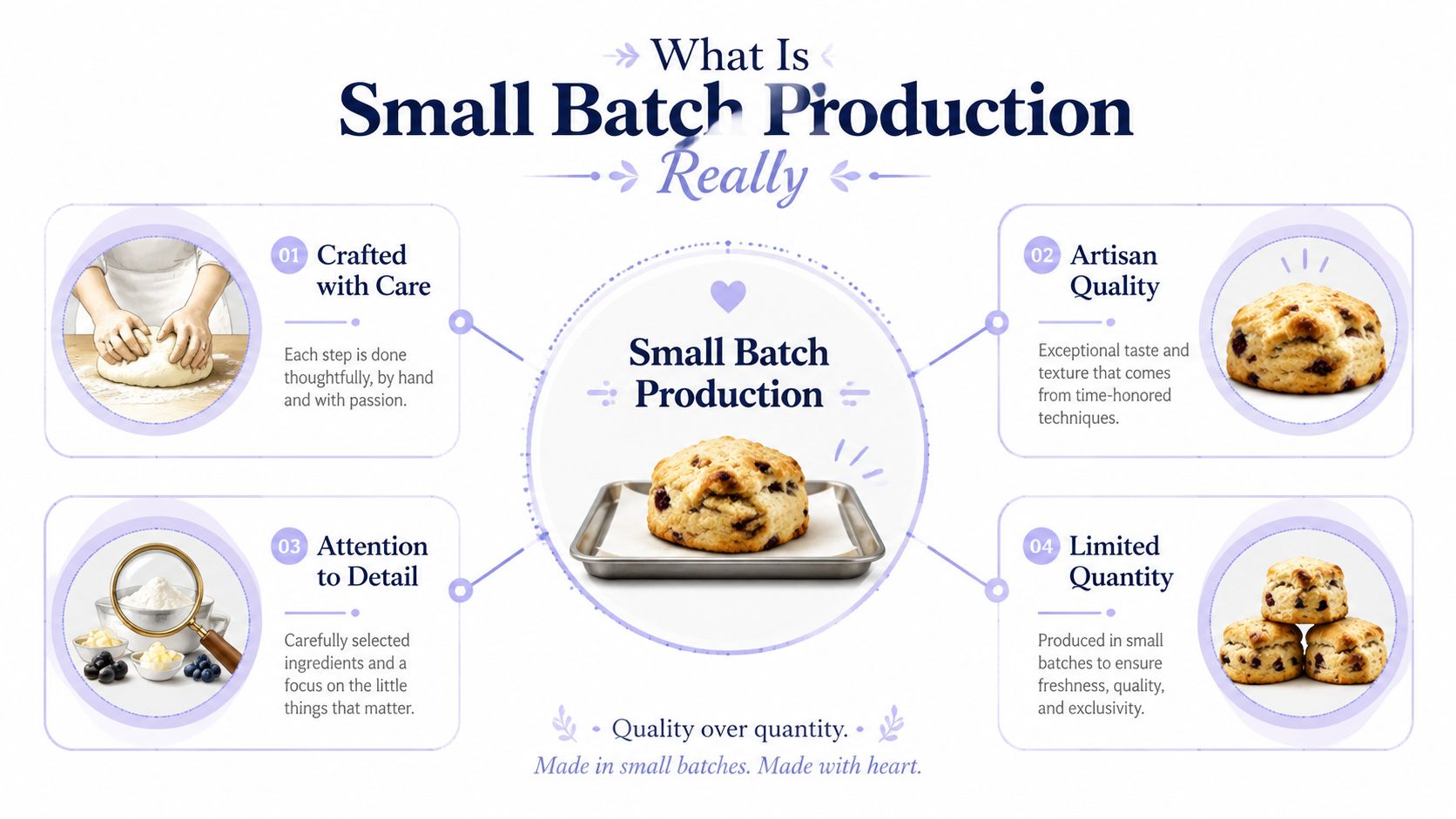
Think of a baker making a dozen perfect scones for a village café.
She watches the butter, notices the dough, and adjusts for the weather if she must. A biscuit factory, by contrast, is built to repeat at speed. Both make baked goods. Only one is organised around touch, variation, and close attention.
That's the easiest way to understand small batch production in fashion. It's a limited production run designed to keep quality high and decisions flexible, rather than chasing volume for its own sake. In practical terms, UK small batch manufacturing is typically defined as around 30 to 500 units per style. That range is big enough to create a proper collection presence and small enough to avoid tying up capital in thousands of pieces before demand is clear.
What makes it different
In a small run, the founder and manufacturer can still respond to reality. If the first sample twists at the side seam, it can be fixed. If customers love the navy knit and ignore the oat one, the next run can reflect that. If a sleeve needs more room, the lesson isn't buried under piles of unsold stock.
That's why small batch production fits naturally with the values behind slow fashion. The point isn't just to make less. It's to make with more thought.
A small batch usually has these characteristics:
- Limited volume that keeps inventory risk lower than mass production.
- Closer quality control because each stage is easier to inspect.
- Faster learning loops because customer feedback can shape the next run.
- More room for special materials that may not exist in industrial quantities.
What it doesn't mean
It doesn't mean amateur. It doesn't mean expensive for the sake of looking exclusive. And it doesn't mean you avoid systems.
In fact, small batch production often requires sharper systems because every unit matters. One cutting error has consequences. One delayed trim can hold up an entire run. One poorly judged colourway can leave you with a rail of expensive regret.
The reward is flexibility. Instead of betting the farm on your first idea, you place smaller, smarter wagers. That's less like gambling and more like good dressmaking. Measure, cut, check, then commit.
The Sun and Storms of Crafting in Small Numbers
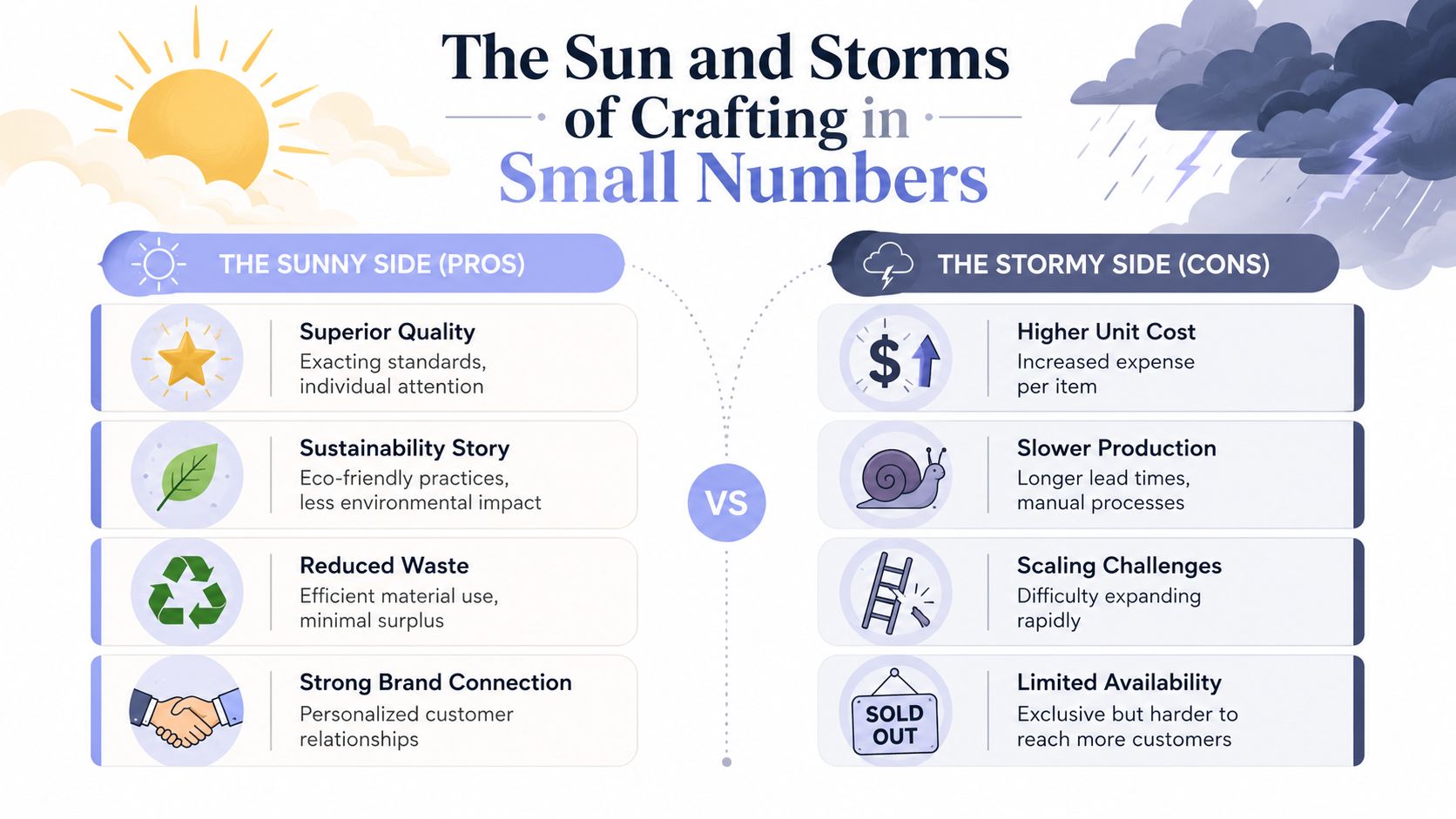
Small batch production has a sunlit side that's easy to fall in love with. Better craftsmanship. Fewer wasted garments. A more intimate relationship with your customer. Founders often feel they can finally breathe because they're building with care instead of sprinting into overproduction.
The momentum behind that model is real. In the third quarter of 2024, average sales for small and mid-sized UK clothing manufacturers surged by 128%. That's a striking sign that agility and sustainability aren't fringe ideals. They're commercially meaningful when brands use them well.
Where the sun shines
When a run is small, a team can notice things. They can catch tension at a seam, test how a cloth behaves after wear, and make adjustments before mistakes spread. That level of attention is hard to replicate when production is organised around scale first.
Small runs also help with brand clarity. Customers can feel the difference between a garment developed with intention and one made to fill a drop calendar. The storytelling becomes honest because the process itself is more traceable.
A few practical benefits stand out:
- Quality stays visible because makers can inspect each piece more carefully.
- Waste is easier to control because brands aren't forced into oversized commitments.
- Product development improves because feedback from one run can shape the next.
- Local relationships deepen when brands work closely with smaller workshops and specialist suppliers.
Where the weather turns
Now for the part that glossy brand decks tend to skip.
Small batch production can be awkward operationally. Some mills prefer larger orders. Some trim suppliers are slow to respond when you only need a modest quantity. Some manufacturers are warm and collaborative until they realise your first order is nowhere near their ideal scale.
Practical rule: If a supplier treats your first small run like an inconvenience, believe them early. A strained relationship at sampling rarely becomes smoother in production.
There's also the emotional challenge. Selling out sounds chic until customers can't get your best piece in their size. Limited runs create scarcity, but they also create disappointment if replenishment planning is weak.
A balanced view
The best founders don't treat small batch production as morally superior or automatically easier. They treat it as a tool.
| Sunny side | Stormy side |
|---|---|
| Craft quality is easier to protect | Per-unit costs are often higher |
| Inventory risk can stay lower | Supplier options can narrow |
| Customer feedback arrives sooner | Restocks require tighter planning |
| Brand story feels grounded in reality | Growth can feel less linear |
That balance matters. Small batch production is beautiful when it's paired with disciplined operations. Without that discipline, the same model that protects you from overproduction can leave you chasing late trims, guessing demand, and apologising for delays.
A Practical Pattern for Small Batch Success
A small run starts long before a needle meets cloth. It starts when a founder decides what deserves to exist first.
The mistake I see most often is trying to launch a whole world at once. Too many styles. Too many colours. Too many fabrics. Small batch production works best when you narrow the field and make the first collection do one clear thing well.
Start with one anchor piece
Begin with the garment that best expresses your brand. Not the easiest one. The clearest one.
If you're making womenswear, that might be a dress with a memorable silhouette, a cardigan with beautiful yarn and buttons, or a trouser shape that solves a fit problem elegantly. Your anchor piece sets the standard for fabric, finishing, pricing, and photography. Once it's right, supporting styles become easier to judge.
Build your run around decisions, not hope
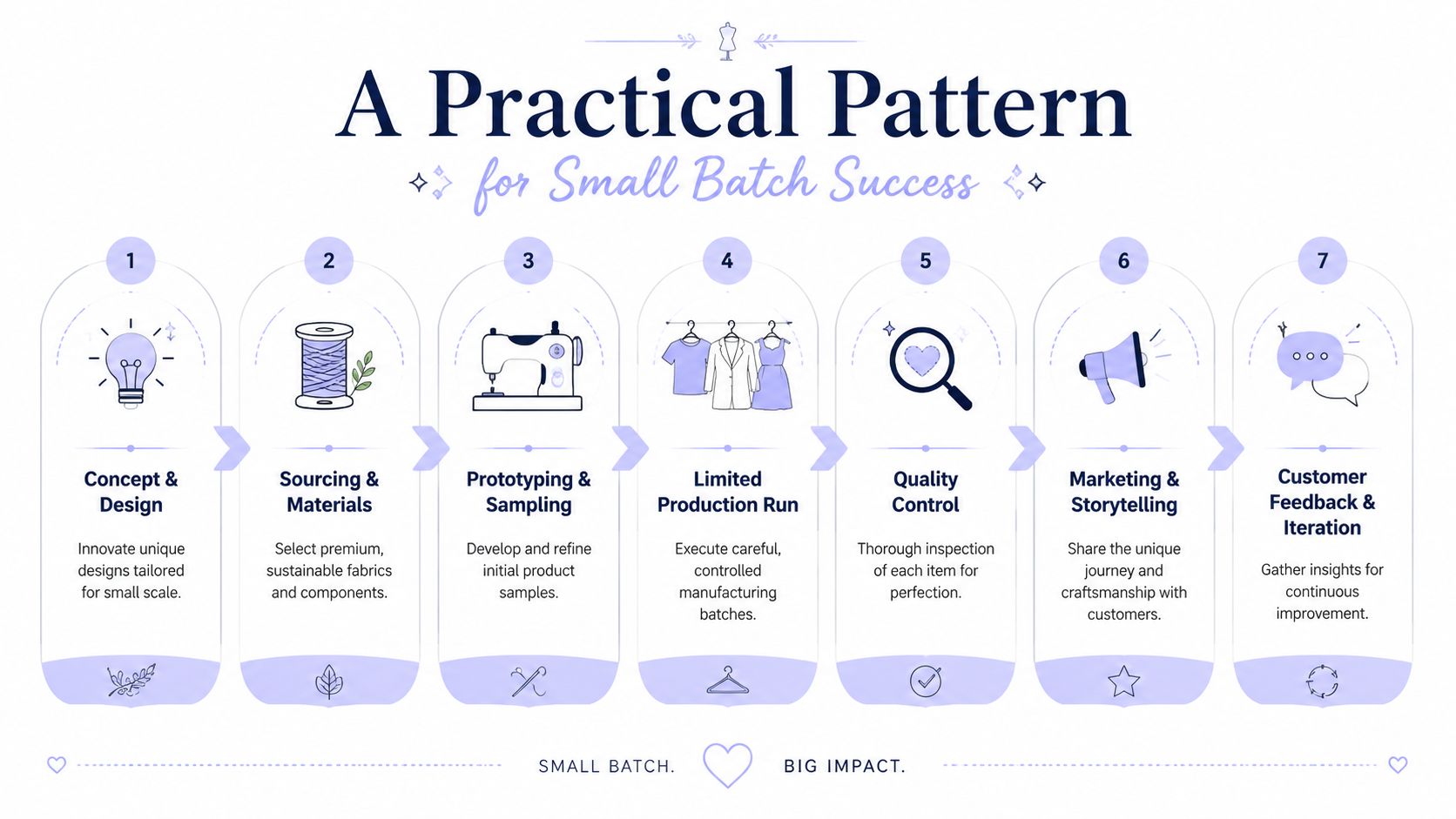
A sensible small batch plan usually follows a sequence like this:
- Choose fewer styles than you want. A compact launch reveals customer preference more clearly than a crowded one.
- Source materials you can reorder. Deadstock can be wonderful, but only if you're comfortable never repeating the exact piece.
- Sample until the garment behaves properly. Fit, movement, lining, fastening, and aftercare all need testing.
- Grade carefully across sizes. Small production doesn't excuse poor size consistency.
- Set a realistic production calendar. Leave room for supplier delays, revisions, and inspections.
- Inspect during production, not only at the end. Catching issues mid-run is cheaper than repairing finished mistakes.
Systems become your best friend. A good stock plan prevents the common founder panic of selling one size out immediately and staring sadly at a stack of the least popular colour. If you need help shaping that side of the business, ECORN's inventory management expertise offers a practical way to think about stock decisions before they turn into expensive clutter.
Sampling is where money is saved
Founders sometimes resent sampling because it feels like paying for garments you can't yet sell. In reality, the sample room is where you buy clarity.
A sample tells you whether the neckline sits properly. Whether the sleeve pitch restricts movement. Whether the zip choice cheapens the piece. Whether a fabric that looked heavenly on the hanger turns troublesome after a day's wear.
Sample with the customer's life in mind. She isn't standing still in perfect lighting. She's sitting, walking, packing, washing, rushing, and living.
Quality control should be tactile
In mass production, quality control can become abstract. In small batch production, it can still be personal.
Check garments as they come off the line. Look for consistency in topstitching, seam allowance, pressing, label placement, and measurements. Try pieces on. Steam them. Fold them. Pack them as a customer would receive them. This isn't fussiness. It's product development in real life.
Keep the first run teachable
A good first batch isn't one that proves you were right about everything. It's one that teaches you what to make next with more confidence.
That might mean discovering your customers want one dress in three dependable colours rather than six experimental ones. It might mean realising your best fabric belongs in a knit, not a blouse. Or it might mean seeing that your strongest sales come from a shape customers can pre-order with confidence because the fit is already trusted.
When you build the run to learn, not just to launch, small batch production starts behaving like a business model instead of a gamble.
The True Cost of Thoughtful Creation
Let's say the quiet part out loud. UK small batch production often costs more. Sometimes much more.
The reason isn't mystery or inefficiency alone. It's the combination of labour, lower volumes, domestic sourcing constraints, and the simple fact that tiny runs don't enjoy the same economics as large overseas orders. According to Make it British, true UK micro-production can require 2 to 3 times higher per-unit costs than overseas alternatives, and 68% of UK womenswear startups switch to India or China after 12 months because UK unit pricing becomes unsustainable.
That statistic stings because it exposes the gap between the romance of making locally and the arithmetic of surviving.
Why the numbers feel so tight
When you make in small quantities, each decision carries more cost. Pattern cutting, grading, machinist time, sampling, and specialist finishing aren't spread over a huge run. If you're using natural or lower-impact materials, your fabric bill may rise too. If you insist on quality packaging and proper inspection, that adds another layer.
None of this means the model is broken. It means the pricing strategy must match the production philosophy.
How founders can offset the pressure
The strongest solutions tend to come from business model design, not wishful thinking.
- Use pre-orders carefully so customer demand funds part of the run before you commit cash to full production.
- Build a premium position by explaining quality, origin, materials, and longevity without drifting into empty luxury language.
- Design for repeat wear so one piece earns its place through versatility, not novelty.
- Explore rental options for standout garments with occasion appeal, increasing the useful life and revenue potential of a single piece.
For brands committed to better materials, cost control often begins at fabric choice and yield. A thoughtful read on eco fabrics available in the UK can help founders think more clearly about materials that support both story and margin.
The goal isn't to make UK production cheap. It's to make it sustainable enough that you don't have to abandon it the moment your first loyal customers arrive.
Pre-ordering also changes the emotional rhythm of a launch. Customers aren't making an ordinary purchase from a shelf. They're participating in its making. Done well, that creates patience, trust, and a stronger connection to the final garment.
Rental adds another useful twist. Instead of assuming every customer wants permanent ownership, it gives certain pieces a longer earning life. For occasionwear, statement knitwear, or highly distinctive items, that can soften the pressure of higher UK unit costs without diluting quality.
Finding Your Fellow Artisans and Suppliers
Choosing a manufacturer is less like hiring a vendor and more like casting a play. Technique matters, of course, but temperament matters too.
The UK market is both promising and fragile. IBISWorld projects that the UK clothing manufacturing industry will comprise 3,762 businesses in 2026, after declining at a compound annual growth rate of 2.1% between 2021 and 2026. That shrinking picture makes the good small-batch partners even more valuable. They're often resilient specialists, not interchangeable factories.
What to look for first
A founder's first instinct is often to ask about price. Ask about process instead.
You want to know how a workshop handles sampling, pattern amendments, lead times, quality checks, fabric issues, and communication during delays. A lower quote means very little if the partner can't manage a nuanced, low-volume run.
A useful shortlist should include partners who can answer these clearly:
- What is your preferred order size for my type of product?
- How do you handle revisions after the first sample?
- Which parts of production happen in-house and which are outsourced?
- What does quality control look like before dispatch?
How to read the relationship
Good suppliers don't just say yes quickly. They ask sensible questions. They want tech packs that make sense. They'll tell you when your chosen cloth is too unstable for the silhouette. They'll push back if your timeline belongs in a fairy tale rather than a calendar.
That kind of honesty is gold.
If you're building a tactile, detail-led brand, it also helps to study adjacent examples of small-order sourcing outside garments. Even packaging choices can teach you how specialist suppliers think about minimums, print runs, and presentation. I've found that guides on practical procurement, such as finding custom cups for small businesses, can sharpen your eye for the broader small-order ecosystem.
Where values show up
Craft values aren't only visible in fabric and finishing. They show up in how people communicate, solve problems, and handle constraints. A supplier who respects your vision without indulging fantasy is often worth far more than the cheapest option on the list.
If your brand is rooted in detail, texture, and hand feel, it helps to stay close to the language of artisan craftsmanship. That mindset will guide your questions and help you spot the difference between a workshop that merely accepts small orders and one that's built to do them beautifully.
A Case Study from The Lavender Lobster
One of the clearest expressions of small batch production at The Lavender Lobster is a piece like the Lobster Bisque Dress. It feels playful at first glance, but the business logic behind a garment like that is remarkably grounded.
A distinctive dress doesn't need to begin with a giant run to succeed. It benefits from a measured launch. A pre-order window can reveal whether customers are drawn to the shape, the fabric, and the colour story before deeper production commitments are made. That protects cash and keeps the design team close to real demand rather than hopeful forecasting.
The beauty of a small-batch approach is what happens next. Finishing can stay meticulous. The story of the garment stays intact. If customers respond warmly, the next run can be adjusted with more confidence. If they ask for a variation, the brand has room to listen.
That same thinking suits pieces made from 100% British alpaca wool, where material quality deserves centre stage and overproduction would dull the whole point. A careful run, a clear story, and a long-wearing design. That's where whimsy becomes durable rather than decorative.
Your Small Batch Questions Answered
How do I scale without losing quality or creating waste
Scale in phases, not leaps. That matters because UKFT reports that 45% of young UK fashion brands exceed 30% overstock waste within two years because they lack phased scaling frameworks, and that emerging pre-order plus rental hybrids can help solve this.
So don't jump from one modest run to a giant seasonal gamble. Repeat proven styles, test newness in tight quantities, and let your replenishment plan follow actual demand.
How should I manage customer expectations on pre-orders
Be specific and calm. Give a realistic delivery window, explain why the garment is being made this way, and send updates when milestones are reached. Customers are usually patient when they feel informed rather than fobbed off.
A small note from the founder, a production update, or a fabric arrival message can make the waiting feel like participation rather than delay.
I'm just starting out. Where do I find my first manufacturer
Start narrow. Look for manufacturers who already make your category well, whether that's knitwear, dresses, or soft tailoring. Speak to people at trade events, ask pattern cutters who they trust, and request small sample runs before discussing a larger order.
What should I launch first
Launch the piece that best represents your standards and can be worn often. Occasion pieces are lovely, but a versatile hero garment often teaches you more about fit, pricing, and repeat demand.
Is small batch production only for luxury brands
No. It suits any brand that wants tighter control over quality, inventory, and story. The key isn't whether your label sounds luxurious. It's whether your operations can support thoughtful, limited runs without pretending scarcity alone creates value.
If you're drawn to fashion that pairs small batch production with natural fibres, pre-orders, rentals, and a little seaside whimsy, explore The Lavender Lobster.