

A British alpaca cardigan begins in mist, not on a shop rail. Fleece, hands, dye, thread, tissue paper, and a front door all belong to its story.
The Story Behind Every Stitch
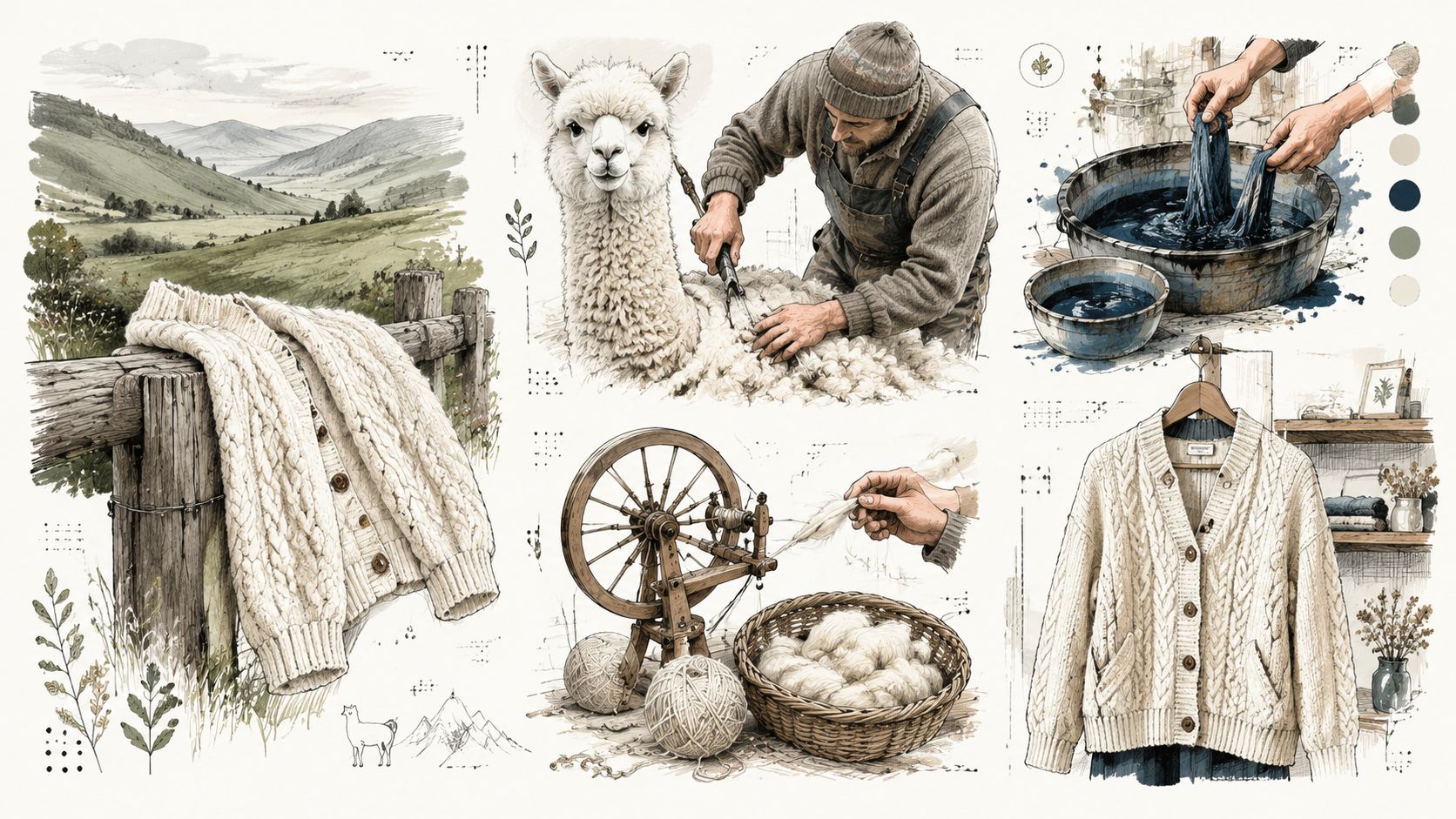
The cardigan is soft enough to invite a second touch. Its fibre began on British hills where alpacas were shorn, then travelled through the careful work of spinners and dyers before becoming a knitted layer with a little countryside cloudiness about it. Somewhere along the way, people made decisions about payment, safety, materials, timing, waste, and what could be told to the person who would eventually wear it.
By the time the cardigan arrives folded in tissue, the final scene looks serene. The underlying story is more intricate. A responsible brand needs to know where the fibre came from, who handled it, how the material was processed, and which records support those answers. Supply chain ethics is the moral framework behind those decisions, from raw-material extraction to final delivery. It asks who is paid, how ecosystems are treated, what is disclosed, and who is accountable when something goes wrong.
The invisible journey
A garment can pass through farms, mills, dye houses, factories, warehouses, couriers, and retailers. In a fragmented fast-fashion chain, the customer may see a simple T-shirt while the brand sees a complicated network of suppliers and subcontractors. If the brand only knows its direct factory, it may know very little about the people who spun the yarn or processed the raw fibre.
That distance creates ethical risk. A polished policy can sit on a website while purchasing teams reward shorter deadlines, lower prices, and sudden changes that suppliers must absorb. Responsibility lives in those everyday commercial choices, not only in a beautifully worded sustainability page.
For a more detailed look at how brands can make their sourcing information clearer, explore supply chain transparency in fashion. Transparency isn't the same as perfection, but it gives customers and workers something solid to question, check, and improve.
A useful question: Can this garment's journey be explained by a person who knows the farms, mills, makers, and terms behind it?
Every purchase is a small vote, although it isn't a magical wand. Choosing a traceable garment doesn't solve the industry's problems overnight, but it can support a model where longevity, honest information, and fair treatment matter more than frantic replacement. The cardigan becomes more than a colour and a silhouette. It becomes a little woolly map of values, with fewer blank spaces.
Four Pillars of a Conscience-Driven Supply Chain
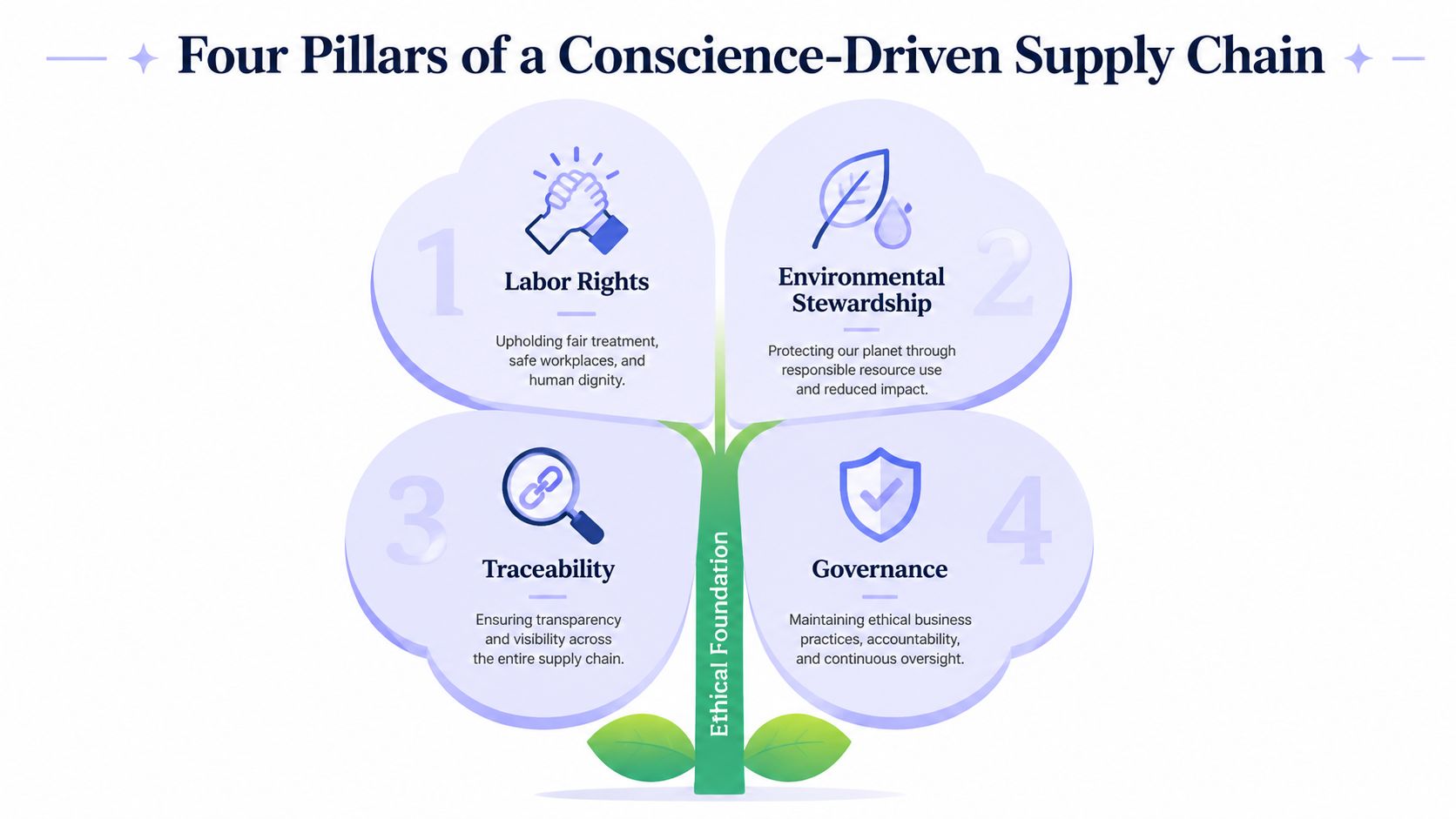
Ethical sourcing resembles a four-leaf clover. Each leaf has a different shape, but the stem joins them. Remove one, and the lucky charm may still look pretty, yet it won't hold its meaning.
Labour rights
The first leaf protects the people who make, process, pack, and transport clothing. It includes living wages, safe conditions, freedom of association, and the elimination of forced and child labour. These aren't decorative additions to a brand identity. They form the minimum conditions for treating workers as people rather than invisible production capacity.
A supplier code can set expectations, but workers also need ways to raise concerns without retaliation. Worker interviews, accessible grievance routes, and attention to working hours reveal details that a tidy management meeting may miss. A brand should ask whether its own buying behaviour supports those standards, especially when it changes orders late or presses suppliers to accept unsustainable prices.
Environmental stewardship
The second leaf concerns the places where people live and work. Water use, chemical management, carbon emissions, biodiversity, and waste reduction all belong in the conversation. A fibre isn't automatically responsible just because it sounds natural, just as a synthetic fibre isn't the only material worth examining. Farming, spinning, dyeing, finishing, packaging, and transport each create different questions.
Environmental harm can become a labour issue when polluted water, damaged soil, or unsafe chemical handling affects surrounding communities. That connection matters because social and environmental responsibility can't be separated neatly into two tidy drawers.
Traceability
The third leaf is the magnifying glass. Tier-one visibility means a brand knows its direct manufacturing partner. Full mapping follows materials further back, towards mills, processors, farms, and other raw-material origins. British alpaca traceability gives a very different basis for accountability from an unverified wool blend whose provenance remains unclear.
Traceability isn't only about collecting names. The information needs to support action. A brand should know which suppliers face higher risks, what evidence exists, and whether corrective work has closed the problem.
Governance
The fourth leaf gives the others a spine. Governance includes anti-corruption controls, grievance mechanisms, board-level oversight, documented responsibilities, and public reporting cadences. In the UK, the Modern Slavery Act 2015 and its Section 54 guidance require qualifying commercial organisations to publish a statement each financial year, secure board approval, and place a prominent homepage link to it.
Parliament describes the Act as world-leading when enacted, and Section 54 applies to organisations carrying on business in the UK with annual turnover of at least £36 million. Parliament's report on the Act identifies 2015 as the foundational milestone for the UK's corporate supply-chain reporting duty.
These leaves depend on one another. Traceability without governance becomes data without teeth. Strong labour practices can't compensate for environmental damage that harms workers' communities. For readers who want a practical companion, this guide to how to identify fair labor fashion offers useful questions for looking beyond the label.
Decoding the Certifications That Matter Most
A certification logo can steady a shopper's hand over the label, but it cannot certify an entire garment's moral story. Fair Trade may examine producer relationships, price floors, and community premiums, while leaving other materials or production stages outside its scope. The useful question is always: which part of the journey has been checked?
GOTS, the Global Organic Textile Standard, brings organic fibre requirements together with processing criteria and labour expectations. That gives it a wider material-to-processing reach than a label verifying fibre content alone. It does not settle every farm-level animal-welfare question, so alpaca or wool still needs separate provenance evidence. A traceable British alpaca story, for example, should stand on more than a polished fibre claim.
B Corp reviews a company's governance, workers, community, and environmental impact. Its label applies to the organisation, not automatically to each garment or supplier. SA8000 concentrates on labour rights and working conditions, drawing on International Labour Organization conventions. It can illuminate worker treatment, but it does not replace checks on materials, chemicals, or environmental effects.
OEKO-TEX Standard 100 tests finished textiles for harmful substances. That matters for clothing worn against the skin, yet a clean chemical result cannot prove fair wages, safe workplaces, or responsible fibre production.
Living-wage initiatives, including the Fair Wear Foundation's wage ladder, let brands compare actual pay with living-wage benchmarks. They may show whether payroll is approaching a meaningful standard rather than merely meeting the legal minimum, but the ladder itself does not prove that every worker receives a living wage.
| Certification | Primary focus | Audit rigour | Key limitation |
|---|---|---|---|
| Fair Trade | Producer pricing and community benefits | Scheme-specific verification | Coverage may apply only to defined products or stages |
| GOTS | Organic fibre, processing, and labour criteria | Chain and processing checks | Doesn't always settle farm-level animal welfare |
| B Corp | Company-wide governance and impact | Governance, worker, community, and environmental review | Doesn't certify every supplier equally |
| SA8000 | Labour rights and working conditions | Labour-focused management system | Doesn't cover the full environmental picture |
| OEKO-TEX Standard 100 | Chemical safety in finished textiles | Product testing | Doesn't verify wages or labour conditions |
| Fair Wear wage ladder | Living-wage progress | Benchmarking and brand engagement | A wage ladder isn't itself proof that every worker receives a living wage |
For a closer guide to ethical manufacturing standards, examine what each scheme covers and what it leaves open. A product such as The Lobster Bisque Dress can be described as a garment made with attention to natural materials, but that description alone is not evidence of a labour audit. A pre-order approach can also reduce excess production, yet it does not replace proof of fair purchasing terms or supplier conditions.
Read labels as clues, not conclusions. Ask whether the certification covers the fibre, factory, company, or finished product. Then look for evidence of worker interviews, corrective action, audit methods, and ongoing improvement. A logo marks one checked doorway. The sourcing record shows how much of the garment's story lies beyond it.
Why Made Locally Is Not Always Made Ethically
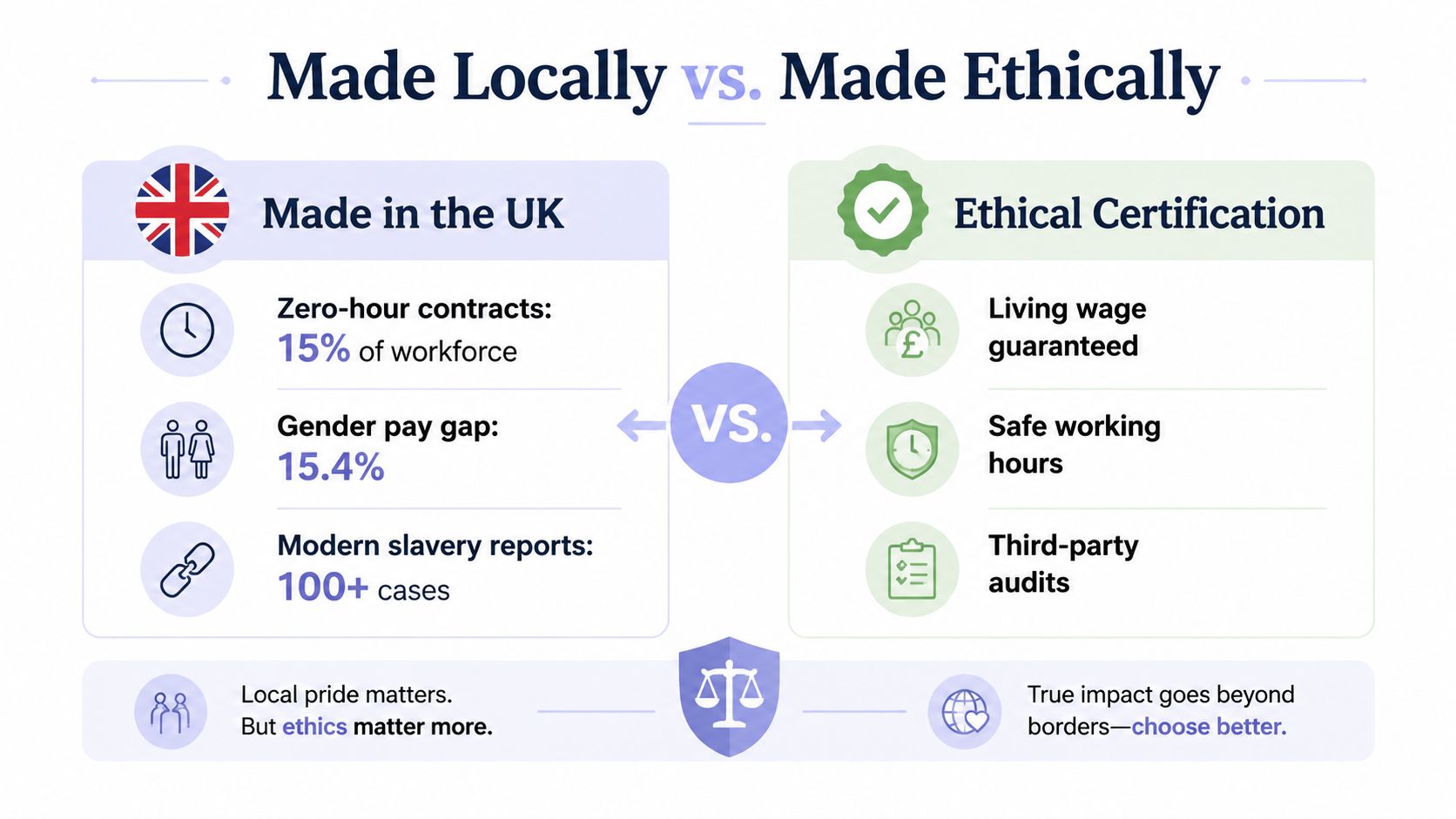
A Union Jack on a swing tag can feel reassuring. It suggests nearby hands, familiar laws, and a shorter route from workshop to wardrobe. But geography is not an ethical certificate.
UK manufacturing still depends on purchasing relationships. If a retailer demands last-minute changes without covering the cost, a local workshop can face pressure just as severe as a distant supplier. A joint evaluation reported in 2026 found that 78% of manufacturers said retailers don't cover the cost of last-minute order changes, while 29% said sudden cancellations had already forced layoffs. Those figures come from the UKFT report on responsible UK fashion and textile supply chains.
The postcode test fails
A factory can sit a short journey from a brand's studio and still lack meaningful worker voice, reliable grievance channels, or fair purchasing terms. An overseas facility can, by contrast, operate under a rigorous labour standard and provide stronger evidence of how workers are treated. The important comparison isn't Britain against everywhere else. It's verifiable practice against comforting assumption.
That means checking subcontracting, pay structures, working hours, safety systems, audit methods, and remediation. A brand that says “made in the UK” has answered one geographical question. It hasn't necessarily answered who made it, under what conditions, and with what power to object.
The same principle applies to reshoring. UKFT's responsible-supply-chain work was built through workshops with brands, manufacturers, and compliance experts, and it identifies gaps in legislation, training, tools, and incentives. Domestic production can be valuable, but it needs commercial behaviour that supports stable work rather than treating local proximity as proof of virtue.
The better question isn't “Was this made near me?” It's “What evidence shows that the people who made it were treated fairly?”
Public procurement reflects this wider view. PPN 02/23 is titled “Tackling Modern Slavery in Government Supply Chains”, and the Supplier Code of Conduct requires suppliers to comply with the Modern Slavery Act 2015 and ensure subcontractors do the same, as outlined in UKFT's sustainability survey report.
Local pride has a place. It shouldn't replace worker interviews, traceability, third-party scrutiny, or fair commercial terms.
How Brands Build Ethics Into Every Decision
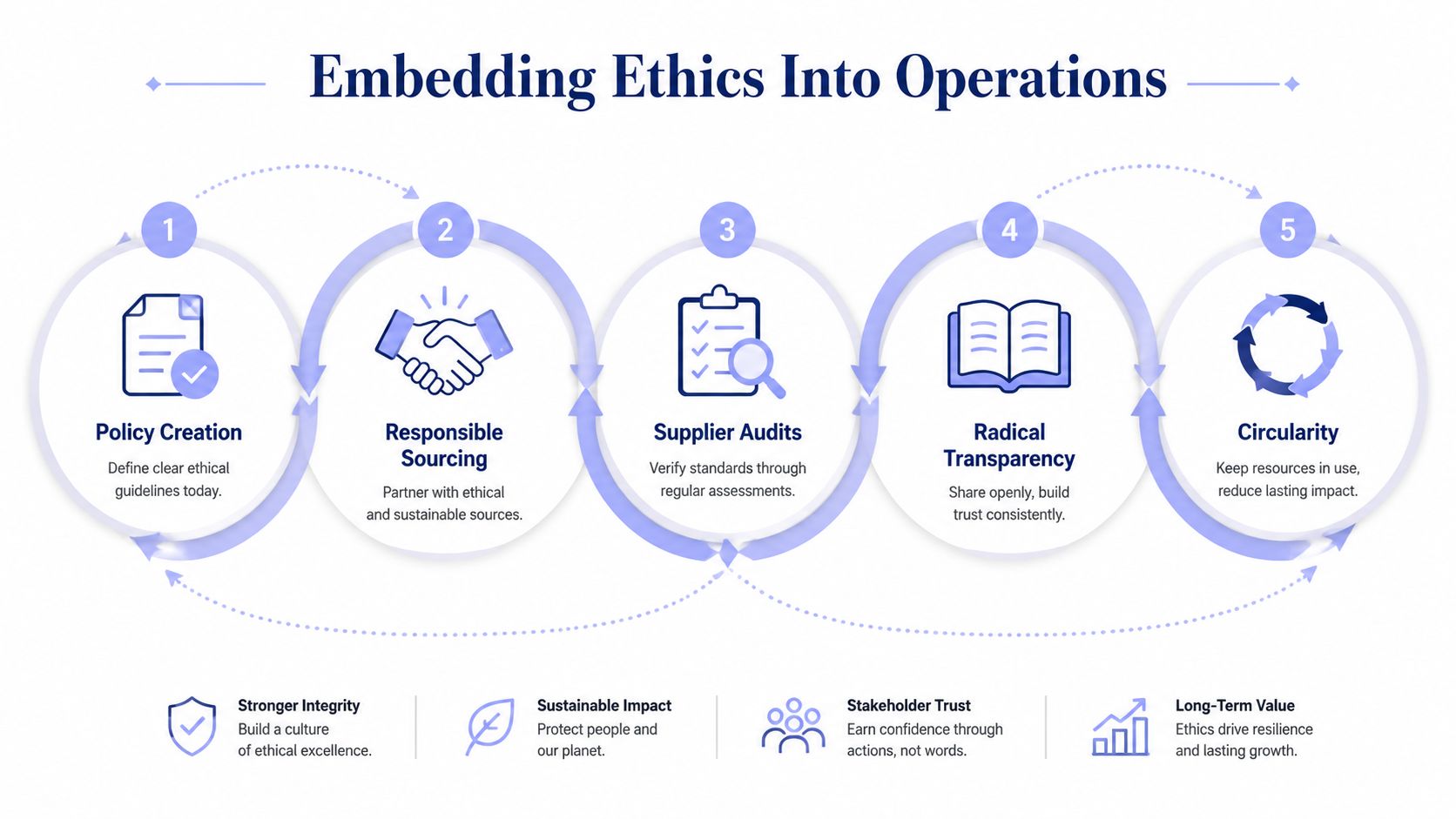
Ethics becomes credible when it enters the calendar, the contract, the costing sheet, and the product brief. A brand doesn't build a responsible supply chain through one grand gesture. It builds one through repeatable decisions that leave an audit trail.
Start with a policy that travels
A supplier code of conduct should set firm expectations for labour, safety, environmental care, anti-corruption, and grievance access. It needs to reach every relevant supplier and subcontractor, not remain tucked inside a company folder like a shy little hedgehog.
Governance also needs an owner. Under Section 54, qualifying UK organisations must publish a modern slavery statement each financial year, obtain board approval, and link to it prominently from the homepage. In 2022, only 29% of firms required to file had registered a statement with the UK government, while the registry recorded 8,730 statements, down 46% from 15,019 the previous year, according to analysis of UK modern-slavery reporting compliance. Publication is a starting control, not proof of excellent practice.
Choose materials with a paper trail
Responsible sourcing begins before the factory. A brand can ask where a fibre was grown or raised, which mill processed it, what chemicals were used, and how the material moved through the chain. British alpaca is useful here because farm-to-finished-knitwear traceability can make the route more visible. GOTS-certified organic cotton offers another route for material and processing scrutiny.
Audit for reality, not theatre
Announced, checklist-style visits can create a polished performance. Stronger assessments combine document review with worker interviews, unannounced elements where appropriate, corrective-action tracking, and repeated follow-up. The purpose isn't to punish every imperfection. It's to discover problems early and close them with evidence.
Publish enough to be questioned
Radical transparency might include supplier names, material origins, production stages, purchasing practices, and cost breakdowns. The UK now has a central public register of modern slavery statements, while independent datasets track more than 60,000 statements dating back to 2016, as shown by TISC Report's transparency data. The volume creates room for comparison, but publication alone doesn't guarantee quality.
Design for circularity
Pre-orders can align production with known demand and reduce the risk of making stock that sits unwanted. Repairs, rentals, take-back schemes, and thoughtful offcut use extend the useful life of materials. The Sailor Hats are made from offcuts of larger garments, with each hat individually made by UK seamstresses and offered in Garden Society, Ledger, and Regatta Stripe prints, subject to fabric availability.
The Lavender Lobster's pre-order approach, direct mill relationships, and fair purchasing terms show how these ideas can become operational rather than ornamental. The magic is practical. It lives in a production plan that respects materials, makers, and the people waiting for the finished piece.
A Shopper's Guide to Spotting Genuine Responsibility
Shopping ethically doesn't require a detective's trench coat, although a small magnifying glass would suit the mood. Use five questions to test whether a brand's story contains evidence or only glitter.
The show-me test
Can the brand name its farms, mills, factories, or makers? “Ethically sourced” is a broad claim. A useful explanation identifies the material and the stage of production, then gives you enough detail to understand what remains unknown.
The numbers test
Does the brand publish meaningful information about wages, water, chemicals, emissions, or waste? It needn't have every answer perfected, but it should distinguish measured facts from aspirations. If a page offers only soft adjectives, this guide to spotting greenwashing can help you examine the wording more critically.
The longevity test
Look for repair support, take-back options, rental, durable construction, or pre-order production. These signals suggest the brand is thinking beyond the first sale and the next collection. Longevity turns a garment from a mayfly into a well-dressed tortoise.
The certification test
Check whether a recognised third party supports the claim. Fair Trade, GOTS, B Corp, SA8000, OEKO-TEX Standard 100, and living-wage initiatives each cover different concerns, so ask what the logo verifies.
The story test
Could the brand trace one garment from fibre to finished product without changing the subject? A clear answer should mention origins, processing, people, and limitations. It should also explain how the brand responds when evidence reveals a problem.
Consumer demand adds a difficult wrinkle. A 2026 UK survey found that 68% of Britons said ethics matter, yet price or quality was the most common basis for the last clothing purchase, and only 12% chose the most ethical option regardless of cost, according to reporting on the survey. The same research found a premium ceiling of about 8% before shoppers returned to cheaper options, while 48% had never checked supply-chain information before buying.
That tension calls for precise communication, not guilt. Even a small linen accessory can carry useful evidence. Clubhouse Cocktail Napkins | Set of 4 are described as embroidered napkins made from 100% flax linen, with a pale blue plain weave, a red stitched border, and a whimsical Lavender Lobster Club scene. Material, construction, and design details give shoppers something more tangible than a vague halo.
The Lavender Lobster's Promise to People and Planet
Return to the cardigan. The fibre began with a visible origin, moved through known hands, and arrived with a story that could be followed rather than imagined. That kind of journey doesn't depend on making grand claims. It depends on keeping the chain close enough to question.
The Lavender Lobster's approach brings that principle into practice through pre-order production, which helps align making with demand and reduce overproduction waste. Its British alpaca sourcing is built around traceability from farm to finished knitwear, while fair purchasing terms are intended to support the small-scale artisans and mills within its network.
The brand also frames responsibility through living-wage alignment, low-impact dyeing processes, and transparent cost breakdowns. Those details matter because they connect the finished garment to the decisions behind it. They let a customer ask not only whether a fabric feels beautiful, but also how the material was handled, how makers were paid, and where the money travels.
UK textile waste remains a stubborn part of the wider picture. A Cambridge University report puts combined clothing and textile waste at about 2.35 million tonnes a year, while a UK government textiles report says less than 1% of textile waste is recycled into new textile products and under 5% of collected clothing was recycled in 2017, as summarised in this Royal Society sustainable-fashion conference report. Pre-orders, repair-minded design, and material reuse don't erase that challenge, but they offer practical ways to resist disposable habits.
Supply chain ethics works best as a creative discipline, not a compliance checkbox. Trace the fibre in your favourite garment, ask the brand for evidence, and choose pieces you'll happily wear, repair, and rewear. Start with one curious question today, then let your wardrobe grow into a collection of stories worth keeping.
Trace the story behind your next favourite garment before you buy it. Ask the brand where the fibre came from, who made it, how long it's designed to last, and what evidence supports its ethical claims.